
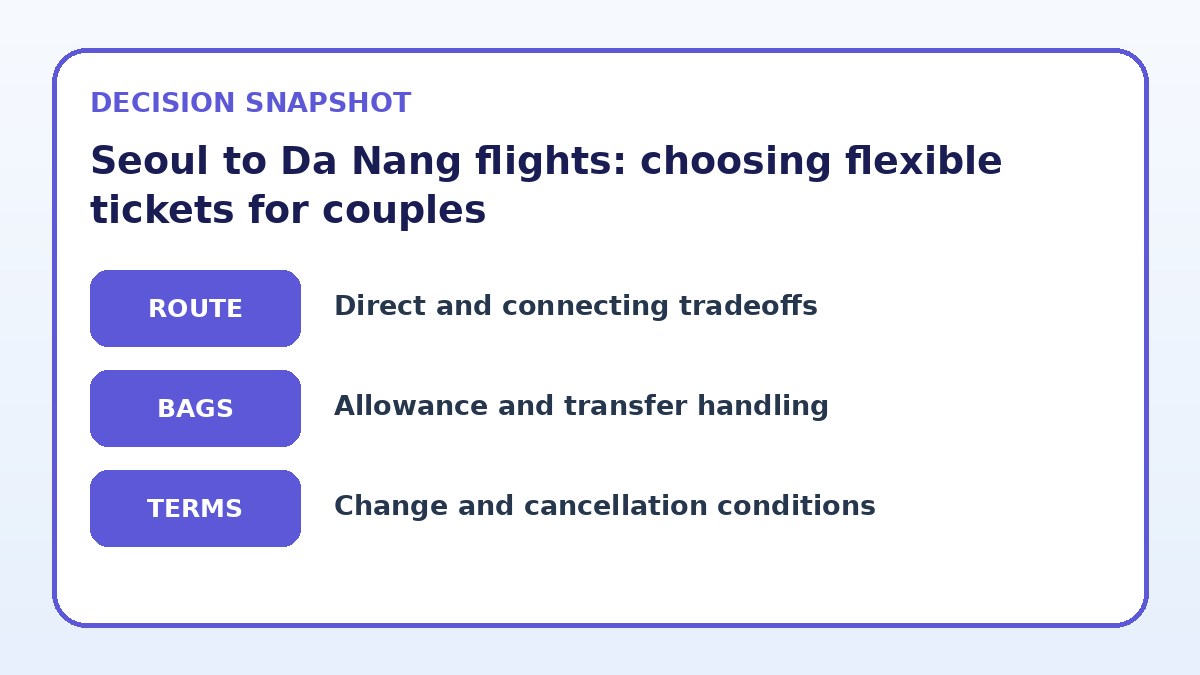
If you and your partner are planning Seoul to Da Nang travel, start by deciding how flexible you need the ticket to be. The practical answer: compare three ticket elements before you book—change fees and rules, cancellation or refundability options, and what happens to taxes and third-party fees on rebookings. For couples this matters more than for solo travelers: different comfort levels with risk, potential schedule conflicts, or a desire to keep plans open for special events all change which fare makes sense. At the same time, flexible tickets often carry higher upfront cost or stricter seat availability. In this article I’ll explain how to read airline rules, compare direct versus connecting itineraries for change/cancellation impact, and list exactly what to verify on the final booking screen so you and your partner can choose the right balance of flexibility and cost.
See current options before you compare the details
Availability and final conditions change. Open Trip.com now or keep reading for the practical comparison.
How to read change and cancellation rules
Start by finding the fare conditions or contract of carriage linked on the booking page. These documents specify whether changes are permitted, the fee for changing a flight, how far in advance changes can be made, and whether reissuing a ticket will require payment of any fare difference. For many carriers the rules vary by fare class (basic economy, economy, premium), so note the exact fare code shown on your itinerary. Couples should compare whether rules apply per passenger or per reservation; in some cases a change by one person forces the whole booking to be reissued under the same conditions.
Next, distinguish between change fees and fare differences. A carrier might waive change fees but still charge the difference if the new flight is more expensive. Also check whether changes initiated through the airline’s call center, web portal, or a third-party seller have different terms. If you book through an online travel agency (OTA), confirm whether changes require contacting the OTA or the airline directly — each route can introduce extra processing time and possibly additional fees. Keep screenshots of the displayed policies during booking to avoid confusion later.
Direct versus connecting itineraries: practical tradeoffs
If a direct flight option exists between Seoul and Da Nang, it can make changes simpler because there’s one ticketed segment and usually one set of rules to apply. However, direct flights may have more limited seats in flexible fare buckets, and the flexible fares offered might be pricier. Connecting itineraries increase choice and sometimes lower cost, but they add complexity: each carrier on separate tickets may have its own change and cancellation policy, and an issue on one segment can leave the rest of the journey stranded or subject to separate fees.
When evaluating options as a couple, ask whether you both want identical flexibility. If one partner prefers a refundable ticket and the other accepts a restricted fare, check whether the booking system allows mixed-fare reservations and how that affects change handling. For connecting itineraries on a single ticket, changes to one segment typically require reissuing the entire ticket, which can be expensive. For separate tickets, you risk misconnection without protective rebooking options, so weigh saved fare cost against potential replacement costs if plans shift.
| Approach | Best for | Tradeoff to check |
|---|---|---|
| Flexible refundable fare | Couples prioritizing certainty and minimal hassle | Higher upfront cost compared with restricted fares |
| Low-cost restricted fare | Couples with firm plans willing to accept change penalties | Strict fees or no refund if plans change |
| Mixed fares in one booking | Couples balancing one partner’s flexibility with the other’s cost-savings | May trigger stricter rules or complicate reissues |
| Separate tickets for each passenger | Couples seeking the cheapest independent options | Risk of misconnection and separate change processes |
Ready to check the option that fits your plan?
Use your exact dates and traveler details so the provider page can show the current total and conditions.

Common clauses and gotchas to verify
Look for specific language about involuntary changes, credits, and travel vouchers. Some airlines automatically rebook you or offer a voucher if they cancel a flight; others give an outright refund for canceled services. If there’s mention of airline-issued travel credit, inspect whether that credit has an expiration date, whether it’s transferable between passengers, and whether it can be used with partner airlines. Couples should note whether credits can be combined into a single booking or must be used separately per passenger.
Watch for processing or service fees on refunds and for exceptions tied to fares purchased through third parties. Taxes and government fees are sometimes refundable even if the fare is not — the booking page should say how these are handled. Also check seat assignment and baggage rule changes after rebooking; some flexible fares include baggage benefits that restricted ones don’t. Finally, check how name changes, date changes, and involuntary reissues are handled specifically so you’re not surprised by a policy that treats family or couple bookings differently.
Before you book
- Locate and save the fare conditions or contract of carriage linked on the booking page before payment.
- Confirm whether change fees apply per passenger or per reservation and record the exact fee amounts.
- Check if the fare is refundable, refundable with processing fees, or refundable as airline credit, and note expiration terms.
- Verify how taxes and third-party fees are handled when a ticket is changed or canceled.
- If booking via an OTA, confirm whether changes must go through the OTA or the airline and how that affects timing and fees.
- Take screenshots of the final booking summary showing fare rules, included baggage, and change/cancel language for both passengers.
How couples should decide which fare to pick
Start by matching the ticket flexibility to the couple’s tolerance for risk. If one of you has a job with unpredictable shifts or family obligations, favor tickets with easy change options or refundable terms. If both of you have firm schedules and want to save money, a lower-cost restricted fare might work; just understand the penalties for both name and date changes. Consider whether travel insurance will backstop nonrefundable tickets — some policies cover cancellations for defined reasons and can be a middle ground between restrictive fares and expensive refundable ones.
Also weigh convenience and stress costs: paying more for flexibility can save time and arguments later, especially if you expect last-minute schedule changes or want to protect a special-date trip. If you opt for different fare types in the same reservation, verify how the carrier treats the booking as a whole — some airlines apply the strictest rule across the whole booking. Finally, before clicking purchase, confirm the final change/cancellation summary on the carrier’s booking page and save confirmation emails and fare rules for both passengers.
Frequently asked questions
Can one person change their flight without affecting their partner’s ticket?
Sometimes yes, sometimes no — it depends on how the booking was issued. If you booked two separate tickets or separate PNRs, one passenger can usually change without touching the other’s reservation. When both passengers are on the same booking record (PNR), many airlines require reissuing the entire ticket for changes, which can mean both fares are subject to rules or fare differences. Always check the fare conditions for wording about per-passenger changes and confirm with the airline before you assume only one itinerary will change.
Are airline credits transferable between passengers or bookings?
Airline credit policies vary widely. Some carriers issue credits that are non-transferable and must be used by the original ticketed passenger; others allow transfer within the same account or to family members under certain conditions. Credits often have expiration dates and may have blackout or routing restrictions. If a couple expects to share a credit, verify the carrier’s policy on transferability and any administrative steps required — and save the credit number and instructions shown on the final confirmation page.
Does travel insurance replace buying a flexible fare for couples?
Travel insurance can cover specific cancellation reasons, such as illness, certain emergencies, or supplier bankruptcy, and may be a cost-effective supplement to a restricted fare. However, insurance rarely reimburses for simple change-of-mind cancellations and does not change the airline’s change fees or rebooking rules. For couples, weigh the scenarios you want covered: if you need protection against routine schedule shifts, a flexible fare is more direct; if you want protection against particular risks, check insurance policy language carefully to ensure the covered reasons match your concerns.
Final planning note
For couples flying Seoul to Da Nang, the right choice balances how much uncertainty you expect against how much you’re willing to pay for flexibility. Read the fare conditions carefully, compare direct and connecting choices for their rebooking implications, and confirm whether rules apply per passenger or per booking. Keep documentation from the booking page and be prepared to call the airline with your confirmation and fare code if you need to change plans. If you book through an OTA, verify where changes must be processed. Taking a few minutes to verify change and cancellation language will save stress and unexpected costs later.
Continue planning
Check current options and final conditions
Use the provider page to confirm live availability, the final total, cancellation terms, and every condition that matters to your trip.
This evergreen planning guide was created with AI-assisted drafting and a structured quality review. It does not display live prices, schedules, availability, visa guidance, or provider rankings. Verify current details before booking. Some links are affiliate links; we may earn a commission at no additional cost to you.