
If you and your partner are planning Amsterdam to Rome flights, the single most useful step is to prioritise ticket flexibility before you lock the booking. Decide whether you want fully refundable fares, same-day change options, or a low-cost ticket with a paid change fee—each option shapes how you’ll handle delays, sudden schedule changes, or a change of plans. Couples often balance cost against flexibility: one partner may prefer cheap tickets while the other wants the security of easy changes. Read the airline’s fare rules on the confirmation page, check what counts as a ‘change’ (time, date, name corrections), and confirm what carries over—seat assignments, luggage, and any extras. Later in this article I’ll explain tradeoffs, how to compare direct and connecting itineraries, and a practical checklist of what to verify before you hit purchase.
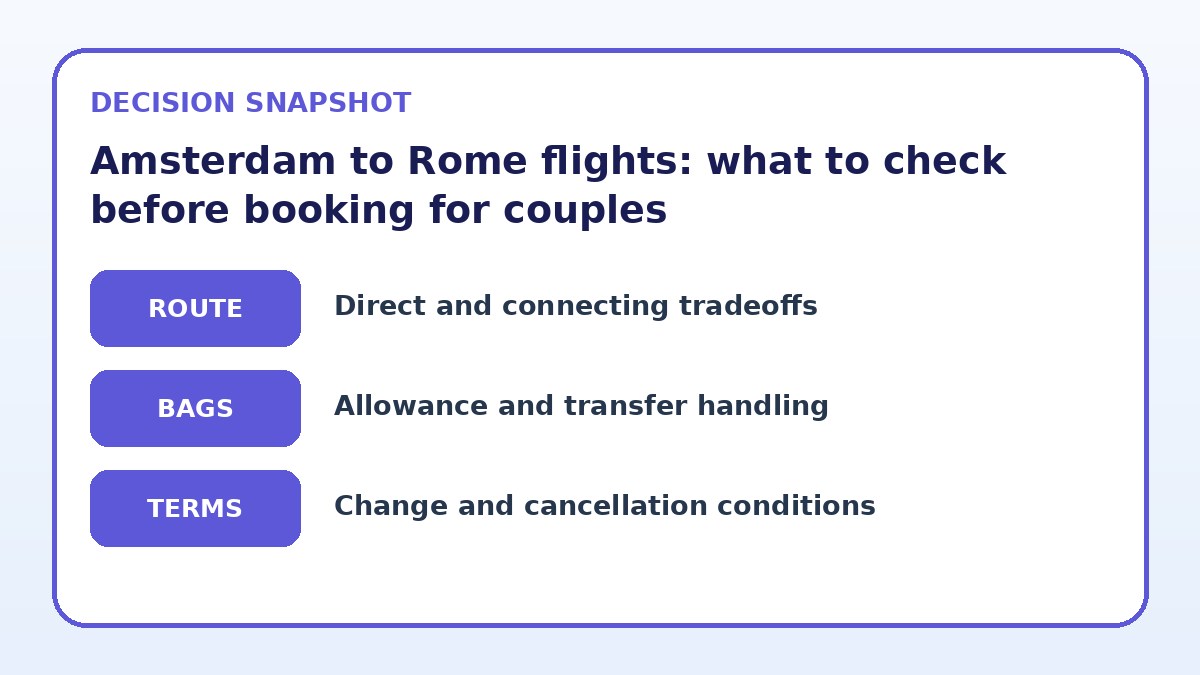
See current options before you compare the details
Availability and final conditions change. Open Trip.com now or keep reading for the practical comparison.
Practical choices: refundable, exchangeable, or basic fares
When you compare Amsterdam to Rome flights, start by categorising fare types. Refundable fares typically let you cancel for a refund or a voucher within specific time windows and sometimes include changes without hefty fees. Exchangeable fares allow date or routing changes in exchange for a fee and any fare difference. Basic or light fares may offer the lowest base price but often exclude checked baggage, seat selection, and permit only paid changes. For couples, think in terms of who is more likely to change plans and whether you need symmetrical protections for both tickets—mismatched fare types can make one partner’s ticket costly to alter later.
Don’t assume labels like “flexible” mean the same across carriers; read the rule text. Look specifically for the change fee amount, whether the fee applies per passenger, and how the airline treats fare differences. Note deadlines—some fares allow free changes up to 24 or 48 hours before departure, others permit changes only within the first 24 hours after booking. Also check whether refunds are issued as cash, credit, or voucher; some operators limit refunds to credited travel funds usable only with that airline. Verify these specifics on the airline’s final booking page before purchase.
Couples and connectivity: direct versus connecting itineraries
Direct flights reduce complexity for couples who prefer minimal transfer risk and fewer coordination points. If a direct option is available, confirm whether it is truly nonstop or involves a technical stop that disembarks passengers. Connecting itineraries may be cheaper or open different departure times, but they increase exposure to missed connections, baggage transfer issues, and separate carrier rules when two different airlines are involved. When comparing options, add probable costs of change or cancellation for both passengers to the base fare to see the real price of flexibility on each itinerary.
For connections, determine whether the itinerary is sold on a single ticket or as separate tickets; single-ticket itineraries usually offer better protection for missed connections under the issuing carrier’s policy. If separate tickets are used, you may be responsible for rebooking at your own cost if the first leg is delayed. Also confirm the minimum connection time the airline allows and whether both passengers must be rebooked together in case of changes. Always verify on the booking page who is responsible for rebooking, what vouchers or re-accommodation options are offered, and whether both traveler names are covered by the same change policy.
| Approach | Best for | Tradeoff to check |
|---|---|---|
| Buy refundable or fully flexible tickets | Couples with uncertain schedules or high risk of changes | Higher upfront cost but simpler, usually faster refunds and fewer penalties |
| Buy exchangeable tickets with a change fee | Couples who want middle ground—lower fares with paid flexibility | Moderate fees at change plus possible fare differences make final cost variable |
| Buy basic/low-cost fares and add protections a la carte | Couples prioritising the lowest base fare and willing to accept rules | Lower initial price but per-person fees and non-refundable extras can add up |
| Mix fare types between passengers | Couples balancing one flexible ticket with one budget ticket | Saves money upfront but complicates changes and may require separate handling |
Ready to check the option that fits your plan?
Use your exact dates and traveler details so the provider page can show the current total and conditions.

Common policy details couples should verify
Before paying, check a short list of line items on the airline’s booking page: the exact change fee per passenger, whether a fare difference applies, deadline for free cancellations or changes, and the type of refund (cash, airline credit, or voucher). Also confirm whether seat assignments and baggage allowances transfer after a change and if name corrections are allowed without a fee. Couples should pay attention to whether special circumstances—medical issues or bereavement—have documented exception policies and what proof the airline requires to process exceptions.
Because policies vary, examine the fine print for ancillary services: is priority boarding or extra baggage refundable or transferable? If you plan to add extras, note whether those add-ons follow the ticket’s refundability or are non-refundable. Look for policy statements about schedule changes initiated by the airline—what qualifies as a significant schedule change, what rebooking options are provided, and whether compensation or refunds are available. Finally, verify whether the policy language references partner airlines or codeshares that may have different procedures.
Before you book
- Compare change and cancellation fees per passenger on the airline’s final booking page before purchase.
- Confirm whether refunds are issued as cash, credit, or voucher and the conditions for each.
- Verify whether a fare difference applies on changes and whether it’s charged per passenger.
- Check if seat assignments, baggage, and added extras remain valid after a change or refund.
- Determine whether the itinerary is a single-ticket connection or separate tickets and who covers missed connections.
- Save and screenshot the fare rules and booking confirmation for both travelers in the same folder.
Decision criteria and tradeoffs for couples
Make a short list of priorities as a couple: lowest upfront cost, maximum flexibility, minimal hassle, or fastest travel time. If one partner’s schedule is more unpredictable—shift work, school, or health considerations—lean toward fares with more lenient change rules for both tickets. Weigh the total potential cost of changes: multiply the change fee by two if it applies per passenger, and add any likely fare differences. If you value simplicity, paying more for refundable or flexible fares can be worth it to avoid complex rebooking conversations while travelling.
Balance the emotional cost of stress against savings. Cheap tickets with rigid rules save money only if nothing goes wrong; the financial hit of two paid rebookings can erase any initial savings. Couples should also plan how they’ll manage a necessary change—who will call the airline, whether to use the airline app, and how to split costs. Finally, document and store confirmations for both tickets in the same folder or app, so refunds, credits, or rebookings can be handled together without lost emails or mismatched policy interpretations.
Frequently asked questions
Should couples buy refundable tickets for Amsterdam to Rome flights?
Refundable tickets offer the least hassle if dates are uncertain, because they frequently permit returns or changes with minimal penalty. For couples, refundable fares avoid coordinating two separate change requests and reduce the risk of one partner facing a large fee. However, refundable fares cost more upfront—so weigh the likelihood of a change, the cost difference versus non-refundable options, and whether the airline’s change policy on the booking page provides similar protections without full refundability.
How do change fees work when two people are travelling together?
Change fees are usually assessed per ticket, meaning you should expect charges multiplied by the number of travelers. Additionally, a fare difference—if the new flight costs more—often applies to each passenger. Some airlines allow group or multi-passenger adjustments under one transaction but still calculate fees per ticket. Always confirm the arithmetic on the airline’s final booking page and ask customer service how fees will appear on the invoice before modifying both travelers’ bookings.
If I book a connecting itinerary, will the airline rebook both passengers if a connection is missed?
If the entire trip is sold on one ticket (a single booking reference covering both legs), the operating carrier usually has a responsibility to re-accommodate you on the next available flight when a delay causes a missed connection. If your outbound and inbound legs are on separate tickets, protection is much weaker and you may be responsible for rebooking at your own cost. For couples, verify on the booking page whether the itinerary is protected as a single ticket and what the carrier’s official rebooking policy is for missed connections.
Final planning note
For couples booking Amsterdam to Rome flights, prioritise clarity over assumptions: read the fare rules on the airline’s final booking page and compare the total expected cost of changes for both travelers, not just the base fare. Decide whether you value lower upfront price or the emotional and logistical security of flexibility—then choose fares and add-ons that align with that decision. When considering connections, check ticketing structure and protection for missed transfers. Keep all confirmations together and, if you want a quick place to compare current options and policies, consider checking Trip.com as one of several comparison tools before you finalize the booking.
Continue planning
Check current options and final conditions
Use the provider page to confirm live availability, the final total, cancellation terms, and every condition that matters to your trip.
This evergreen planning guide was created with AI-assisted drafting and a structured quality review. It does not display live prices, schedules, availability, visa guidance, or provider rankings. Verify current details before booking. Some links are affiliate links; we may earn a commission at no additional cost to you.