
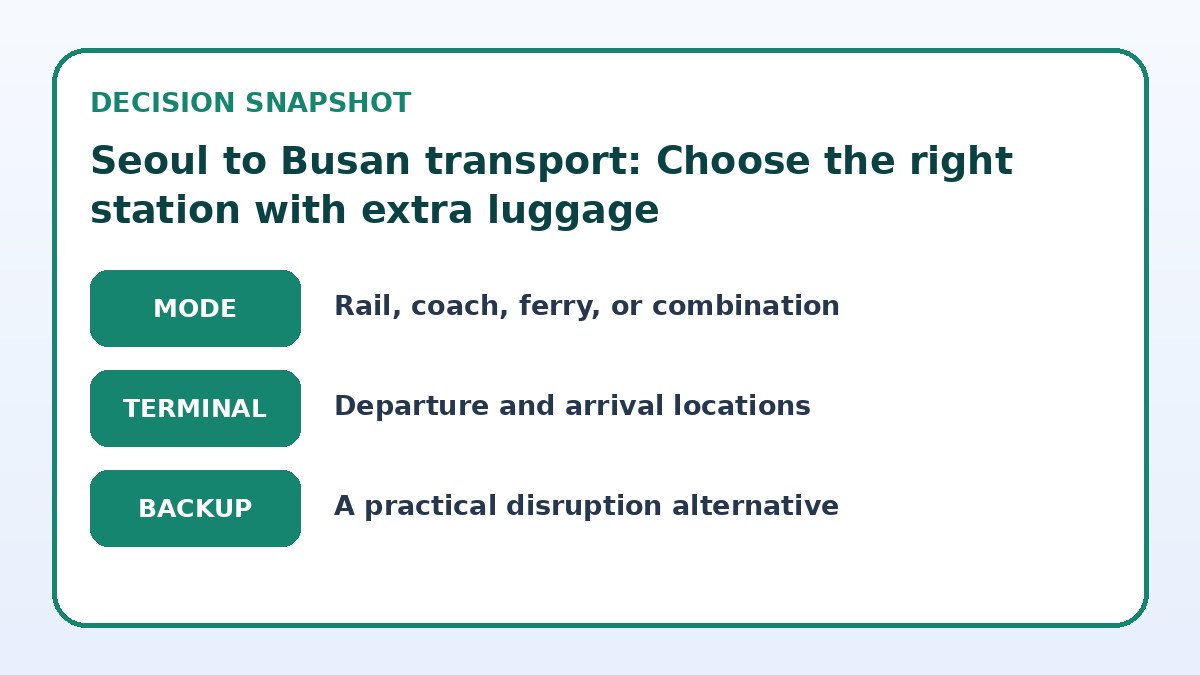
If you’re traveling from Seoul to Busan with bulky or extra luggage, the most practical decision is to pick departure and arrival points that minimize transfers, handle large bags easily, and match your onward plans. Start by prioritizing direct rail options that stop at major stations with clear elevator/escalator access and luggage storage, and consider bus terminals only if they put you closer to your final destination. Decide whether you prefer door-to-door convenience (taxi or private transfer) or cheaper transfers with more walking and lifting. Before you book, check the operator’s baggage rules, station accessibility details, and vehicle type on the provider’s official booking pages. If you want a single comparison, you can look at an aggregator such as Trip.com, but always verify baggage dimensions, transfer times, and access photos on the carrier’s site or station map.
See current options before you compare the details
Availability and final conditions change. Open Trip.com now or keep reading for the practical comparison.
Pick stations and terminals based on transfers, not speed alone
When you’re traveling with heavy or oversized baggage, the fastest train on paper may not be the smoothest choice. Large, central stations usually offer step-free routes, elevators, and clear signage that reduce the strain of moving bags. Smaller stops or peripheral terminals can add last-mile transfers: a short train to a secondary station might look convenient on a timetable but could force you onto a taxi or local bus with limited luggage space. Think through the whole journey from your accommodation in Seoul to your final address in Busan, and map not just travel time but the number of times you will lift your luggage.
In practice, choose departure and arrival points that cut down on transfers and difficult station navigation. If a direct service uses major stations, it will often be advantageous even if the scheduled travel time is marginally longer because it eliminates transfers and additional handling. For each candidate station, check where elevators and wide staircases are located, how many platform changes are necessary, and whether luggage storage or porter services are available. Confirm these accessibility features on station maps and provider pages before committing to tickets.
Compare door-to-door transfer options with luggage in mind
Once you’ve selected preferred stations, plan the ground transfers at each end. Door-to-door convenience comes with choices: taxis or pre-booked private transfers avoid heavy lifting between platforms and curbside, but they require drivers comfortable with oversized baggage and vehicles that accommodate your bags. Public transit can be cheap and efficient, but expect crowds, stairs, and limited luggage space during peak hours. If you’ll be moving between different modes—train to bus or train to subway—identify the exact exit or terminal where the connection happens and how far you’ll carry your luggage.
When evaluating options, get specifics: is the station exit you’ll use elevator-equipped? Are there covered walkways or short outdoor stretches? Does the taxi rank have a ramp or level curb for easy loading? Ask providers or check recent traveler photos on review platforms to confirm practical details. For pre-arranged transfers, confirm vehicle size and the number of bags allowed on the provider’s booking page. If you plan to use local buses or subways, check whether luggage fits into priority areas and anticipate standing space requirements during busy periods.
| Approach | Best for | Tradeoff to check |
|---|---|---|
| Direct major-station train (no changes) | Travelers wanting minimal handling and clear station facilities | Might be slightly longer in-clock travel but reduces transfers and heavy lifting |
| Faster express with peripheral stops | Those prioritizing in-vehicle time and comfortable seats | May require additional taxi or shuttle transfers to reach central locations |
| Intercity bus to central terminal | Travelers whose start or end points are near bus terminals | Less flexible luggage rules and potential difficulty storing oversized items onboard |
| Private car or pre-booked transfer | Door-to-door convenience and minimal station handling | Higher cost and reliance on confirming vehicle size and pickup points |
Ready to check the option that fits your plan?
Use your exact dates and traveler details so the provider page can show the current total and conditions.
Luggage handling and storage: strategies to lighten transfers
If you can reduce what you carry between stations, transfers become much easier. Consider leaving nonessential items in Seoul at a verified luggage storage service near your departure station or at your accommodation if they offer temporary storage. For long stays, shipping bulky items ahead to your Busan destination via a reputable courier can be worth the cost. If storage is necessary at the station, verify size limits, pricing structure, and opening hours on the official station website—don’t assume round-the-clock access.
For same-day travel, pack a small, comfortable backpack for items you’ll need during the journey and consolidate larger items into manageable pieces. Use wheeled suitcases with sturdy handles and consider luggage straps to secure two pieces together so you can move one trolley instead of carrying multiple bags. If you need assistance when boarding or changing platforms, ask station staff in advance—many major stations have customer service desks that can direct you to accessible routes or temporary help, but you must check their hours and services ahead of time.
Before you book
- Confirm baggage size, weight, and quantity rules on the ticket page for the specific service you plan to book.
- Study station maps for elevators, ramps, and exit locations to plan the shortest route between platform and street.
- Measure your packed bags and check vehicle or storage locker dimensions if you’ll use taxis or station lockers.
- Book a transfer or taxi with confirmed vehicle size if you cannot manage stairs, and reconfirm pickup curb details.
- Arrange luggage storage or shipment for nonessential items if multiple transfers or long walks are unavoidable.
- Allow extra connection time in your schedule to account for elevator waits, ticket checks, and slow-moving crowds.
Practical booking checks and what to verify before purchase
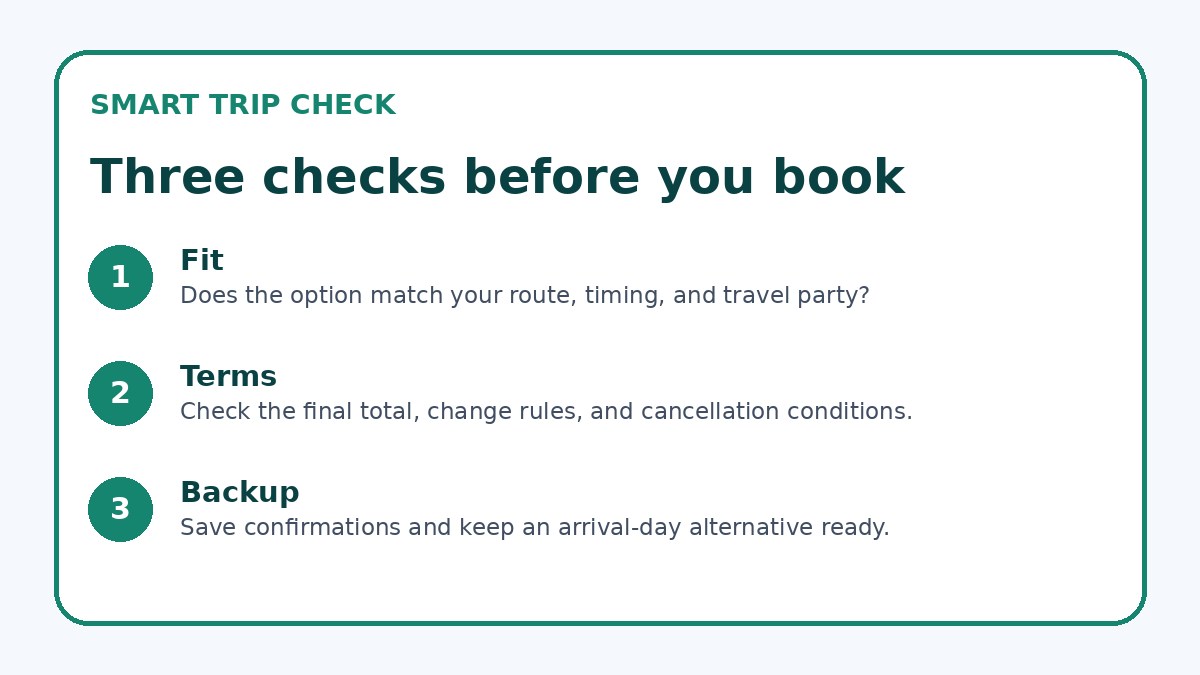
Before you click buy, confirm several facts that could change the travel experience for a luggage-heavy traveler. Check the operator’s baggage allowance and restrictions, including maximum dimensions and the number of free items or charged extras; verify whether checked baggage is possible on the exact service you plan to take. Review station maps to locate elevators, level access routes, and the distance between platforms and taxi ranks. If you rely on a connecting service, ensure minimum connection times are realistic given the walking, queuing, and possible lifts you’ll need.
Also verify refund and change policies in case you need to alter a trip due to luggage constraints or unexpected accessibility issues. For private transfers or taxis booked in advance, reconfirm vehicle type and pickup curb location with the provider. If you use a third-party aggregator to compare options, such as Trip.com, use it only as a starting point and validate baggage rules, transfer procedures, and station access directly with the carrier or station authority before finalizing the booking.
Frequently asked questions
Can I take oversized luggage on intercity trains between Seoul and Busan?
Policies vary by operator and even by service type; some trains accept large suitcases with no special handling while others have limits or require checked baggage. Always check the baggage allowance on the operator’s official booking page for the exact train you plan to take, and if dimensions matter, measure your packed items. If the provider offers luggage check-in at the station, confirm hours and whether you must reserve this service. If in doubt, contact customer service directly before purchase to avoid surprises on travel day.
What’s the easiest way to get from the arrival platform to a hotel with heavy bags?
The simplest path is to pick a major arrival station with step-free exits and then use a taxi or pre-booked private transfer for the short street-level ride to your hotel. Before you travel, identify which station exit is closest to the taxi rank and whether that exit has elevators. If your hotel is within walking distance, plan a route that minimizes steps and busy intersections. For peak arrival times, allow extra time for queuing at taxi ranks, and confirm your driver knows the correct curbside pickup spot.
Should I use station lockers or ship luggage ahead when moving between cities?
Use station lockers for short delays when you need to explore without heavy bags, but verify locker size, availability, and operating hours on the station’s official page—large items may not fit. Shipping luggage ahead via a courier can be efficient for bulky items or when you want true door-to-door convenience, but it requires lead time and knowledge of where the shipment will be delivered. Compare locker dimensions and courier delivery windows against your schedule, and confirm any pickup ID requirements before choosing either option.
Final planning note
Traveling from Seoul to Busan with extra luggage is mainly a planning problem: reduce the number of transfers, pick stations with accessible layouts, and verify baggage rules before booking. Prioritize routes that keep you on major terminals to cut down on stairs and confusing connections, and balance the tradeoffs between in-vehicle speed and door-to-door convenience. Use station maps, operator baggage policies, and pre-arranged transfers to remove uncertainty—check these details on the carrier’s official pages and reconfirm vehicle sizes, elevator locations, and storage availability. With a little prep you’ll choose the option that saves effort and stress on travel day.
Continue planning
Check current options and final conditions
Use the provider page to confirm live availability, the final total, cancellation terms, and every condition that matters to your trip.
This evergreen planning guide was created with AI-assisted drafting and a structured quality review. It does not display live prices, schedules, availability, visa guidance, or provider rankings. Verify current details before booking. Some links are affiliate links; we may earn a commission at no additional cost to you.