If you’re booking Sydney to Auckland flights for business travel, build a short, focused checklist to avoid surprises that can cost time, money and productivity. Start by deciding whether you prioritize schedule flexibility, total door-to-door time, or lower base fares; this single decision will steer how you weigh seat choice, connection risk, baggage allowances and change fees. Gather passport and travel-authority details, check likely connection points, and note preferred departure/arrival times that match your meetings. Use the checklist to compare direct versus connecting itineraries, class upgrades, and the real cost of ancillary fees. The remainder of this article lays out the decision criteria, practical tradeoffs, and specific items to tick off before pressing buy so your trip runs smoothly from boardroom to hotel in Auckland.
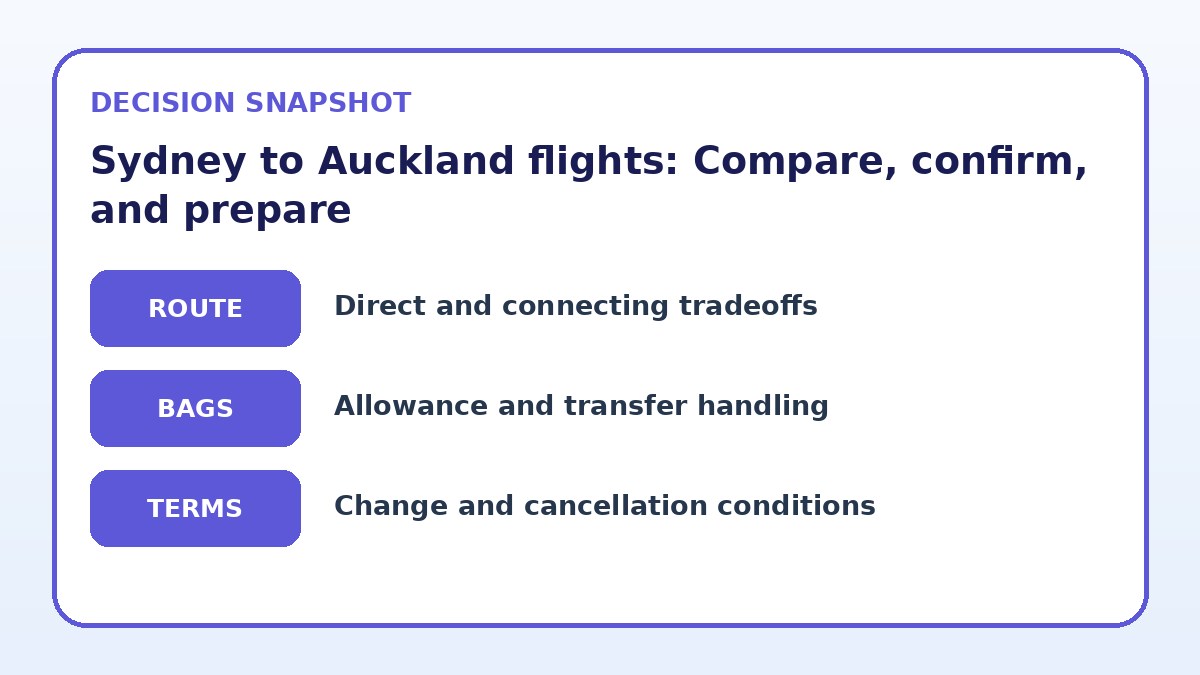
See current options before you compare the details
Availability and final conditions change. Open Trip.com now or keep reading for the practical comparison.
Decide your primary booking priority
Before you search itineraries, choose the priority that best serves your trip objectives. For short business visits the most valuable metric may be the shortest door-to-door travel time so you arrive early and rested; for multi-stop work trips flexibility and changeable return dates might matter more. Cost-sensitive corporate travelers will look to minimize base fare while accepting tighter connection margins, whereas senior executives often prefer refundable or changeable fares with lounge access. Clarifying this now reduces time spent comparing irrelevant options and makes it easier to pick add-ons like preferred seats, fast-track security, or lounge access that match your priority.
Once you’ve selected a priority, translate it into concrete search filters and tolerances. If minimizing travel time matters, limit options to the narrow window that lands with ample buffer before meetings and prioritize direct flights where available; if flexibility is key, expand your search to include fares with refundable or low-change-fee conditions and consider product that offers free rebooking within a certain period. Document the acceptable tradeoffs—how much extra you’ll pay for a shorter schedule, how long a connection you’ll allow, and whether you’ll accept a middle seat on a cheap fare—so you can quickly eliminate options that don’t meet your standard.
Compare direct versus connecting itineraries
Direct flights typically reduce risk and complexity, but they may depart at less convenient times or carry higher base fares. Connecting itineraries can open more schedule choices and sometimes lower direct cost, but each connection adds potential delay points, tight transfer times, and the need to collect and recheck luggage if the airline doesn’t through-check it. For business travel, a single short connection with a reliable carrier and a generous minimum connection time may be acceptable. Always examine whether connections involve changing terminals or passing through security and immigration, which can substantially lengthen transfer time on arrival in Auckland.
When you compare options, calculate the realistic door-to-door duration and include transfer time at both ends. Look at historical on-time performance trends reported by the airline or other reliable sources and check the minimum connection time suggested for the airport pairing. If the itinerary requires switching between domestic and international terminals or re-clearing security, add extra buffer to your schedule. Finally, verify baggage handling terms on the booking page—confirm whether bags transfer automatically or if you must collect and recheck them during the connection, and plan accordingly.
| Approach | Best for | Tradeoff to check |
|---|---|---|
| Prioritize shortest door-to-door time | Tight meeting schedules or single-day trips | Often higher fares and fewer flexible change options |
| Prioritize ticket flexibility | Unpredictable itineraries and multi-meeting trips | Higher fare and potentially longer travel time |
| Prioritize lowest base fare | Cost-constrained corporate travel with fixed dates | Fewer included ancillaries; more potential airport costs |
| Prioritize premium comfort (upgrades or business class) | Long daytime flights where rest or onboard work is essential | Significantly higher ticket cost; evaluate ROI |
Ready to check the option that fits your plan?
Use your exact dates and traveler details so the provider page can show the current total and conditions.
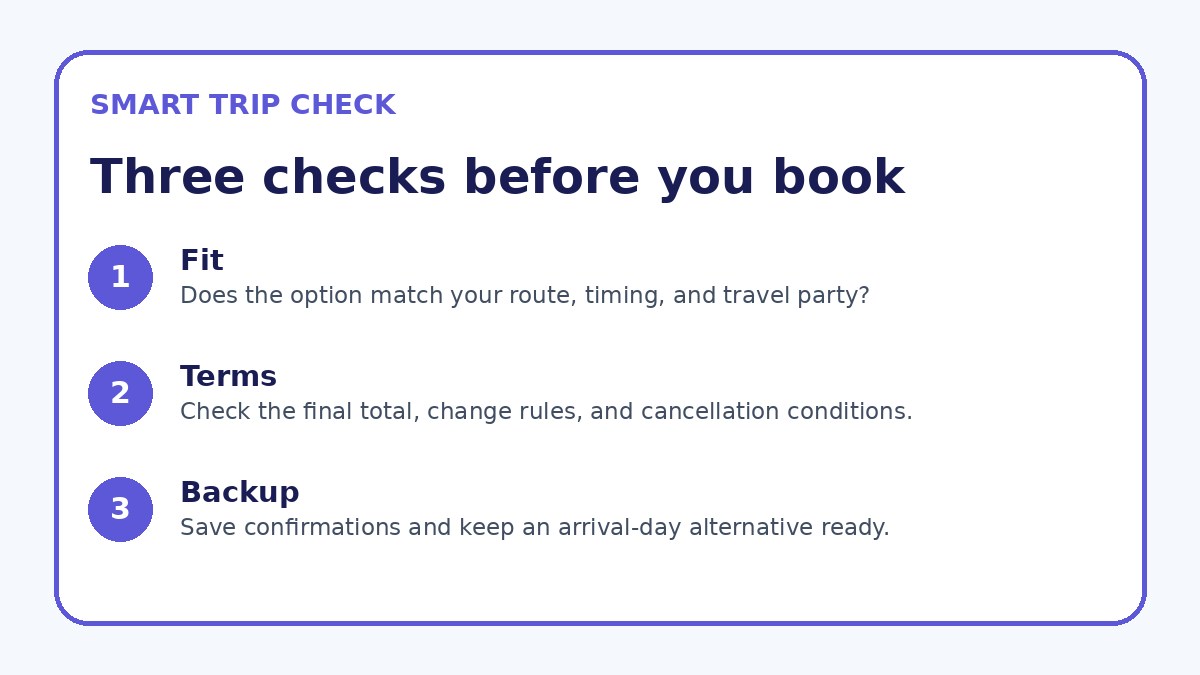
Check fare rules, ancillaries and seat options
Fare classes and ancillary rules determine real costs beyond the headline price. Business travellers should scrutinize refund and change policies, upgrade eligibility, and baggage allowances on the ticketing page before purchase. Low-cost or basic economy fares may look economical but often exclude seat selection, checked baggage, and priority boarding—items that can cost more at the airport and add stress if you need a specific seat for work rest. If you value working inflight, check whether the fare offers a guaranteed seat type, power outlets, and Wi-Fi availability, or whether an upgrade or premium bucket is necessary to access those conveniences.
Use the airline’s final booking page to confirm exactly which services are included and what incurs extra charges: checked baggage weight and piece limits, carry-on dimensions, seat selection fees, change fees, upgrade pathways and lounge access. If you’re booking through third-party sites, always cross-check the fare code and rules on the carrier’s own site to ensure the policy is current. Note the conditions for earning and redeeming frequent-flyer credits since that can influence the long-term value of choosing one carrier over another for repeated corporate travel.
Before you book
- Confirm your passport validity and any travel authorisations required for New Zealand and note any transit visa needs for connection countries.
- Decide whether you need a direct flight or an acceptable minimum connection time, then set a maximum acceptable door-to-door duration.
- Compare fare rules on the airline’s final booking page for change, cancellation and baggage policies before adding ancillaries to the basket.
- Reserve seats or upgrades early if you need a specific seat type, aisle access, or power outlets for inflight work.
- Plan ground transport from Auckland Airport to your meeting location, book transfers if needed, and allow buffer time for immigration and baggage.
- Save the airline booking reference, arrival contact details, and the corporate travel desk number to your phone and calendar for quick access.
Plan arrivals, ground transport and contingency time
Auckland arrival logistics can affect whether you make your first meeting on time. Check likely customs and immigration processing times, especially during peak arrival hours, and factor in time for baggage claim and potential inspections. Decide in advance which ground transport suits your schedule—airport shuttle, private transfer, ride-hail, or rental car—and research the typical journey times to central business districts or your meeting location. For early-morning or late-night arrivals, verify operating hours and whether your preferred transfer option runs at those times.
Also plan for contingencies: build a buffer into your schedule to absorb possible delays, and know the options for re-routing or rebooking should a flight be significantly disrupted. Keep contact details for your corporate travel desk and the airline handy, and consider purchasing a fare with flexible change conditions if your meeting schedule risks shifting. Finally, prepare an arrival checklist that includes local SIM or roaming arrangements, meeting confirmations with local contacts, and a fast track for immigration and baggage where available or by purchasing a priority pass if it’s likely to save you critical time.
Frequently asked questions
Should I prioritize a direct flight from Sydney to Auckland for business travel?
Direct flights reduce transfer risk and typically lower the number of potential delay points, which helps when meeting schedules are tight. However, direct options may depart at inconvenient times or come at a higher base fare. If your priority is minimizing time lost in transit and you can align meeting times with available direct departures, choose a direct flight. If schedule flexibility or cost is more important, a well-timed single-connection itinerary with a reliable carrier and sufficient connection buffer can be acceptable—verify transfer requirements and baggage handling on the booking page first.
What ancillary services are most important to buy for a business trip on this route?
Key ancillaries for business travellers include seat selection (for workability and rest), checked baggage if you need extra luggage, priority boarding or fast-track security to save time, and lounge access for work between flights. Wi-Fi or power availability may also be important for productivity on board. Review what is included with your fare and buy only the services you genuinely need—sometimes a modest upgrade to a fare class that bundles these items is cheaper than adding them à la carte. Always confirm availability and exact terms on the airline’s final booking page.
How much buffer time should I plan between arrival in Auckland and my first meeting?
Allow at least enough time for immigration, baggage claim, customs checks and ground transport, plus an extra buffer for potential delays. For most business travelers, a minimum of 2–3 hours after scheduled arrival is prudent for late-afternoon or morning flights; during peak times or unfamiliar terminals you might extend that. If your meeting is immediately after arrival, consider a later arrival the day before or choose a fare with reliable timing. Check expected immigration wait trends and your chosen transfer mode to refine the buffer you actually need.
Final planning note
Booking Sydney to Auckland flights for business travel is a decision best driven by a clear priority: speed, flexibility, cost, or comfort. Use the pre-booking checklist to translate that priority into concrete search filters—acceptable connection windows, necessary ancillaries, and buffer times for arrival logistics. Compare direct and connecting options by calculating total door-to-door time, verifying fare rules on the airline’s booking page, and confirming baggage and seat policies. Prepare ground transport and contingency plans in advance, and save all booking references and contact details where you can access them quickly. A short, disciplined checklist keeps you focused and reduces last-minute friction so your trip supports your work, not the other way around.
Continue planning
Check current options and final conditions
Use the provider page to confirm live availability, the final total, cancellation terms, and every condition that matters to your trip.
This evergreen planning guide was created with AI-assisted drafting and a structured quality review. It does not display live prices, schedules, availability, visa guidance, or provider rankings. Verify current details before booking. Some links are affiliate links; we may earn a commission at no additional cost to you.