Short answer: for most families staying mainly within central Seoul, public transport usually wins; a car adds value only if your itinerary includes frequent day trips outside the city or you travel with lots of bulky gear. Seoul’s subway, buses, and taxis are extensive and family-friendly, but they do not cover every temple, coastal town, or rural attraction efficiently. Renting a car makes sense when door-to-door flexibility, multi-stop rural routes, or mobility needs outweigh urban parking hassles. This guide explains the tradeoffs you must weigh—route value, insurance wording, pickup and return friction—and gives a clear non-driving fallback so you can finalize a booking with confidence.

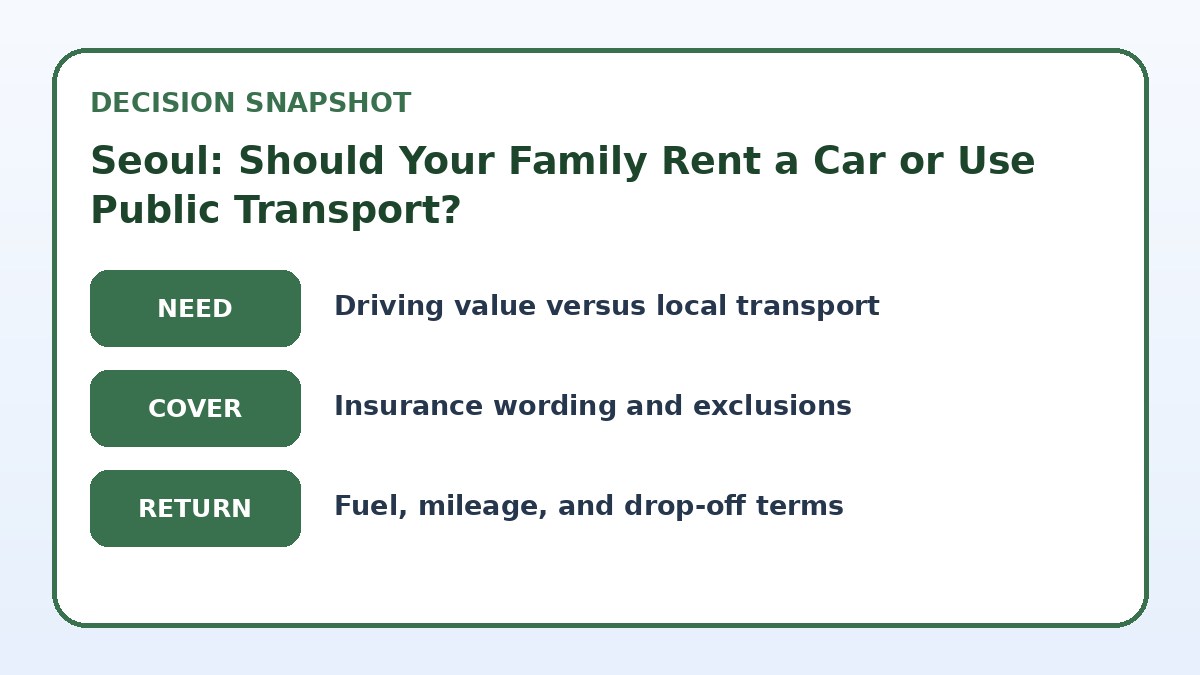
Route value: when driving truly helps
Evaluate each day of your trip and ask whether driving reduces transfers, walking, or waiting with children. Trips that start and end at different points, multiple stops beyond Seoul’s metro area (for example coastal or mountainous day trips), or very early/late departures that aren’t covered by public transport are where a car delivers clear value. For short sequences of fixed locations inside the city—museums, parks, palaces, and family restaurants—the subway is often faster because it avoids surface congestion and parking searches.
Consider the interior logistics: families with toddlers, elderly relatives, or significant luggage save time by avoiding stairs, platform transfers, and multiple baggage lifts. But that time saving must be weighed against time spent finding parking, walking from distant lots into attractions, and possible traffic jams at peak times. Map the door-to-door time for a sample day both driving and using public transport to see which choice truly improves your family’s comfort and schedule.
Decide whether driving earns its place
| Mobility strategy | Best for | Cost or friction to check |
|---|---|---|
| Rent a car for the whole trip | Families doing frequent intercity day trips or needing constant door-to-door mobility. | Parking, traffic, and pickup/return friction inside Seoul can add time and stress; verify insurance and toll handling. |
| Public transport only (subway + buses) | Families with city-focused itineraries and light luggage who prioritize avoiding parking and congestion. | Limited convenience for remote attractions or early/late trips; may require taxis or transfers for the final mile. |
| Public transport plus occasional taxi/private transfer | Families who are city-based but need selective flexibility for specific day trips or mobility needs. | Paying for multiple single-leg transfers can add up; requires planning to avoid last-minute availability issues. |
| Self-drive for some days, park car at base the rest | Families staying in one neighborhood who rent a car only for a few rural excursions. | You still incur pickup/return and parking costs for the rental period; coordination with lodging is required. |
Check live rental choices only after the route test
Use the exact driver, dates, pickup point, and return plan to compare current conditions.
Insurance wording and coverage: what to verify
Insurance phrasing varies and matters. On any rental page, look for the exact liability limits, whether third-party and collision damage waivers (CDW) are included or optional, and what counts as an excluded driver or excluded use (for example, unpaved roads or crossing into other countries). Confirm whether roadside assistance and replacement vehicles are provided and if deductibles apply. If a quoted insurance phrase is unclear, contact the company and request the section of the contract that defines ‘‘damage’’ and ‘‘theft’’ in plain language before you finalize a booking.
Also verify policies around young drivers, additional drivers, and child safety seats—some contracts require an extra fee or specific documentation. Ask exactly how tolls and parking fines are handled and whether the rental company will charge processing fees to pass them on. When in doubt, obtain a written confirmation of coverage details and keep a copy with you while traveling. If you prefer a single place to compare current options, Trip.com can be used to see available suppliers, but always read the chosen provider’s final policy page carefully.
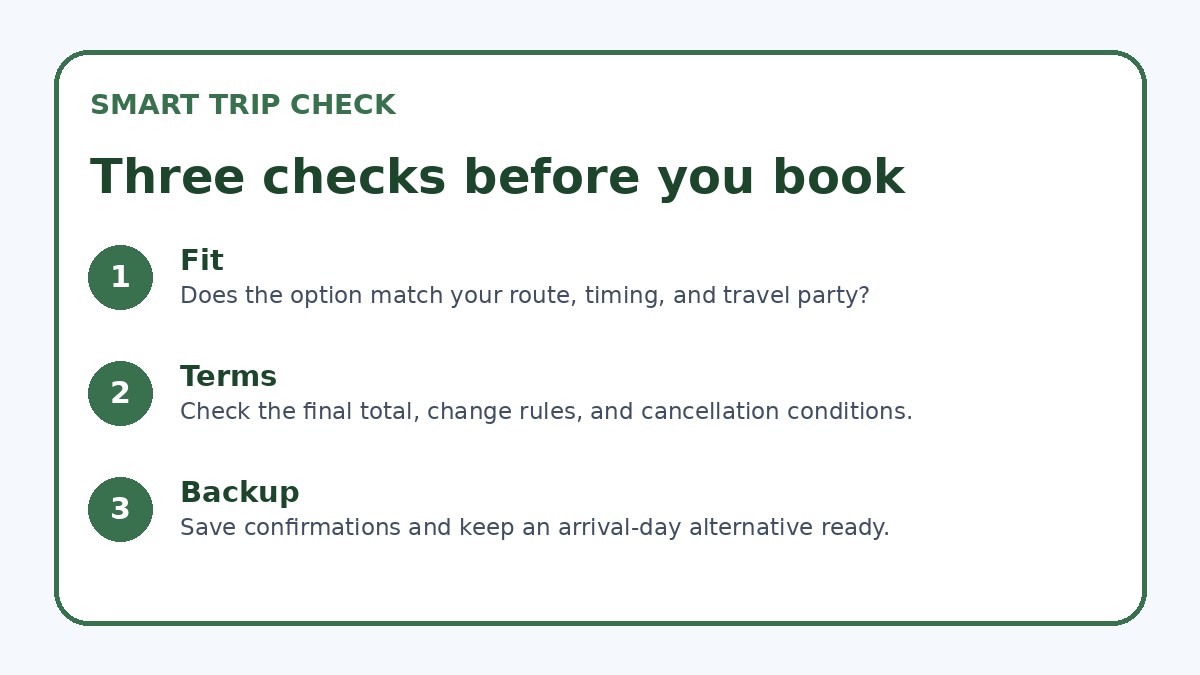
Compare the full rental conditions
Confirm insurance wording, exclusions, deposit, fuel, mileage, and return terms on the final page.
Pickup and return friction: practical considerations
Pickup and return are often where a car trip becomes costly in time and stress. Airport pickup may be straightforward, but city-center offices can require navigating to specific garages or waiting for shuttle transfers. Check where the vehicle is located, whether airport counters offer bilingual staff, and how late returns are handled. For families, a short walk with luggage or needing a shuttle that isn’t frequent can turn a convenient rental into an exhausting experience—so measure the number of steps between terminal, counter, and car before you book.
Also consider one-way fees, out-of-hours charges, and the practicalities of refueling and returning fuel policy. If your itinerary ends at a different location, verify relocation fees and whether drop-off in a different city is permitted. If any part of pickup/return seems cumbersome, weigh that friction against the cumulative time a car would save on daily excursions. A smooth rental experience should save family energy overall, not just provide the vehicle itself.
Car rental terms to verify
- Map door-to-door travel time for at least three representative days by car and by public transport to test route value.
- Request and save a copy of the rental company’s insurance wording showing liability limits, CDW details, and exclusions.
- Confirm pickup and return locations, hours, shuttle requirements, and after-hours procedures before booking the vehicle.
- Check whether child seats are included, available, or require prior reservation and whether any additional fees apply.
- List the nearest subway or bus stop and taxi rank for each lodging to build a non-driving fallback plan.
- Verify how tolls, parking fines, and fuel charges will be processed and whether administrative fees are added.
Non-driving fallback: assemble a realistic plan
A realistic non-driving plan mixes Seoul’s excellent public transport with taxis and regional services where needed. For intercity legs, compare express buses and regional trains for comfort and luggage policies; these often serve nearby provincial destinations efficiently. Within the city, use the subway for the backbone of movement, supplementing with taxis for late-night or door-to-door convenience. If an attraction is poorly connected, a short private transfer or a local taxi for a single day trip can replace the need for a rental car.
Prepare backup options for unpredictable needs: identify taxi apps available to tourists (and whether they accept international cards), note the nearest train or bus stations to each lodging, and research private transfer providers for any rural day trips. Compile approximate last-departure times for trains and buses on the days you plan travel so that a missed connection doesn’t force an impromptu rental. This layered plan preserves convenience without committing to the full burden of car ownership in the city.
Car Rental & Road Trip questions travelers ask
Is driving in Seoul with a family harder than in other large cities?
Driving in Seoul presents typical large-city challenges: heavy peak congestion, limited curbside parking in central districts, and busy pedestrian areas. For families, the extra time to find and pay for parking, and to walk between lots and attractions, can outweigh the convenience of a private vehicle. However, if your itinerary includes frequent trips to the outskirts or you need a lot of luggage space and child equipment, driving can reduce transfers and keep small travelers comfortable. Always compare door-to-door time and factor in parking locations when deciding.
How do I evaluate insurance language so I’m not surprised later?
Look for explicit statements about what is covered and excluded, the deductible amount, and whether damage to tyres, glass, or undercarriage is included. Verify whether roadside assistance and replacement vehicles are guaranteed, and which events invalidate the policy (for example, driving on unpaved roads or using the vehicle for commercial purposes). If any clause is ambiguous, ask the rental company for a clear written explanation and keep that with your booking confirmation. Never rely on a summarized coverage line alone—always read the policy text on the provider’s final page.
What’s the easiest way to mix driving and public transport on the same trip?
Plan a home base where you can park long-term and use public transport for city days. Rent a car for a defined block of days dedicated to rural or multi-stop excursions, returning it to the same base when done. Alternatively, reserve the car for the outbound day trip and use express buses or trains back, depending on schedules. Coordinate with your accommodation about parking—some hotels or guesthouses will hold a vehicle for a fee—and check one-way rental charges if you plan different pickup and drop-off points.
Final decision note
For most families focused on central Seoul, public transport supplemented by taxis or targeted private transfers is the lowest-stress, cost-effective choice. Rent a car when multiple off-city day trips, bulky gear, or mobility needs make door-to-door flexibility essential—then prioritize clear insurance wording and simple pickup/return logistics. Build a non-driving fallback so missed connections or unexpected closures don’t force a last-minute rental. Verify the rental company’s contract details, toll and parking handling, child seat availability, and pickup hours on the provider’s final booking page before confirming. With those checks, you’ll choose the option that keeps your family comfortable and your days running smoothly.
Continue planning
Check current options and final conditions
Use the provider page to confirm live availability, the final total, cancellation terms, and every condition that matters to your trip.
This evergreen planning guide was created with AI-assisted drafting and a structured quality review. It does not display live prices, schedules, availability, visa guidance, or provider rankings. Verify current details before booking. Some links are affiliate links; we may earn a commission at no additional cost to you.