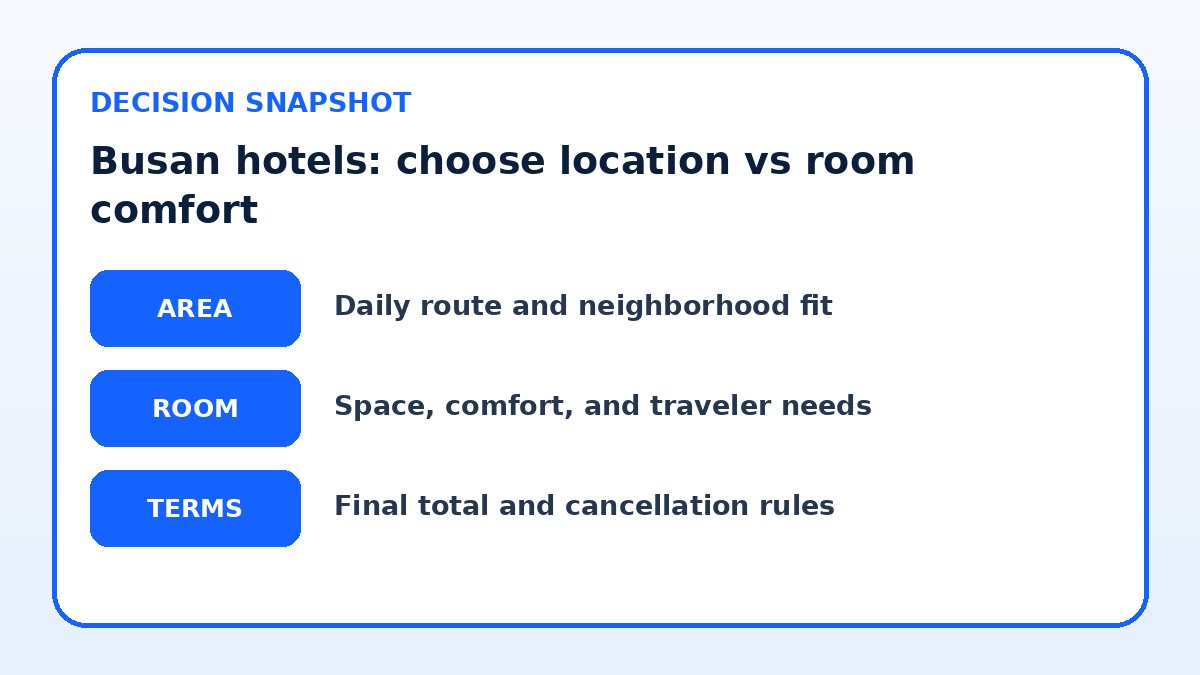
Pick the stay area first, then match room type to how you’ll spend your days. For a first visit to Busan, location determines daily friction: beach mornings, market afternoons, and easy subway access save time and stress. But room comfort—bed size, soundproofing, bathroom layout, and luggage space—shapes how well you recover between outings. If you plan walking-heavy days around Haeundae or Gwangalli, prioritize proximity; if you’ll use Busan as a base for slow mornings or late nights, prioritize quieter rooms or higher floors. This guide gives a short actionable decision path, explains tradeoffs across four common area-selection approaches, and lists the exact booking terms and room details to verify before confirming so you can shortlist an area with confidence.

Check live stays in the areas that fit
Use your dates and party size to compare current rooms after you narrow the neighborhood fit.
Neighborhood fit: pick your base by daily plans
Start by mapping your must-see list and grouping attractions into morning, afternoon, and evening clusters. If your days center on beaches and seaside cafes, Haeundae and Gwangalli put you in walking distance of sunrise and coastal promenades. For museum visits, shopping malls, and a central transit hub, Centum City and Seomyeon offer quick access to buses and subways. Nampo-dong and Jagalchi are right for markets, historic alleys, and night views, but expect more street noise and crowded sidewalks in the evenings. Choosing an area that naturally groups most of your planned activities lowers daily transit time and reduces the need to move hotels mid-trip.
Also consider how your days will flow: early starts for photo times, late nights for bars or seafood dinners, or mixed day trips. If you prefer late nights without a long return, stay in a lively neighborhood near transit that still has quieter inner streets or higher-floor rooms. If you’re doing day trips beyond Busan—coastal drives or trains—proximity to major stations matters more than beachfront scenery. Think of the base area as a tool to cut friction and preserve energy for exploring; match it to your typical day rather than to every single attraction.
Choose an area-selection strategy
| Area approach | Best for | Tradeoff to check |
|---|---|---|
| Choose beachfront (e.g., Haeundae/Gwangalli) | Morning beach walks and seaside cafes; minimal daily transit for coastal activities. | More tourist bustle and higher noise levels; possible longer subway rides to inland attractions. |
| Choose central transit hub (e.g., Seomyeon/Centum City) | Quick cross-city travel, shopping, and easy subway connections for day trips. | Rooms may sacrifice view or beach proximity; neighborhoods can feel more commercial and busy. |
| Choose historic/market area (e.g., Nampo-dong/BIFF) | Immersive food and night scene; walking access to markets and coastal cliffs. | Irregular streets and evening noise; smaller rooms and less green/open space. |
| Choose quieter residential edge or near station | Lower noise, more local life, often better value for larger rooms. | Longer walks to major tourist sites or the beach; fewer evening dining options within immediate walking distance. |
Daily-route friction: subway, taxi, walkability
Evaluate how much time you want to spend moving between places versus being in them. Subways in Busan are efficient for medium-distance hops, so a hotel near a major station like Seomyeon or Busan Station can shorten cross-city transfers. Walking distances matter—Haeundae and Gwangalli cluster beachfront attractions, making them ideal if you prioritize strollable days. In contrast, Nampo-dong concentrates market activity but has steeper alleys and irregular sidewalks that slow progress. Taxis are affordable for short rides after midnight, but traveling by taxi during rush hours can still cost time due to traffic.
To estimate friction practically, pick your top three daily routes and time them on a map: hotel to breakfast spot, hotel to your main afternoon attraction, and hotel back from dinner. Include realistic transfer time for luggage, elevator waits, and walking between attractions. If any single route looks regularly longer than 30–40 minutes each way, consider a different base. Balancing walkability with transit access reduces stress; you don’t need the absolute closest hotel to every site, but avoid a location that forces long daily commutes.
Now compare like with like
Keep the same dates, guests, room needs, and cancellation preferences while you compare the final choices.
Room and party needs: who’s sleeping where and how
Decide the room attributes that matter to your party: bed configuration, space for luggage, adjoining rooms, and noise sensitivity. Couples might prefer larger beds and quieter streets; families need connecting rooms or suites and a bathroom layout suited to kids. Solo travelers or business visitors often accept smaller rooms if they save time by being in a central neighborhood. If anyone in your group is a light sleeper, prioritize higher floors, soundproof windows, and properties that explicitly list noise control. Don’t assume bed type—many hotels offer twin-to-queen convertible options but you must confirm the exact configuration for your booking.
Also factor in stay length and daily routines: longer stays benefit from a room with a mini-fridge, kettle, and storage; short stays prioritize location and a comfortable bed. If you plan to work from the room occasionally, check that the listing mentions a desk or reliable Wi‑Fi, and verify plug locations and international adapter availability. For late arrivals or early departures, request flexible check-in/checkout options and early-luggage storage. These details determine how comfortable your room will feel and whether the area tradeoffs are worth it for your group.

Hotel booking check before payment
- Map your top three daily routes from each candidate area and time them to compare realistic transit and walking times.
- Confirm exact room type and bed configuration listed on the final booking page, not just the headline room name.
- Verify cancellation and prepayment conditions, then choose a rate that matches your flexibility needs.
- Ask the hotel about elevator access, luggage storage, and late-check or early-check options if you have unusual arrival times.
- Read recent guest comments on noise, elevator wait times, and room size—then verify those specifics with the property when necessary.
- Check whether breakfast is included and how it’s served; if important, confirm hours and seating rules on the hotel booking page.
Final booking terms: what to confirm before you pay
Before completing a reservation, verify four key booking details on the provider’s final page: exact room type and bed configuration, cancellation and prepayment rules, whether breakfast is included and how it’s served, and any extra fees such as city tax or cleaning fees. Hotel pages sometimes list several room variants under the same name; make sure your selected one matches the number of guests, bed preference, and accessibility needs. If the property has multiple buildings or an annex, confirm which building you’re booking and whether transfers are needed between them.
Also confirm arrival logistics: how to reach the hotel from the subway or bus stop, whether there’s on-site luggage storage for early arrivals, and if the hotel can hold a late arrival. If the listing mentions facilities—gym, sauna, rooftop view—check the hours and any reservation requirement on the booking page since these can change. Use Trip.com or the hotel’s official site to compare current availability and exact terms, but always finalize based on the hotel’s stated room description and booking policy to avoid surprises.
Hotel Guide questions travelers ask
Should I prioritize a hotel near the beach or a central transit hub in Busan?
Choose based on daily priorities: if most mornings and evenings are for the beach and nearby cafes, a beachfront hotel reduces walking and transit time. If you plan cross-city sightseeing or day trips by subway and bus, a hotel near a major station like Seomyeon or Centum City will shorten transfers and give more schedule flexibility. Consider mixing: stay beachfront for a few nights and central for others if your itinerary requires both, and confirm luggage transfer or storage options before switching hotels.
How can I tell if a listed room will be quiet enough for light sleepers?
Look for explicit mentions of soundproofing, higher-floor availability, or rooms facing an inner courtyard in the room description. Filter reviews for recent comments about street noise and thin walls, and contact the property to request a quiet room or higher floor; ask which side of the building faces the main road. Remember that neighborhoods differ—market areas naturally have more evening activity—so pair a quieter room choice with a neighborhood that already leans toward lower nightlife activity.
What are the key room features to check when traveling with family?
Confirm bed configuration and whether connecting rooms or suites are available for privacy. Verify bathroom layout—separate bathtub and shower can help with routines—and ask about extra beds or cribs if needed. Check storage and luggage space, plus on-site services like laundry and breakfast options suitable for kids. Also ensure the property has elevator access and that stair-heavy historic properties won’t be a problem with strollers or heavy luggage; always confirm these operational details on the hotel’s booking page.
Final decision note
For first-time visitors to Busan, decide the area before you compare individual hotels: location shapes daily convenience, while room features shape rest and practical comfort. Use your planned rhythm—early beach walks, museum afternoons, late dinners—to pick an area that minimizes daily friction. Once you’ve shortlisted neighborhoods, filter rooms for bed configuration, noise control, and luggage needs, and confirm exact booking terms on the hotel’s final page: room layout, cancellation rules, arrival logistics, and facility hours. With the area chosen and the key room details verified, you’ll be prepared to open live inventory and book with confidence.
Continue planning
Check current options and final conditions
Use the provider page to confirm live availability, the final total, cancellation terms, and every condition that matters to your trip.
This evergreen planning guide was created with AI-assisted drafting and a structured quality review. It does not display live prices, schedules, availability, visa guidance, or provider rankings. Verify current details before booking. Some links are affiliate links; we may earn a commission at no additional cost to you.