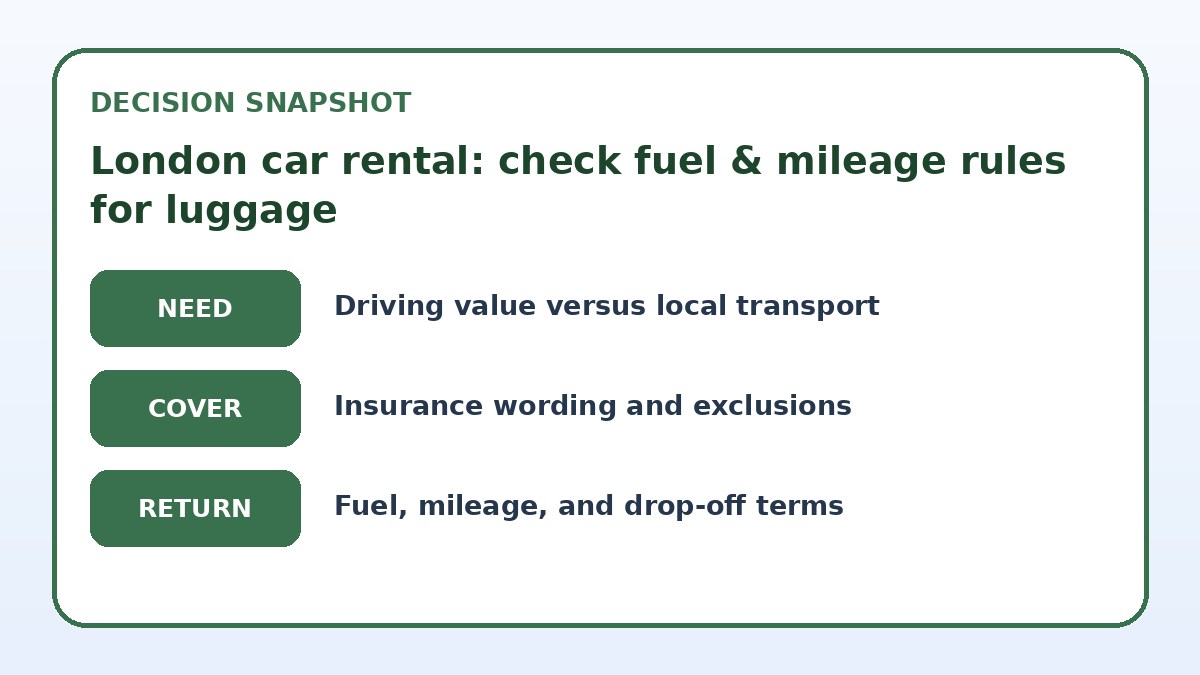
If you’re carrying extra suitcases, sports gear, or equipment, driving in London can feel like freedom — until you hit hidden fuel rules, mileage caps, or cramped pickup logistics. The practical answer: only rent a car if your trip needs door-to-door flexibility that public transport and taxis can’t handle, and if the hire contract’s fuel and mileage terms fit your luggage-driven route. Before you book, compare how much space you truly need, whether your itinerary includes low-emission zones or congestion areas, and whether the rental’s stated fuel policy and allowed mileage will add unexpected costs. This article walks through route value, insurance wording specific to excess baggage, pickup and return friction, and a clear non-driving fallback so you can make a confident decision.

Decide whether driving adds real route value
Start by mapping where your luggage needs to go and how often you’ll move between locations. Driving pays when door-to-door trips, heavy items, or off-grid destinations are central to your plan — for example, several short hops between suburbs or trips with bulky sports equipment. If most activity is inside central London, public transport plus a single taxi or a luggage-forwarding option will often be simpler, since central parking, traffic, and low-emission zones reduce the practical value of a private car.
Think in trip segments, not just days. A rental becomes attractive when many segments require carrying heavy or bulky items, or when your itinerary includes times when trains run less frequently. Compare the logistical hassle of carrying bags through stations and up stairs against the time and cost of fuel, congestion charges, and possible mileage penalties. The decision hinges on whether the time saved and convenience justify the rental’s fuel rules and mileage boundaries.
Decide whether driving earns its place
| Mobility strategy | Best for | Cost or friction to check |
|---|---|---|
| Full rental car for entire trip | Multiple door-to-door stops and regular transport of heavy or bulky items. | Higher fuel, mileage, parking, and possible low-emission zone costs; check contract limits before booking. |
| Short-term rental for heavy-leg only | One or two heavy transfers (airport to countryside) while using trains in-city. | Requires extra handovers and coordination; watch for per-day mileage caps and fuel return rules. |
| Rail or coach plus taxis | Mostly central-London itineraries where large luggage only appears occasionally. | Cheaper on miles and fuel but can be inconvenient when multiple bulky items or tight schedules occur. |
| Luggage-forwarding and on-demand taxis | Travelers who want minimal handling and are willing to pay for door-to-door delivery of bags. | Adds a separate delivery cost and timing dependency; confirm size/weight limits and insurance for items. |
Check live rental choices only after the route test
Use the exact driver, dates, pickup point, and return plan to compare current conditions.
Understand insurance and wording around excess baggage
Insurance wording can affect whether large or expensive items are covered when transported in the rental. Most standard collision and theft coverages protect the vehicle but may exclude personal item losses unless you buy additional cover or check the policy wording. When booking, read the rental agreement's sections on personal effects, declared valuables, and any weight limits for roof racks or tow bars. If the insurer or rental firm requires you to declare high-value equipment, follow that procedure before departure.
Also verify whether the rental’s damage cover uses a deductible or excess that would apply if your loaded car is damaged while parked or manoeuvring heavy gear. If you plan to fit a bike in the boot or use a roof box, check the authorised fitting methods, weight limits, and whether the provider requires specialist attachments or additional insurance. When in doubt, ask to see the exact clause on the final booking page and save screenshots of any additional waivers you buy.
Compare the full rental conditions
Confirm insurance wording, exclusions, deposit, fuel, mileage, and return terms on the final page.
Pickup and return friction when you have extra luggage
Collecting and returning a car with lots of baggage is more than a five-minute handover: it requires space to load, time to inspect the vehicle, and sometimes a second person to help. Ask where the pickup lot is located — airport terminals, city depots, and on-street lockers impose different walking distances and luggage-handling challenges. If the supplier’s designated pickup point has stairs, narrow doors, or busy pedestrian flows, that increases the friction. Reserve extra pickup time and confirm whether staff will assist with loading or if trolleys are available.
Return policies mean you may need to refuel, drop the car at a specific lot, or allow for a vehicle inspection. If you have oversized cases, think about where you’ll leave them while staff check the car or whether inspection areas are sheltered from rain. Some companies levy penalties for late returns or excessive cleaning if you bring sand, mud, or pet hair; read those clauses and ask how they treat baggage-related damage. Always check the final booking page for precise pickup hours, required documentation, and step-by-step return instructions.
Car rental terms to verify
- Read the rental contract’s fuel policy and prefer full-to-full or note exactly how return refuelling charges are calculated on the booking page.
- Confirm the allowed mileage and any per-mile fees for exceeding limits, especially for suburban or multi-day driving plans.
- Check insurance wording for personal effects, declared valuables, and excess amounts that apply to damage while loading or unloading.
- Measure your luggage and verify boot dimensions, seat-folding procedures, and whether roof-boxes or bike racks are permitted and insured.
- Ask the provider for explicit pickup and return procedures, assistance availability, and any extra cleaning fees tied to heavy or dirty baggage.
- If using a fallback, pre-book larger taxis or luggage-forwarding services and save provider refund and timing policies from the final booking page.
Non-driving fallback: plan a seamless alternative
If driving looks like extra cost or complexity, set up a realistic non-driving fallback before you cancel car options. Break your route into public-transport-friendly segments, check door-to-door taxi pricing for heavy loads, and investigate luggage-forwarding services that pick up and deliver large items between addresses. For multi-stop itineraries, compare a rail-focused approach with local taxi clusters and look for trains with accessible luggage areas or step-free access so you aren’t wrestling bags at every connection.
Prepare the fallback’s contingencies: pre-book larger taxis for airport-to-hotel transfers, confirm luggage size limits with any carrier, and allow time buffers for handovers. If you expect uncertain schedules, reserve a single flexible car for the most luggage-heavy leg only, then switch to public transit for the city centre. When comparing options on provider pages, verify refund rules and any added fees for oversized items so your fallback remains predictable and affordable.
Car Rental & Road Trip questions travelers ask
How do fuel policies typically work and which is easiest when travelling with extra luggage?
Fuel policies vary: full-to-full means you pick up the car with a full tank and return it full — this is usually the clearest and often the cheapest option if you can refuel locally. Pre-purchase fuel sells convenience but can be expensive if you return partly used fuel. Other options include full-to-empty, where you pay for a full tank up front and return as empty; that can be wasteful with unpredictable routes. Always check the exact wording on the final booking page about whether fuel charges are calculated by tank fraction or flat fees, and where the nearest accepted fuel stations are.
What mileage terms should I watch for if I have a long multi-stop London itinerary?
Verify whether the rental includes unlimited miles or a daily/total mileage allowance, and check the per-mile or per-kilometre fee for overages. Some city rentals impose tight daily caps that seem fine for urban driving but become costly on suburban or day-trip routes. If you expect one long drive day, calculate projected miles and compare the cost of a short-term rental for that leg versus a single-day taxi or rail option. Look for any fine print on the final booking page that excludes certain road types or countries from the mileage allowance.
Will my personal valuables be covered if they’re damaged or stolen from the rental car?
Coverage for personal effects is separate from vehicle insurance in many contracts. Standard collision damage waiver covers harm to the car but often excludes contents unless you purchase a specific personal effects cover. Providers may set limits per item and require you to declare high-value equipment. Always read the personal belongings and theft sections on the booking page, note any required receipts or serial-number records, and consider additional insurance if your items are valuable or professionally essential.
Final decision note
Driving in London with extra luggage is worthwhile for travellers who need frequent door-to-door transfers, bulky equipment transport, or flexible timetables that public transit can’t meet. But the true cost depends on the rental’s fuel policy, mileage allowance, insurance wording for personal items, and the time it takes to pick up and return a loaded vehicle. If any of those terms look restrictive or unclear, plan a fallback that combines rail for long legs with pre-booked taxis or luggage-forwarding for heavy items. Before you confirm anything, read the final booking page carefully for fuel charges, mileage limits, pickup/return rules, and insurance clauses so there are no surprises at handover.
Continue planning
Check current options and final conditions
Use the provider page to confirm live availability, the final total, cancellation terms, and every condition that matters to your trip.
This evergreen planning guide was created with AI-assisted drafting and a structured quality review. It does not display live prices, schedules, availability, visa guidance, or provider rankings. Verify current details before booking. Some links are affiliate links; we may earn a commission at no additional cost to you.