If you’re traveling from New York City to Washington, DC for the first time, the practical choice comes down to how much door-to-door friction you’re willing to accept. For most visitors the decision is between rail for a comfortable, city-center-to-city-center experience; coach for lower-cost curbside travel with more stops; or a mixed plan that uses rail or coach plus a local transfer. Begin by comparing where each option drops you off relative to your DC accommodations and what luggage handling and onward transfers you’ll face. Also decide how flexible your timing must be—do you need a fixed arrival time, or can you accept wider windows? With that practical frame, the rest of this guide explains the tradeoffs, what to check before booking, and how to prepare your travel day so it’s as smooth and predictable as possible.
Choosing between rail, coach, ferry or mixed routes
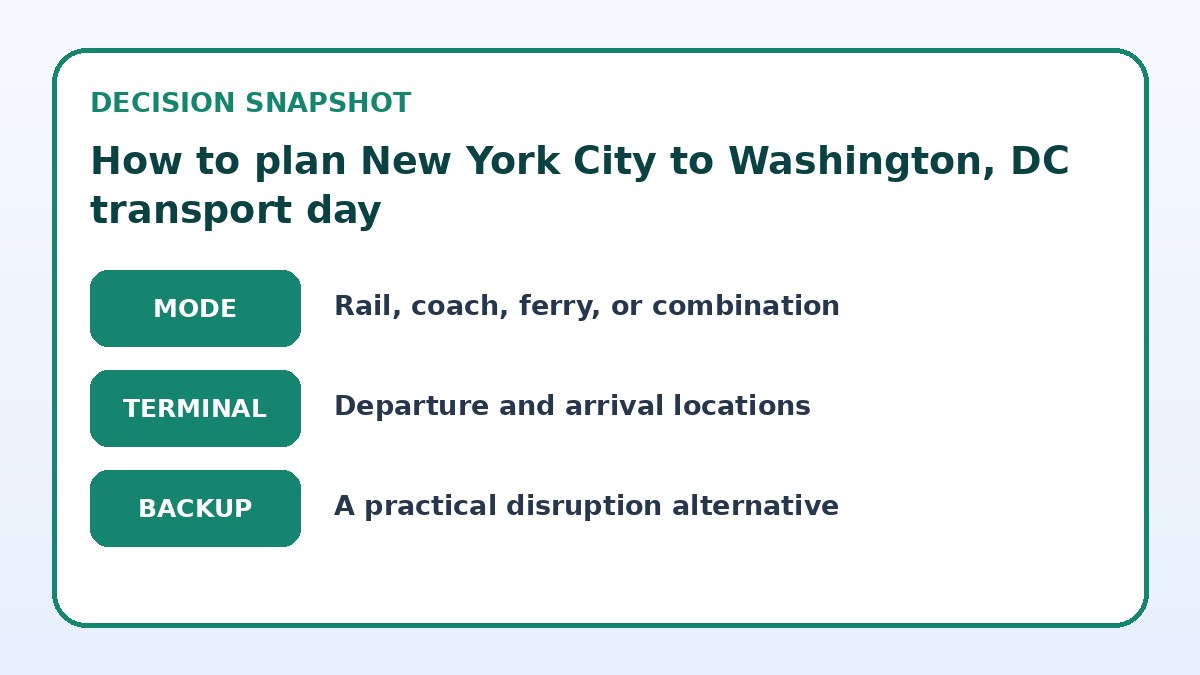
Start this decision with terminals and where they sit relative to your start and end points. Rail services typically run between major city-center stations, which tends to reduce local transfer time and simplifies luggage handling. Coaches usually operate from curbside depots or terminals that can be convenient but sometimes require more walking or a short local transfer. Ferries are not a direct option for the full NYC–DC corridor for most travelers, but combinations—such as a regional ferry to a rail hub—translate to more steps and require careful timing.
Cost, comfort, and frequency interact differently for each mode. Rail offers a comfortable ride and predictable terminals, which helps first-time visitors because it minimizes unknowns on arrival. Coaches often have lower fares and decent onboard amenities but can be affected by traffic and multiple stops. A mixed plan can make sense if you live or stay near a specific terminal or if one mode’s schedule aligns better with your appointments; just map door-to-door arrival times to see which option truly wins.
Choose the end-to-end journey plan
| Journey approach | Best for | Friction to check |
|---|---|---|
| Direct rail (city-center to city-center) | Travelers prioritizing low transfer friction and predictable arrival city-center access | Often costs more than coach and may have fewer last-minute seats during peak times |
| Coach (curbside or terminal) | Budget-minded travelers comfortable with potential longer total travel time | More subject to traffic and may require longer walks or transfers at either end |
| Mixed-mode (coach or local transit to a rail hub) | Those who need a specific departure time or cheaper alternatives with acceptable transfers | Adds transfer complexity and increases the chance of missed connections |
| Flexible, last-minute multimodal planning | Visitors with flexible schedules who can switch modes to avoid delays | Requires time to monitor schedules and can be stressful without solid contingency plans |
Check live intercity options
Look beyond the ride itself and compare terminals, transfers, luggage, and arrival fit.
Terminal fit and luggage/transfer friction
Before you book, sketch your door-to-door route: starting point to departure terminal, vehicle travel time, and arrival terminal to final address. Consider how you’ll move luggage—are there stairs, elevators, long pedestrian links, or a short rideshare needed? Trains usually allow more comfortable luggage space and easier platform access at large stations. Coaches may require lifting bags into cargo bays and sometimes a longer walk from the stop. If your plan includes an overnight bag and carry-on, pack so you can manage transfers without assistance.
Think about timing windows at terminals. Larger stations have restrooms, coffee, and places to wait, which makes arriving early less stressful. Smaller curbside stops have fewer amenities and may require precise arrival timing to avoid long waits outside. If you’ll rely on rideshare or taxis to get to or from terminals, give extra buffer for pickup waits and urban traffic, and confirm the exact drop-off/pick-up point used by drivers at each terminal to avoid last-minute searching.
Timing flexibility and scheduling strategies
Decide whether you need strict arrival times or flexible windows. If you must reach DC by a specific hour for a meeting or check-in, choose frequent services or those that run with high reliability and shorter margins for delay. When you have flexible arrival, mid-day departures often avoid peak urban congestion and may be less crowded. Consider travel windows that leave you extra time at both ends to absorb delays—this reduces stress, especially when you’re unfamiliar with local transit connections.
When comparing departure options, look beyond the advertised run time. Add estimated time to get to the departure terminal, the time to collect luggage and travel from the arrival terminal to your final destination, and potential traffic or public transit waits. If a direct service and a one-change service show similar total door-to-door times, the direct option usually reduces the chance of missed connections, but a one-change itinerary can be a good backup if it offers more frequency or cheaper cancellation terms.
Compare the practical alternatives
Use the final page to confirm what is actually offered on your dates and save a workable fallback.
Intercity travel checklist
- Map door-to-door times: starting address to departure terminal, in-transit duration, arrival terminal to final address.
- Confirm baggage rules and how luggage is handled at each terminal; pack to manage transfers independently.
- Pre-book or note rideshare/taxi pickup points and save screenshots of booking confirmations and terminal maps.
- Download offline maps and tickets or print them, and carry a charged power bank for your phone.
- Identify at least two alternate departures and an alternate mode in case of cancellations or severe delays.
- Set calendar alerts for departure times allowing extra buffer for local transit, check-in, and security procedures.
Disruption backups and what to verify before booking
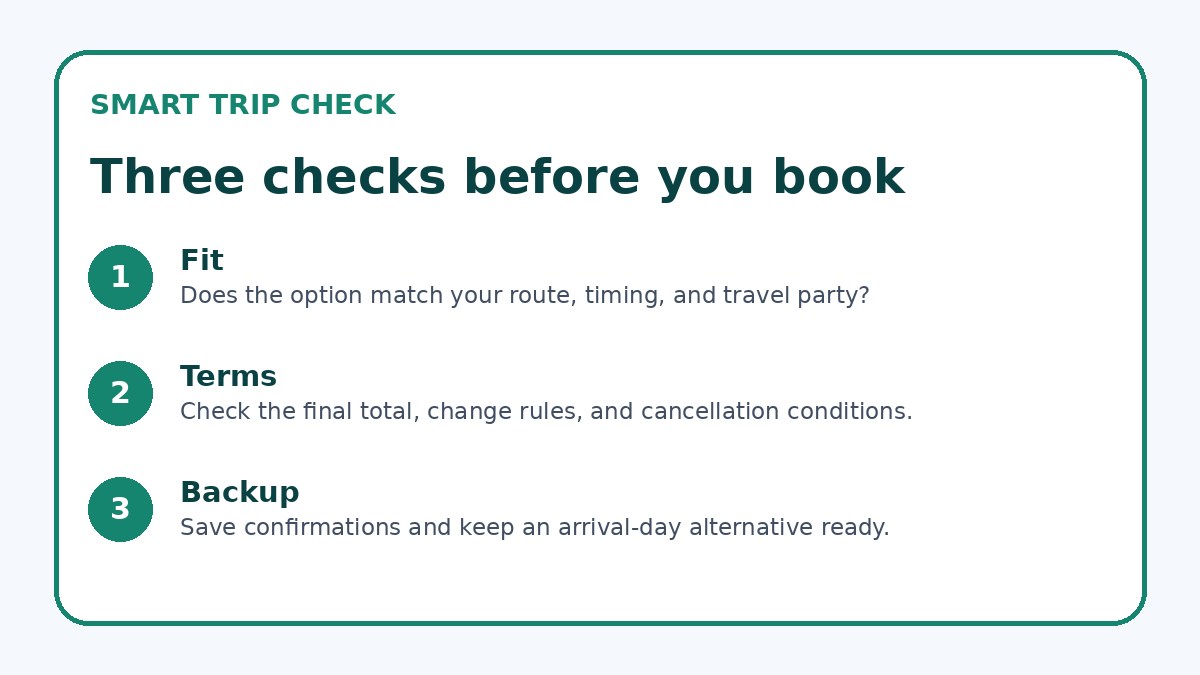
Build a simple contingency plan: identify the next three departures on at least one alternate mode, a nearby overnight option if delays force a late arrival, and a backup way to get from the arrival terminal to your accommodation. Save or screenshot confirmation pages and station maps, and keep emergency contacts and pickup directions easily accessible. If you rely on rideshare services, have local transit alternatives mapped in case surge pricing or long wait times make rideshare impractical.
Before you finalize any booking, verify the provider’s latest terms on the official booking page: refund and change conditions, baggage allowances, terminal addresses, and boarding requirements. Schedules and policies can change; check whether you need to print a ticket or can use a mobile pass, and confirm the exact drop-off/pick-up points for rideshares at both ends. For quick availability checks, Trip.com is an optional place to compare current options, but always confirm details on the transport provider’s final booking page.
Rail & Intercity Transport questions travelers ask
Should I choose rail or coach for the smoothest travel day between New York City and Washington, DC?
For most first-time visitors seeking the smoothest travel day, rail typically reduces door-to-door friction because trains run between major stations with predictable boarding areas and better onboard space for luggage. Coaches can be comfortable and economical but are more exposed to road traffic and sometimes require longer walks to or from curbside stops. Consider how each option fits your start and end points—if a station is closer to your accommodation, the slightly higher rail cost can be worth the simplified transfers. Always verify terminal addresses and baggage rules on the booking page before committing.
How much time should I allow for transfers and unexpected delays on the travel day?
Allow extra buffer time beyond the vehicle’s advertised running time to cover local travel to the departure terminal, time to check and stow luggage, and the segment from the arrival terminal to your final destination. If you must arrive by a specific time, build at least an hour or more of cushion depending on when you travel and whether you’ll rely on rideshare during peak traffic. For flexible itineraries, mid-day departures often reduce rush-hour risk. Also check the provider’s change and refund policies so you can adapt if your schedule shifts.
What should I do if my train or coach is delayed or canceled en route?
First, keep the provider’s contact and the station agent’s details handy; they can rebook you or advise on alternatives. If delays look long, check alternate departures on other modes and note how to reach them from the arrival or nearest hub. Have a small emergency fund for an unexpected taxi or last-minute overnight stay if connections are missed. Save screenshots of tickets and schedules, and consider informing your accommodation or appointment host about potential delays so they can adjust. Preparing options in advance makes decisions faster when disruption happens.
Final decision note
Preparing for the travel day between New York City and Washington, DC is about more than choosing a vehicle—it’s about minimizing door-to-door friction, packing for easy transfers, and having a clear disruption backup. First-time visitors will save stress by matching terminals to their exact start and end points, verifying baggage and boarding rules on the provider’s booking page, and pre-booking transfer connections when possible. Keep alternate departure options in mind, download tickets and maps for offline use, and allow scheduling buffers that fit how critical your arrival time is. With this practical prep, you’ll be ready to pick the option that best balances comfort, cost, and reliability on the day.
Continue planning
Check current options and final conditions
Use the provider page to confirm live availability, the final total, cancellation terms, and every condition that matters to your trip.
This evergreen planning guide was created with AI-assisted drafting and a structured quality review. It does not display live prices, schedules, availability, visa guidance, or provider rankings. Verify current details before booking. Some links are affiliate links; we may earn a commission at no additional cost to you.