If you have only a few days in Seoul, start by choosing the neighborhood that cuts friction, not the one that sounds nicest in photos. For most first-time visitors on a short schedule, a base near a major subway line with straightforward connections to the airport and a variety of restaurants and convenience stores will save hours. Decide first: do you want the fastest transit to main sights, the quietest streets to rest after long days, or the most compact walking options for downtown exploration? Once you pick that primary priority, you can narrow neighborhoods, compare typical room sizes and party needs, and check booking terms. This article gives a practical shortlist of areas and the tradeoffs to make an informed choice before opening live hotel inventory like Trip.com or other booking sites.

Check live stays in the areas that fit
Use your dates and party size to compare current rooms after you narrow the neighborhood fit.
Neighborhood fit: match your daily agenda to an area
Start by mapping the things you most want to do in Seoul and where they cluster. If your plan centers on palaces and museums, a base near Jongno or Anguk reduces transfer time to Gyeongbokgung and nearby galleries. If nightlife and restaurants are the main draw, Hongdae or Itaewon places you closer to late-night food and bars but can be noisier late into the evening. For a middle ground with straightforward transfers across the city, consider Myeongdong or Seoul Station areas—they sit on major lines and keep travel times manageable for short stays.
Also think about practical daily needs: convenience stores, pharmacies, and 24-hour eateries make quick trips more convenient when time is limited. Some neighborhoods have narrow streets or many stairs; those can be charming but tougher with luggage or mobility constraints. If your priority is low friction between hotel, transit, and top sights, favor neighborhoods with multiple station exits and clear walking routes over ones that look picturesque but require circuitous walks.
Choose an area-selection strategy
| Area approach | Best for | Tradeoff to check |
|---|---|---|
| Choose the busiest transit hub (e.g., Seoul Station) | Travelers prioritizing fast connections across the city and to airport rail links | More foot traffic and fewer quiet streets; neighborhoods can feel less local or residential. |
| Pick a central shopping district (e.g., Myeongdong) | Visitors focused on shopping, dining, and easy evening options within walking distance | Can be crowded and noisy; sightseeing routes to historic areas may require extra transfers. |
| Base in a cultural quarter (e.g., Jongno/Insadong) | Those prioritizing palaces, museums, traditional tea houses, and historic atmosphere | Fewer late-night dining options and potentially longer transfers to nightlife-heavy districts. |
| Stay in a nightlife/expat area (e.g., Hongdae or Itaewon) | Travelers who plan evenings out, want international dining, and vibrant street life | Noise and late activity can disrupt rest; daytime transit to some tourist sites may take longer. |
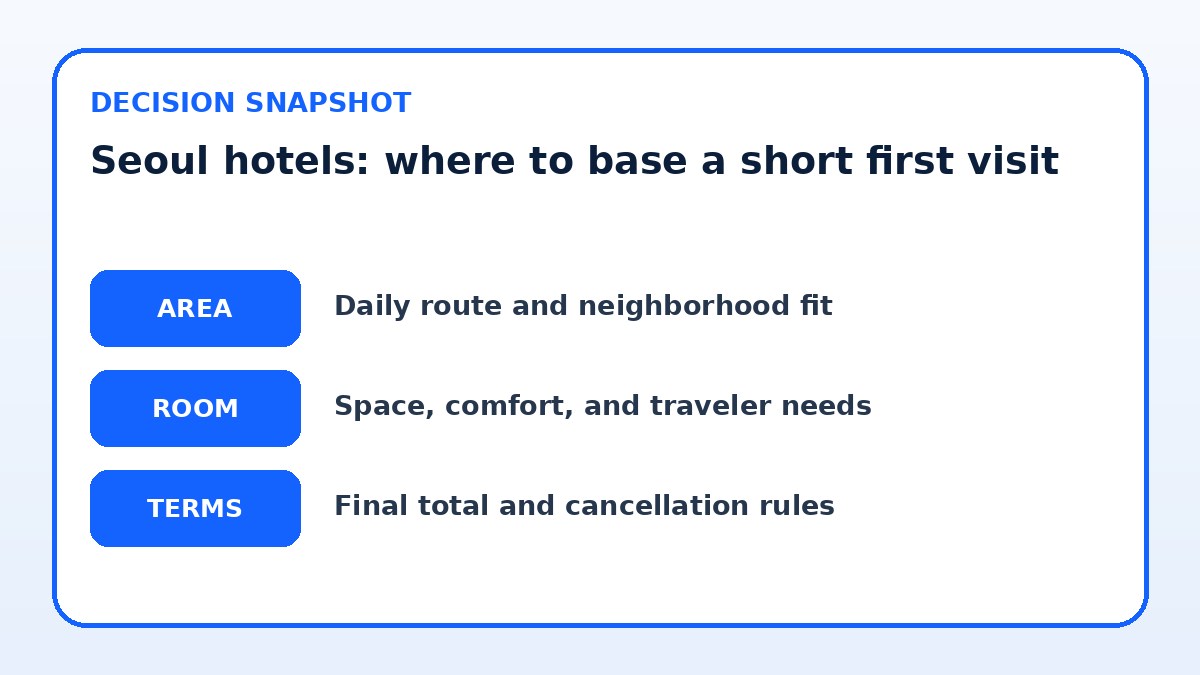
Daily-route friction: minimize wasted time on short trips
With limited days, minimize transfers and walking between attractions and your hotel. Choose a hotel within a comfortable walk of a subway line that provides direct or one-transfer connections to the places you plan to visit. For example, staying near a transfer hub like Seoul Station, City Hall, or Jongno 3(sam)-ga reduces the chance you’ll need frequent multi-step transfers. Verify on transit maps whether a hotel’s closest station offers the lines you need and how many transfers typical routes require.
When you compare hotels, estimate door-to-door time: include the walk to the station, transfer times, and any stairs or long corridors inside stations. For short stays, a 10–20 minute predictable route beats a 5-minute route that requires multiple crowded transfers. If you have mobility concerns or heavy luggage, prioritize hotels with elevator access at the station and hotel entrances. Before booking, check station exit numbers and whether a chosen exit has escalators or lifts; confirm these details on official station or hotel pages.
Now compare like with like
Keep the same dates, guests, room needs, and cancellation preferences while you compare the final choices.
Room and party needs: picking the right layout and services
Decide who’s traveling with you and how you want to sleep, store bags, and refresh between activities. Solo travelers often accept compact rooms and prioritize location; couples may want a double bed and a slightly larger bathroom; families or small groups usually benefit from rooms with two beds, connecting rooms, or suites with small kitchenettes. For a short stay, storage space and a comfortable bed can matter more than in-room extras. Confirm the exact bedding configuration and whether rollaway beds or cribs are available before you book.
Also check services that change daily convenience: early or late check-in options, luggage storage, and in-house breakfast that can save time on mornings. Hotels list amenities differently; when a provider’s page uses generic terms like ‘breakfast available’ or ‘parking on site,’ verify specifics—hours, menus, and whether parking is secure—on the hotel’s own booking page or phone line. If reliable Wi-Fi matters for work or navigation, ask whether speeds are sufficient for video calls and whether there’s any extra charge.

Hotel booking check before payment
- Map your must-see sites and check the nearest subway stations; mark transfer counts to estimate door-to-door travel times.
- Confirm the exact bed configuration and room square footage on the hotel’s booking page or by message before reserving.
- Verify the hotel’s cancellation and prepayment policy in writing and save any confirmation emails or screenshots.
- Ask the hotel about luggage storage and early/late check-in options if your arrival or departure falls outside standard hours.
- Check whether the station exit nearest the hotel has elevators or escalators and note the exit number to save time on arrival.
- Compare at least two booking channels, then confirm any critical service detail (shuttle, Wi‑Fi, breakfast) on the hotel’s official page.
Booking terms and final checks before clicking confirm
On a short trip, flexible booking terms matter more than a marginal price difference. Favor rates that allow free cancellation or date changes up to a reasonable window before arrival, especially if your schedule could shift. Read the property’s stated cancellation and payment policy on the booking page; if anything is ambiguous—such as partial prepayment requirements or nonrefundable clauses—contact the hotel or booking platform to get written confirmation. If you use a third-party site, verify the same cancellation language on the hotel’s own site if possible.
Other final checks: confirm how to reach the hotel from the airport (which airports, whether there’s a direct bus or a clear rail route), whether the room photos match the bed configuration you reserve, and what ID or deposit the property requires at check-in. When provider-specific facts could change—like shuttle schedules, lift availability, or renovation work—look for the hotel’s most recent notices and save any correspondence that clarifies terms. You may compare live availability and conditions on booking sites such as Trip.com, but always confirm details on the property’s final booking page.
Hotel Guide questions travelers ask
Which Seoul neighborhood is best for a first-time visitor staying three days?
For a three-day first visit, choose an area that minimizes transfers to the attractions you prioritize. If your itinerary mixes palaces and downtown shopping, a central neighborhood with multiple line access—like near City Hall, Myeongdong, or Seoul Station—balances easy transit, dining, and luggage handling. These areas let you reach historic sites, shopping districts, and transport links without wasting much of a short trip on complex routes. Ultimately match the neighborhood to your top activities rather than trying to be equidistant from everything.
Is it better to stay near the airport or closer to central Seoul for a short visit?
Staying near the airport rarely pays off for short city visits because most tourist time is spent in Seoul itself. Choose a hotel with a clear, quick connection to the airport—either close to a direct airport rail line or a shuttle route—so arrivals and departures are easy, then base yourself closer to the central subway network. For short trips, saved time each day by staying centrally will usually outweigh a slightly easier airport transfer; only consider an airport-area stay if your schedule demands an immediate early departure or very late arrival.
How should I judge hotels that advertise ‘near subway’ on booking sites?
Treat ‘near subway’ as a starting point, not a guarantee of convenience. Look for the station name and exit number, then check a map to see the actual walking route—some ‘nearby’ stations involve uneven sidewalks, stairs, or long mall corridors. Estimate the walk with luggage and factor in time for navigation. If accessibility or fast transfers matter to you, message the property to confirm the nearest exit, whether there are lifts, and the typical walk time to the hotel entrance; ask for photos or directions from the station to the property if anything feels unclear.
Final decision note
For a short first visit to Seoul, the single most useful decision is where to base yourself: pick a neighborhood that reduces daily friction between your hotel, transit, and main sights. Prioritize a hotel within easy walking distance of a major subway line or transfer hub, confirm the room layout fits your party, and insist on clear booking terms. With that framework you can quickly shortlist two or three neighborhoods, compare specific properties with the checklist above, and then open live inventory to confirm availability and specific policies. Doing this work before you book saves time on the ground and lets you experience more of Seoul in a short visit.
Continue planning
Check current options and final conditions
Use the provider page to confirm live availability, the final total, cancellation terms, and every condition that matters to your trip.
This evergreen planning guide was created with AI-assisted drafting and a structured quality review. It does not display live prices, schedules, availability, visa guidance, or provider rankings. Verify current details before booking. Some links are affiliate links; we may earn a commission at no additional cost to you.