Short answer: driving in Seoul can make sense for couples planning day trips outside the city, but the decision hinges on fuel terms, mileage allowances, and how pickup and return are handled at your rental. Before you book, confirm whether the car is supplied with a full tank or by a fuel-charge policy, whether daily or total mileage caps apply, and what fees trigger excess-mileage charging. Also check how roadside assistance and insurance apply if you exceed mileage or drive outside specific regions. If your itinerary mainly covers central Seoul neighborhoods, driving often adds friction; if you want coastal or rural day trips, a rental may be convenient. This guide focuses on the exact fuel and mileage clauses to inspect, how those items interact with insurance and pickup/return logistics, and what to do if driving is more trouble than it’s worth.
When driving truly adds value for a couple
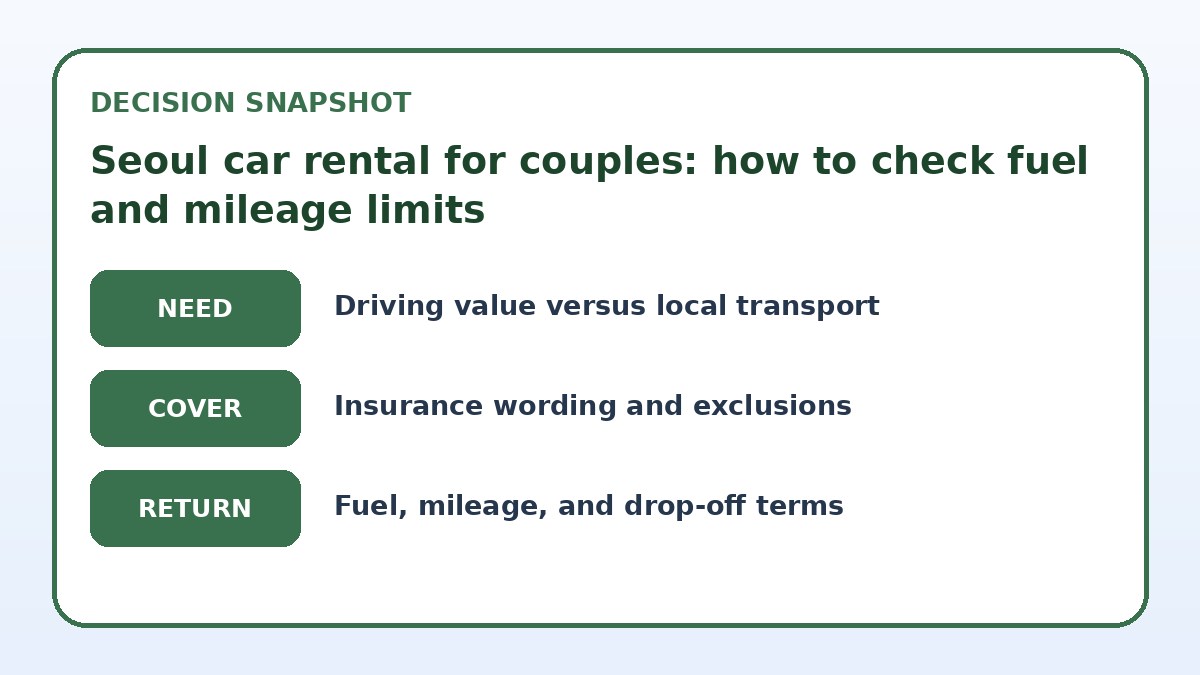
Decide whether a car helps your specific couple’s plan by mapping destinations and weighing convenience against friction. A rental pays off when your days include multiple out-of-city stops — think coastal villages, mountain trails, or a string of heritage sites where public transport would multiply transfers. Also consider luggage: if you carry equipment, baby gear, or shopping, a car reduces carrying fatigue and makes spontaneous detours comfortable. Balance those gains against the cost and time of finding parking, paying tolls, and navigating unfamiliar streets.
For short stays centered in Jongno, Myeongdong, Gangnam, or Hongdae, the math usually favors public transit, walking and occasional taxis because Seoul’s subway is frequent and extensive. Couples who value relaxed, unhurried exploration of Seoul’s urban neighborhoods typically find driving creates more stress than benefit. But if your couple’s style is to explore farther afield on your own schedule, a rental can unlock day trips that are otherwise long or complicated by connections. The key is comparing door-to-door travel time and the intangible comfort of controlling your itinerary.
Decide whether driving earns its place
| Mobility strategy | Best for | Cost or friction to check |
|---|---|---|
| Rent a car with full-to-full fuel and limited mileage | Couples doing one or two longer day trips with predictable distances | Lower fuel hassle but risk of overage charges if you miscalculate distance |
| Prepaid fuel or fuel service charge with unlimited mileage | Couples planning many kilometers in a short trip who prefer upfront costs | Higher upfront cost; you may pay for fuel you don’t use |
| Short-term rental just in Seoul with low mileage caps | Couples staying within the city but wanting occasional convenience | City parking and traffic reduce convenience; mileage caps can bite on day trips |
| Transit and taxis with occasional one-way car hire | Couples prioritizing stress-free city travel and selective driving for specific legs | Less flexible door-to-door control, but avoids most fuel and mileage contract risks |
Check live rental choices only after the route test
Use the exact driver, dates, pickup point, and return plan to compare current conditions.
Exactly what to check on fuel and mileage terms
Fuel policy language determines the drop-off chore and costs. Common variants are full-to-full (you return with a full tank), prepaid fuel (pay once and return empty or at any level), or fuel service charges (the company tops up and bills you). On the final booking page, verify whether the rate quoted assumes full-to-full and whether the provider accepts fuel receipts as proof. Note any minimum tank-level fines and how they invoice fuel: some apply a per-liter fee plus an administrative charge, which can be much higher than local pump prices.
Mileage rules can be daily caps, weekly or total-trip allowances, or unlimited mileage. Look for explicit units (kilometers per day or total kilometers on the rental agreement) and the rounding rules used to calculate overage. Confirm the overage rate per kilometer and whether the odometer reading at pickup and return is recorded on the same document you sign. Also verify geographic limits: some contracts restrict mileage for travel into neighboring regions or across national borders. If you plan long drives, request a written exception or upgrade to an unlimited-mileage plan before you finalize the booking.
Compare the full rental conditions
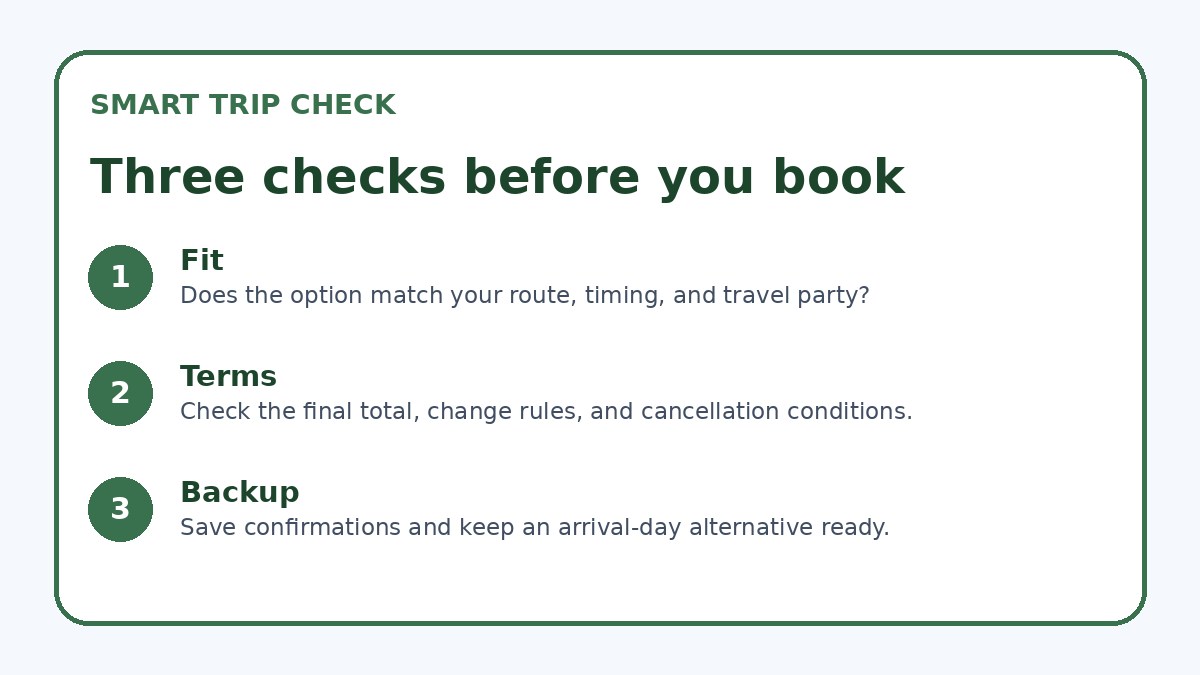
Confirm insurance wording, exclusions, deposit, fuel, mileage, and return terms on the final page.
Insurance wording and how mileage or fuel breaches affect coverage
Insurance contracts often include conditions that can nullify coverage if the rental terms are violated. Read whether coverage depends on observing fuel policy, staying within permitted mileage, or parking in approved areas. Look specifically for phrases such as "void if vehicle used outside designated area" or mileage-related clauses. On the booking page and the signed rental contract, confirm the deductible amount, whether collision damage waiver (CDW) reduces your liability, and whether excess is chargeable if a breach occurred, such as returning with insufficient fuel or driving beyond agreed limits.
Also confirm roadside assistance scope: does it cover flat tires, battery jump-starts, or towing when far from the city? Check whether assistance response differs if you’re out of region or inside tunnels and mountain roads where access is complex. If any of the coverage depends on you following mileage or fuel rules, get it in writing. When insurance language is ambiguous or mentions "voiding" rather than precise penalties, ask the provider for a clarified, written explanation on their final booking page so you can weigh the risk.
Car rental terms to verify
- Confirm the fuel policy wording on the final booking page (full-to-full, prepaid, or service charge), and save a screenshot.
- Note the exact mileage allowance type (per-day or total) and the overage rate per kilometer before booking.
- Ask the supplier in writing whether fuel-policy or mileage breaches affect your insurance coverage or deductibles.
- Record the pickup odometer reading and fuel level on the rental contract and keep your copy until final return is processed.
- Plan your drop-off: identify an approved refueling station near the return location or confirm after-hours return procedures.
- Compare door-to-door travel time and taxi/transit alternatives for each day to see if driving actually saves time or adds friction.
Pickup, return friction and a practical non-driving alternative
Pickup and return logistics add time to a couple’s travel day. Verify where the supplier’s desk is—airport counters, downtown branches, or hotel delivery—and whether late returns incur hourly fines. Inspect the exact pickup checklist: do they record fuel level and odometer reading on your copy? If the company requires a specific gas station for refuel before return, note its location relative to your drop-off. Also ask whether after-hours returns are allowed and how they handle fuel-level disputes when the branch is closed.
If driving seems more hassle than help, plan a non-driving fallback that gives you similar freedom: combine Seoul’s subway, intercity buses, regional trains and ride-hailing for day trips. For excursions outside the city, look at express intercity buses or regional train services to a nearby town, then use local taxis for last-mile transport. Trip.com can be used to compare availability and conditions for trains and buses, but always verify times and connection rules on the operator’s final booking page. A solid transit-plus-taxi plan often matches the cost and saves you from fuel and mileage uncertainty.
Car Rental & Road Trip questions travelers ask
How do I avoid fuel disputes at drop-off?
Avoid disputes by choosing a rental with clear full-to-full terms and documenting the fuel level at pickup. Photograph the fuel gauge and odometer when you collect the car and keep photos with timestamps. If the rental accepts receipts, use the nearest public station before return and keep the receipt linked to your contract. If you’re asked to pay a refueling fee at return, request the written calculation and comparison to local pump prices; if the branch is closed, follow the company’s formal after-hours return process and file a claim with photos if charged later.
What if I need to exceed the mileage limit during my trip?
If your planned route might exceed the stated mileage, contact the rental provider before you go over and ask for a change to the contract—either increase the mileage cap or switch to an unlimited-mileage rate. Make sure any change is recorded on the booking page and on your rental agreement. If you can’t modify the booking, track odometer readings daily and estimate potential overage costs so you can decide whether to adjust the itinerary or pay the fee. Never assume verbal permissions; get confirmed, written amendments.
Can returning with less fuel void insurance?
Some rental contracts state that violating fuel policy can affect liability or coverage, but the specifics vary. Read the insurance clause on the final booking page to see if it mentions fuel-policy breaches as grounds for reducing or voiding coverage. If the wording is unclear, ask the provider to clarify in writing how fuel-policy violations relate to CDW, liability, and roadside assistance. If you’re uncomfortable with the answer, consider an alternative supplier or a different fuel policy to keep your coverage clean.
Final decision note
For couples, the right decision about Seoul car rental depends on honest mapping of your days and careful reading of fuel, mileage and insurance wording. Driving opens certain day trips and luggage convenience, but only if you accept the contract’s fuel policy, mileage limits, and pickup/return logistics. Before booking, verify the exact fuel procedure, mileage units and overage rate, and any insurance clauses that reference breaches of the rental terms. If central Seoul sightseeing is your priority, a transit-and-taxi strategy often reduces friction. Keep copies of odometer and fuel photos, get any exceptions in writing, and use the checklist above when you finalize the booking.
Continue planning
Check current options and final conditions
Use the provider page to confirm live availability, the final total, cancellation terms, and every condition that matters to your trip.
This evergreen planning guide was created with AI-assisted drafting and a structured quality review. It does not display live prices, schedules, availability, visa guidance, or provider rankings. Verify current details before booking. Some links are affiliate links; we may earn a commission at no additional cost to you.