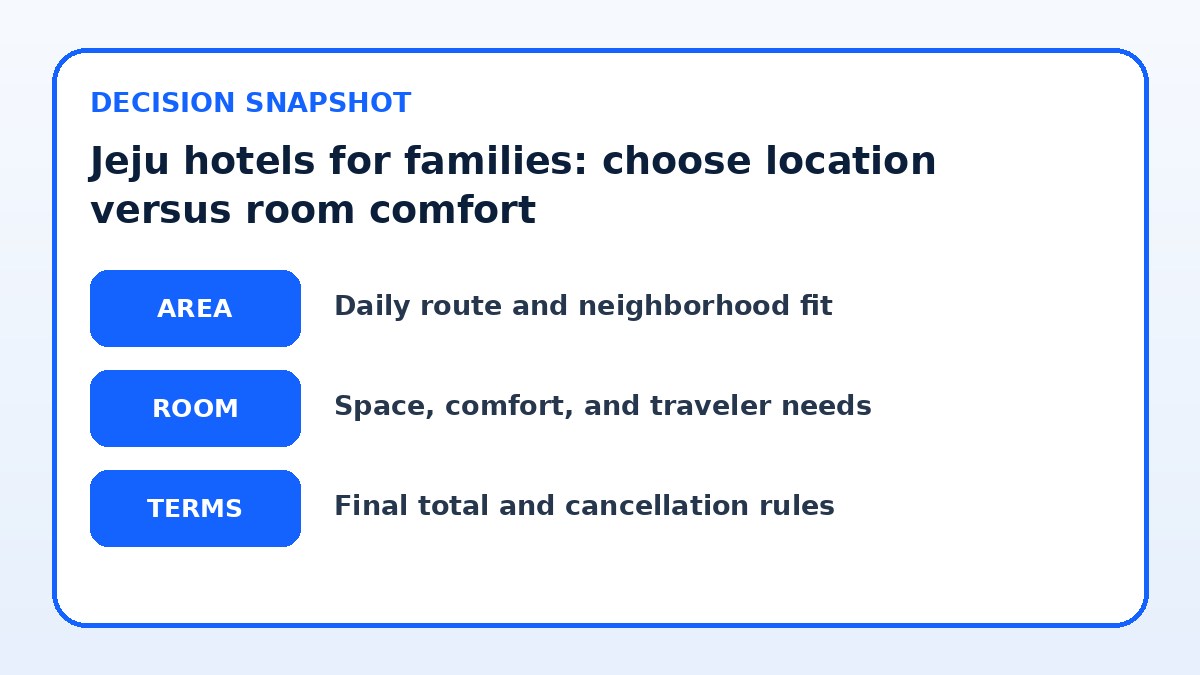
Choose your stay area first, then refine for room comfort and family needs. In Jeju the difference between a seaside village, a busy resort strip, a central transit hub, or a quieter inland neighborhood shapes every day: how long transfers take, whether evenings are walkable, and which attractions are easiest to reach. Families often face a tug-of-war between a large room with kitchen facilities and a location that saves hours on transit. Start by picking an area that minimizes daily friction for the attractions you plan to visit, then prioritize room layout, sleeping arrangements, and amenities like a kitchenette or storage. This article helps you shortlist one of four area types, assess daily-route tradeoffs, and choose room features that keep travel days smoother for children and caregivers.
Check live stays in the areas that fit
Use your dates and party size to compare current rooms after you narrow the neighborhood fit.
Neighborhood fit: choose by daily friction, not just views
Start your planning by mapping daily friction—how many minutes of transit or drives you’re willing to accept between your hotel and the places you’ll actually visit. Families with small children usually prefer shorter, more predictable transfers over a scenic but remote stay. On Jeju, that choice will push you toward either the coast near major attractions, the resort strip with bundled services, or a central town near transit and shops. Decide whether you want walkable evenings (restaurants, convenience stores, short walks) or you’re comfortable driving back to a quiet room after each day; this shapes the area list more than view or prestige.
Also consider time-of-day needs: will you arrive late, leave early, or rely on taxis after sunset? Neighborhoods close to the airport or major bus hubs reduce stressful transfers; beachside and rural areas often require private transport. For families that prefer to sleep in and move slowly, a central area with shops and short routes to museums, aquarium, or parks can be a huge quality-of-life win. Make a simple map showing your top three priorities—beach time, specific attractions, or minimal driving—and eliminate areas that make two of the three harder to reach.
Choose an area-selection strategy
| Area approach | Best for | Tradeoff to check |
|---|---|---|
| Beachside resort strip | Families wanting bundled services and immediate sea access | Often farther from inland attractions and may require longer drives for varied island sightseeing |
| Central town near transit | Families prioritizing short daily routes and easy access to shops and buses | Less scenic views and fewer on-site family facilities compared with resorts |
| Quiet inland neighborhood | Families who value calm evenings and larger rooms at lower density | Can add substantial travel time to popular coastal attractions and ferries |
| Near airport or ferry terminal | Families with early/late arrivals or tight transfer windows | Limited dining and evening options; may feel utilitarian rather than vacation-like |
Room and party needs: layouts, bed options, and practical amenities
Once you’ve chosen a neighborhood, decide what room features make travel days easier. Families commonly need separate sleeping spaces for children, a safe place for naps, and a basic setup to prepare snacks or simple meals. Look for rooms with two beds or a sofa bed plus blackout curtains, or for family suites with partitioned sleeping areas. If you travel with infants, confirm space for a travel cot; with toddlers, check flooring and the availability of child-safe furniture. Prioritize a dedicated workspace or table if someone needs to handle logistics or meal prep while others rest.
Practical amenities often matter more than hotel extras. A small kitchenette, microwave, and refrigerator let you manage meals and late-night snacks without leaving the room. Laundry access—washer or hotel laundromat—reduces luggage and keeps you flexible on a longer stay. Also check bathroom layout: a bathtub is useful for young children, while a walk-in shower can be easier for quick rinses. When you open booking pages, verify exact room dimensions, bed types, and whether kitchen appliances are included rather than assuming standard descriptors.
Now compare like with like
Keep the same dates, guests, room needs, and cancellation preferences while you compare the final choices.
Daily routing and transport: reduce wasted time and fatigue
Match your chosen neighborhood and room to the practicalities of moving around Jeju. If your days contain multiple stops—waterfalls, beaches, museums—cluster your itinerary so you return to the hotel along a short route instead of zigzagging the island. Families with a car will value parking convenience and minimal on-site steps; those relying on buses or taxis should prioritize proximity to a main bus stop, ferry terminal, or town center. A longer drive to a quieter hotel can feel worthwhile at low traffic times but exhausting on busy days, so estimate typical transit intervals rather than absolute distances.
Think about arrival and departure logistics. If your flight or ferry timing is outside daytime hours, staying near the airport or a city with easy late-night taxi access reduces stress. For island-wide excursions that start early, a central base can save an unnecessary pre-dawn transfer. Before you book, check how the hotel handles late check-in, luggage storage, and early departures. When possible, contact the property to confirm practical details that affect family comfort—transport arrangements to major piers or parks, stroller storage, and whether the hotel can advise on low-traffic routing for peak season days.

Hotel booking check before payment
- Map your top three daily attractions and eliminate neighborhoods that add more than one long transfer each day.
- Confirm exact room layout and bed types on the hotel’s page; request photos or floorplans if the listing is vague.
- Verify whether the room includes kitchenette appliances you need and what cooking utensils, if any, are provided.
- Check transport logistics: nearest bus stop, taxi availability at night, and parking rules if you will rent a car.
- Ask the property about late check-in, luggage storage, crib provision, and early breakfast options before booking.
- Compare cancellation and extra-person fees across two room categories in your chosen area to protect flexibility.
Final booking terms: what to verify on the provider page
When you reach live availability, confirm items that change often: exact bed types, room square footage, cancellation policy, extra-person fees, and whether a crib is provided on request. Don’t assume descriptors like “family room” or “suite” mean the same thing across properties; look for photographs showing the actual layout and a detailed room description. If a kitchenette is essential, verify which utensils or appliances are supplied and whether there’s a grocery option nearby for supplies. If the property lists shuttle service, check schedules and whether seats must be reserved.
Also verify service-level details that matter with children: early breakfast options, availability of on-demand housekeeping, and whether the property can store perishable food. Check parking arrangements—free, paid, or limited spaces—if you rent a car. If you rely on public transport, confirm the nearest stop and typical wait times. Use the hotel’s own booking page for these confirmations; Trip.com can be used once to compare availability and conditions, but always reconcile specifics on the provider’s final booking page before completing your reservation.
Hotel Guide questions travelers ask
Should I prioritize a larger room or a more central location for a week in Jeju with small children?
Prioritize the factor that reduces daily stress for your family’s typical schedule. If your plan is full days visiting sites across the island, a more central location near transit and shops will shorten repeated transfers and give you easier access to supplies. If you expect low daily movement—mostly pool time, beach, and on-site relaxation—a larger room with kitchen facilities makes sense. Consider a hybrid approach: choose a neighborhood that shortens the most common transfer and book a room category with space for naps and simple meal prep.
Is it worth paying extra for on-site family facilities like pools or kids’ programs in Jeju hotels?
Only pay extra if those facilities match how much time you plan to stay at the hotel. On-site pools, kids’ clubs, and evening activities are valuable when your itinerary includes downtime at the property, but they don’t compensate for long daily drives to attractions. For families aiming to explore the island every day, invest the budget in a better location or a larger room; for families who want built-in entertainment between short outings, a hotel with reliable child programming can simplify logistics.
How can I make late arrivals or early departures easier when booking a family hotel in Jeju?
Choose a neighborhood with straightforward late-night transport—near the airport, major bus hubs, or a town center with 24-hour taxi access. When booking, confirm the property’s late check-in procedure and whether staff can hold or tag luggage. Ask about early breakfast or grab-and-go options if you must leave before standard meal service. Always verify those operational details on the hotel’s booking page and confirm with the property directly because times and services change more often than room descriptions.
Final decision note
Decide the neighborhood first: it shapes every day and determines how comfortable even a great room will feel after long excursions. Once you lock an area that minimizes the kinds of transfers your family dislikes, use room filters to prioritize layout, bed types, and practical amenities such as a kitchenette, bathtub, and laundry. Verify essential details—exact bed configuration, appliance availability, parking, and check-in procedures—on the hotel’s booking page before committing. Shortlist one neighborhood, compare two room categories there, and you’ll open live inventory with clear needs: that makes choosing among Jeju hotels faster and far less risky for families.
Continue planning
Check current options and final conditions
Use the provider page to confirm live availability, the final total, cancellation terms, and every condition that matters to your trip.
This evergreen planning guide was created with AI-assisted drafting and a structured quality review. It does not display live prices, schedules, availability, visa guidance, or provider rankings. Verify current details before booking. Some links are affiliate links; we may earn a commission at no additional cost to you.