If you’re a solo traveler weighing San Francisco to Vancouver flights, the practical answer is to decide which matters more to you right now: a flexible ticket that lets you change plans without stress, or a more convenient itinerary (shorter flight time, fewer connections, predictable boarding) that may be less tolerant of last-minute shifts. Start by locking in the exact travel dates, your preferred departure window from SFO, and whether you’ll check bags or travel carry-on only. Those details drive whether you prioritize refundable or changeable fares, direct versus one-stop routing, and buffer time for connections. Below you’ll find a clear routing and fare framework that highlights baggage and connection risk, schedule fit, and what fare conditions to verify on the airline’s final booking page or a booking engine such as Trip.com.

See live routes for your exact travel day
Compare direct and connecting choices with the same baggage and traveler details.
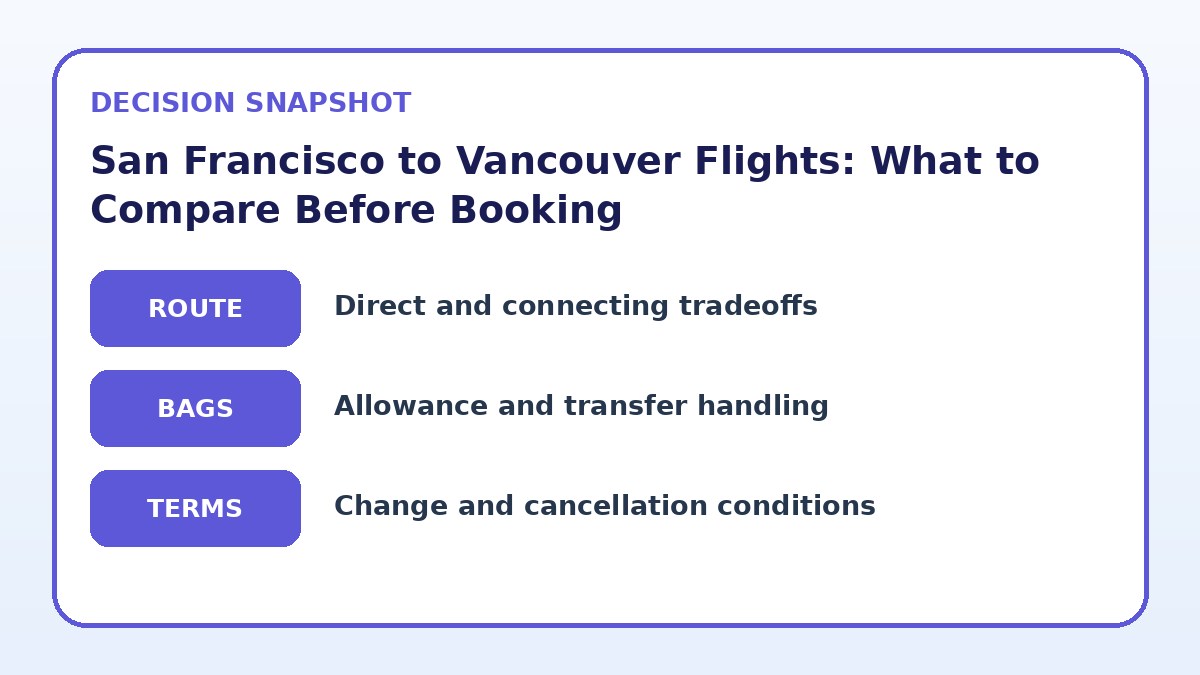
Routing: direct vs connecting and why it matters
For solo travelers, routing is the clearest tradeoff between convenience and schedule flexibility. A direct flight (when available) minimizes moving parts: fewer boarding passes, no re-clearing security between segments, and reduced chance of baggage mishandling. However, direct flights are often on fixed schedules with limited seats at the lowest fare buckets, so they can be less adaptable if your plans change. Connecting itineraries can open more time windows and carriers, giving you options on dates and times but introduce extra connection risk and longer total travel time.
When you compare options, look beyond the advertised elapsed time and read the connection details: are connections airport-to-airport within the same terminal or require a transfer? Do itineraries show minimum connection times that feel tight given your tolerance for stress? For solo travelers who prefer simplicity, a slightly longer single-stop option with a comfortable connection window may be preferable to a hurried direct gate-to-gate race. Always verify connection transfer procedures on the airline’s final booking page before payment.
Baggage and connection risk: what solo travelers should plan for
Checked baggage adds convenience but increases risk when itineraries include connections, especially on separate tickets or interline-unsupported segments. If you’ll check a bag, prioritize through-checked itineraries where the carrier assumes responsibility for transfer. For mixed-carrier or separate-ticket itineraries, consider traveling carry-on only or buying protected connections that explicitly include baggage transfer. Solo travelers should also plan for contingencies: know backup flight options, how the airline handles missed connections, and what documentation is needed to claim delayed or lost baggage.
Packing strategy affects your routing choice. If convenience and speed through airports are priorities, pack light and use a carry-on to reduce dependence on baggage transfer and to leave more time flexibility. If you need checked bags and choose a connecting itinerary, add at least the airline’s recommended minimum connection buffer plus an extra 30–60 minutes depending on the airport layout and whether you expect security lines or terminal changes.
Compare flight-selection strategies
| Flight strategy | Best for | Risk to check |
|---|---|---|
| Buy the cheapest basic fare and travel carry-on only | Budget-focused solo travelers who can lock dates and pack light | Least flexibility for changes and no checked baggage; fees may apply for changes or baggage |
| Choose a slightly higher flexible/refundable fare | Travelers who want low stress about date changes or cancellations | Higher upfront cost but easier changes; may still have seat or baggage limitations to confirm |
| Pick a convenient single-stop with generous connection time | Those prioritizing fewer airport transfers while keeping more scheduling options | Longer total travel time than direct but lower connection stress and typically safer baggage transfer |
| Book separate tickets to expand schedule options | Solo travelers needing very specific departure or arrival times not available on one carrier | Higher connection and baggage risk; you assume responsibility for missed connections unless protected by the airline or purchased protection |
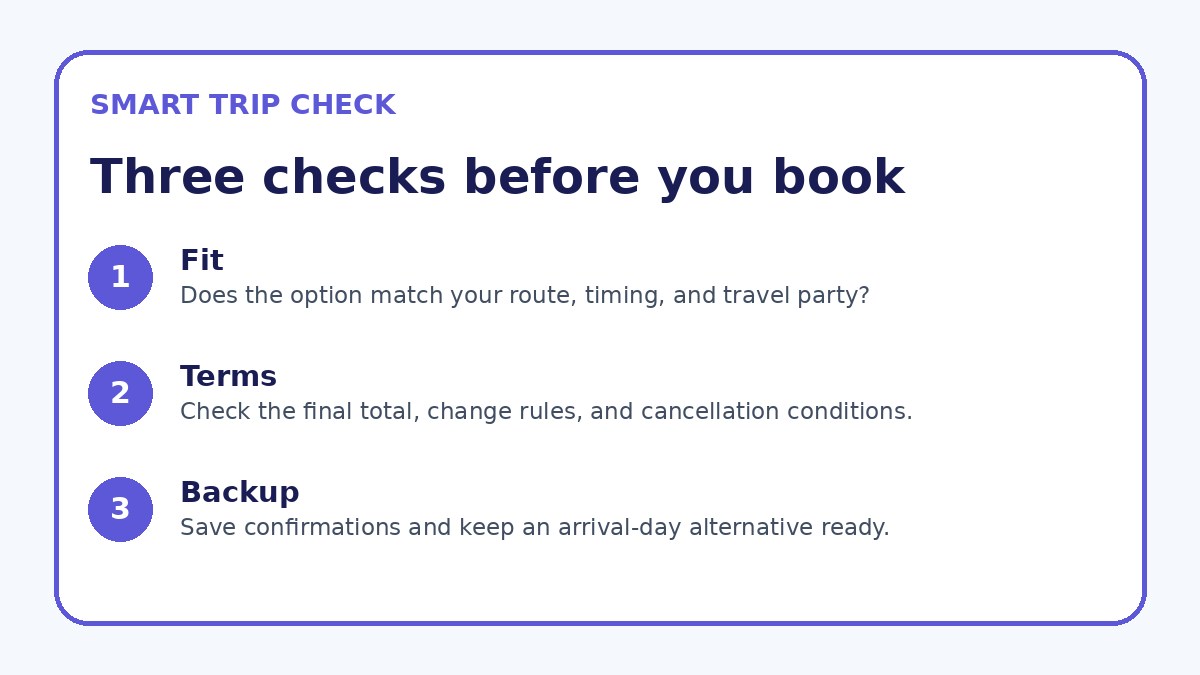
Recheck the complete itinerary
Confirm airports, connection handling, baggage, and change conditions before deciding.
Schedule fit: matching departure windows to your itinerary
Schedule fit means aligning available flights with your daily rhythm and onward plans in Vancouver. Solo travelers should pick departure and arrival windows that leave wiggle room for ground transport, check-in, and any appointments on arrival. Morning departures can reduce cumulative delays later the same day but can require very early commutes to the airport; evening flights may be more convenient but leave less recovery time if disrupted. Think about how much buffer you need between arrival and any fixed plans like tours, meetings, or hotel check-in.
When comparing schedules, also consider how changes ripple through your trip. A flight that’s slightly less convenient but on a fare with free changes might suit flexible travel dates, while a more convenient but restrictive fare requires confidence in fixed plans. Before booking, prepare exact travel dates, the solo traveler’s mobility and luggage preferences, and any connecting ground transport so you can evaluate whether a chosen schedule truly fits your whole day, not only the airborne time.
Flight details to verify
- List exact travel dates, preferred departure windows from San Francisco, and your arrival time preferences in Vancouver before searching fares.
- Decide whether you will check baggage; if you will, prioritize through-checked itineraries or plan to buy protected connections.
- Note the acceptable minimum connection time for you and add buffer (30–60 minutes) for airport transfers or security variations.
- On the airline booking page, confirm the fare’s change, cancellation, and refund rules and record the fare code or booking class.
- Compare total door-to-door time including airport commute, security, and customs, not just airborne time or advertised elapsed time.
- If booking on a third-party site, cross-check the final itinerary and fare conditions on the operating carrier’s official page prior to payment.
Fare conditions: what to verify before you click purchase
Fare rules determine how costly or feasible it will be to adapt if plans shift. For each fare, verify change and cancellation policies on the airline’s official booking page: confirm the exact change fee (if any), whether reprice or fare difference applies, and whether refunds are allowed for involuntary disruptions. Also check baggage inclusion: some fares only include carry-on and charge for checked bags, which can negate a fare’s apparent savings once your needs are considered.
Other fare conditions to verify include seat selection rules, upgrade eligibility, and the provider’s policy for missed connections caused by schedule changes or delays. If booking through a third-party site like Trip.com, use it to compare availability but always cross-check the final fare conditions on the operating carrier’s site before paying. Write down the fare code or booking class so customer service can reference it if you request changes later.
Flight Guide questions travelers ask
Should I always prefer a direct flight from San Francisco to Vancouver as a solo traveler?
Not always. Direct flights reduce points of failure and are easier for solo travelers who prioritize convenience, but they can be less flexible on dates and may be costlier in certain fare buckets. If your schedule is fixed and you value minimal airport hassle, a direct flight is often worth the premium. If you need more date options or lower fares, a single-stop itinerary with a comfortable connection might give you the practical balance between flexibility and acceptable convenience.
How much connection time should I leave when booking a one-stop itinerary?
Aim for at least the airline’s published minimum plus an extra 30–60 minutes if you value low stress, especially when changing terminals or passing through additional security. Factors to consider include whether your bags will be checked through, whether you need to re-clear security, and the layout of the connecting airport. If you’re booking separate tickets, build a longer buffer or add travel protection because you’ll be responsible for missed connections unless protection is explicitly provided.
What fare details matter most when I want the option to change dates?
Focus on change and cancellation policies first: confirm whether changes are permitted, whether there’s a fixed fee, and how fare differences are handled. Also verify refundability versus travel credit, and whether the fare allows rebooking into the same or lower class. Don’t forget baggage inclusion and seat selection rules; a low-change-fee fare that charges separately for every checked bag or seat may not be practical. Always validate these details on the airline’s official booking page before finalizing.
Final decision note
Balancing schedule flexibility and convenience on San Francisco to Vancouver flights comes down to setting priorities before you search: do you want the freedom to change dates without penalty, or do you want the smoothest, fastest airport experience? Solo travelers benefit from preparing exact travel dates, luggage strategy, and preferred departure windows so you can compare direct, single-stop, flexible, and separate-ticket options on equal terms. Verify fare conditions, baggage rules, and connection procedures on the operating carrier’s final booking page; if you use a third-party site like Trip.com to compare availability, cross-check the carrier’s rules before purchase. With clear priorities and a short checklist you’ll choose the route and fare that match your tolerance for risk and need for convenience.
Continue planning
Check current options and final conditions
Use the provider page to confirm live availability, the final total, cancellation terms, and every condition that matters to your trip.
This evergreen planning guide was created with AI-assisted drafting and a structured quality review. It does not display live prices, schedules, availability, visa guidance, or provider rankings. Verify current details before booking. Some links are affiliate links; we may earn a commission at no additional cost to you.