Short answer: often yes—but only if your itinerary, pickup logistics, and comfort thresholds line up. If you plan multiple stops far apart, have bulky bags (sport gear, large suitcases, musical instruments), or value door-to-door flexibility, a rental car on Jeju commonly reduces carrying hassles and saves time. If most of your stay is in one town, you’re comfortable with taxis and luggage-friendly transfers, or you prefer not to drive on unfamiliar roads, you may want to skip renting. This guide helps you decide by weighing route value, insurance details, pickup/return friction, and a clear non-driving fallback. Read it to match your baggage profile to how Jeju’s roads, parking, and transport options will affect comfort and cost. I’ll tell you what to verify at booking so you don’t discover surprises at pickup.

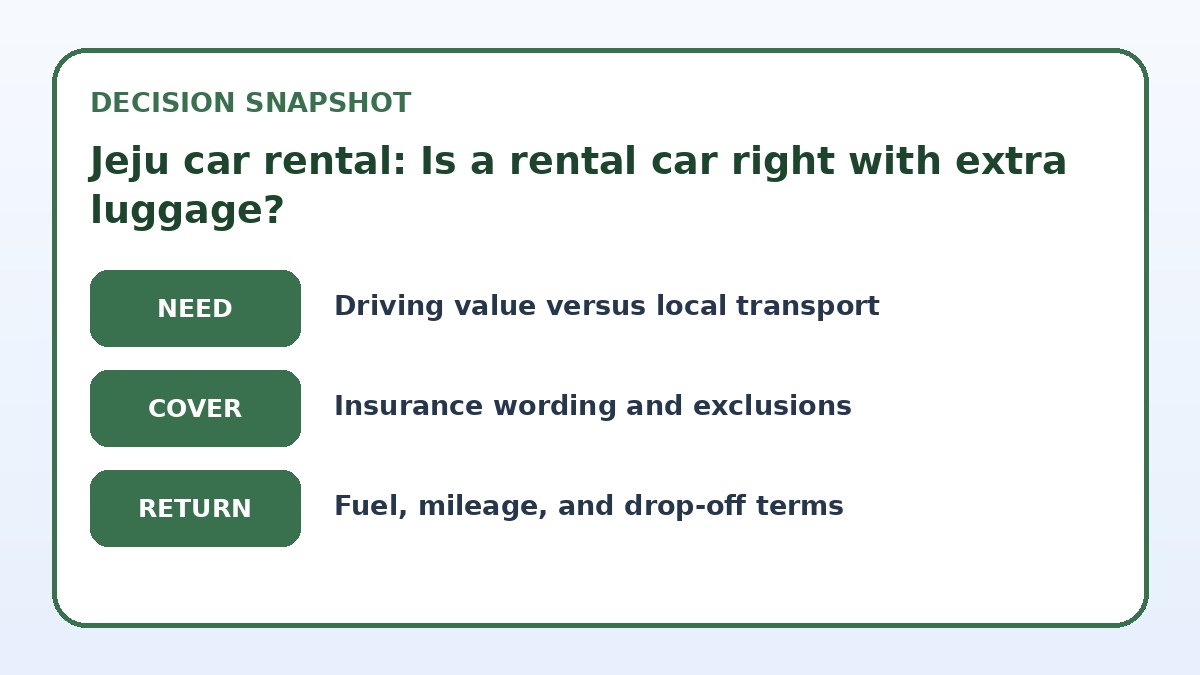
Route value: when driving genuinely improves your Jeju itinerary
Driving adds the most value when your plan includes multiple stops at widely spaced attractions—coastal viewpoints, remote beaches, Hallasan trailheads, or guesthouses away from Jeju City. A car makes it easy to move heavy or bulky luggage between dispersed accommodations without relying on schedules or multiple taxi calls. Consider distance between planned overnight stays and whether public buses serve those routes directly; if buses require many transfers or long walks with bags, a car may be worth the effort. Also account for time of day: early-morning or late-evening departures are much simpler with a private vehicle.
Conversely, if you’re staying in one base—like Jeju City or Seogwipo—and planning short day trips using organized tours or frequent intercity buses, the logistical advantage shrinks. Urban areas have more taxis and luggage-friendly hotels, and high-frequency bus corridors reduce the need for a car. Match the density of your stops and luggage volume: more scattered stops plus heavier bags strongly favors renting, whereas compact itineraries with light luggage favor skipping it.
Decide whether driving earns its place
| Mobility strategy | Best for | Cost or friction to check |
|---|---|---|
| Rent a car for the whole stay | Travelers with many stops, bulky gear, or remote lodgings who value flexibility. | Higher responsibility for driving, insurance nuances to check, plus parking and fuel responsibilities. |
| Short-term rental only for transfer days | Visitors who need a car for specific heavy-luggage transfers between distant stays. | More pickup/return events and possible extra fees; requires precise timing to avoid missed bookings. |
| Taxis and private transfers | Groups or families with heavy bags who prefer door-to-door service without driving themselves. | Potentially higher cumulative cost and limited availability in remote areas or off-peak hours. |
| Public transport plus luggage shipping | Light-footed travelers wanting low cost who can ship surplus luggage between hotels. | Less flexibility for spontaneous stops and reliance on shipping schedules and hotel handling. |
Check live rental choices only after the route test
Use the exact driver, dates, pickup point, and return plan to compare current conditions.
Insurance wording: which clauses determine real coverage
Don’t rely on summary claims; read the rental agreement’s exact insurance wording. Look for the collision damage waiver (CDW) and whether it’s full or partial—full CDW lowers your financial exposure, while partial still leaves an excess or deductible. Confirm third-party liability limits to ensure bodily injury and property damage protections meet your comfort level. Some policies exclude driving on unpaved roads or ferrying non-passengers; if you intend to visit remote beaches or cross to smaller islands (if permitted), those exclusions matter.
Also verify optional add-ons: zero-excess, additional driver coverage, roadside assistance, and coverage for glass, tires, or undercarriage damage. If you’ll transport expensive equipment in the trunk, check whether contents are covered under the vehicle policy or require separate insurance. When in doubt, capture screenshots or print the insurance section used to book; on the provider’s final booking page you should confirm the deductible amounts, covered risks, and terms for claim handling.

Compare the full rental conditions
Confirm insurance wording, exclusions, deposit, fuel, mileage, and return terms on the final page.
Pickup and return friction: luggage-friendly practicalities to check
Pickup and return logistics can turn a convenient rental into a headache if you don’t plan ahead. Confirm where the office is located relative to your arrival point—airport counters usually have tarmacked transfer options but off-airport locations may need shuttle rides where you’ll handle bags. Check whether the company will meet you at the terminal, whether they charge transfer fees, and how long the shuttle takes. At pickup, count for loading time, inspection procedures, and whether staff will help with luggage into the trunk; slower processes multiply discomfort when you’re tired or carrying heavy cases.
Return processes can be disruptive on departure day: some firms require returning during office hours, others offer after-hours drop boxes with specific procedures. Confirm fuel return rules, key-drop policies, and whether an inspector will check the car while you wait; unexpected waiting time with luggage may force you to linger longer than planned. Make sure your flight or ferry schedule aligns with the rental counter’s hours, or book flexible pickup/return options and verify any late-return fees on the booking page.
Car rental terms to verify
- Measure your suitcases and compare combined dimensions to the rental car’s trunk volume listed on the booking page.
- Confirm where the rental counter meets customers at your arrival point and whether a shuttle or additional transfer fee applies.
- Read the insurance section on the final booking page: check deductible amounts, third-party limits, and excluded damages.
- Ask the provider about spare driver charges, child seat or roof box availability, and any limits on carrying sports equipment.
- Verify office hours for pickup and return to ensure they align with your flight or ferry schedule and avoid late fees.
- If skipping a rental, prebook a luggage-friendly transfer or schedule luggage shipping between hotels to avoid carrying large bags.
Non-driving fallback: practical alternatives for heavy-baggage travelers
If you decide not to drive, build a luggage-first fallback so your bags don’t dictate uncomfortable transfers. Options include prebooked private airport-to-hotel transfers that accommodate large suitcases, luggage shipping services that move bags between island addresses, or choosing accommodations near major bus terminals and ferry piers to reduce walking with cases. For multi-stop trips consider sending some luggage ahead to your next hotel and traveling only with a day bag, which is often cheaper and reduces strain.
Also compare taxi bundles and local vans for day trips; some operators offer mini-van tours with space for bags and door-to-door pickup. When using public transport, plan realistic connections: allow extra time for boarding with luggage, check station elevator availability, and request luggage assistance at your hotel. Finally, keep the rental option as a contingency—if you arrive and find taxis scarce or your itinerary expands, a short-term rental may still be the correct pivot.
Car Rental & Road Trip questions travelers ask
Can a compact car handle two large suitcases and two passengers on Jeju?
Possibly, but verify actual trunk measurements rather than assuming. Compact sedans vary widely: some trunks squeeze two large suitcases plus a smaller bag, others fit only a single large case. When booking, check the provider’s trunk volume or photo of the actual model and ask whether the spare wheel or tool kit reduces usable space. If the trunk is tight, consider booking a larger category or asking about roof boxes or rear carrier options. Always confirm loading assistance and how many carry-on bags can fit in the cabin.
What insurance terms should I never overlook when booking a Jeju rental?
Focus on the deductible/excess amount you would owe after a claim, third-party liability limits, and exclusions such as off-road driving or unattended property loss. Confirm whether roadside assistance is included and how claims are processed—some companies require payment up front and reimbursement later. Also check whether damage to tires, glass, undercarriage, or roof racks is covered. For expensive equipment being transported, verify whether contents are covered or need separate insurance. Always save the exact insurance clauses shown on the final booking page.
How can I handle pickup or return if my flight arrives late at night?
First, confirm the rental office’s hours and whether they offer after-hours pickup or key drop. Some providers use shuttle services that stop running late, which would require an office-based pickup. If after-hours service is available, ask for the precise procedure, any additional fees, and how vehicle inspection is documented. If the company cannot accommodate your arrival time, arrange a taxi to a 24-hour hotel and pick up the car the next morning, or prebook a private transfer to your first night’s stay and rent a car only for subsequent days.
Final decision note
For travelers with extra luggage, deciding whether to rent a car on Jeju comes down to matching baggage realities with route shape and timing. If your trip is dispersed across the island, includes remote stays, or carries bulky equipment, a rental usually saves time and physical strain—provided you check trunk size, insurance deductibles, and pickup/return procedures in advance. If you’re staying centralized or are comfortable with taxis, public buses, and luggage shipping, a non-driving plan can be simpler and less responsible. Before booking, verify the vehicle dimensions, insurance wording, office hours, and any transfer fees on the provider’s final page so the choice you make fits your bags and your peace of mind.
Continue planning
Check current options and final conditions
Use the provider page to confirm live availability, the final total, cancellation terms, and every condition that matters to your trip.
This evergreen planning guide was created with AI-assisted drafting and a structured quality review. It does not display live prices, schedules, availability, visa guidance, or provider rankings. Verify current details before booking. Some links are affiliate links; we may earn a commission at no additional cost to you.