
If you’re carrying oversized bags, sports equipment, or multiple suitcases on the Prague to Vienna route, the practical choice hinges on how easy transfers will be at each station or terminal. Start by matching arrival and departure points: the convenience of a single central station connection often outweighs a small fare saving when moving heavy luggage. Prioritize options with step-free access, short transfer distances, and reliable assistance or luggage services listed before you commit. This article explains the main transfer scenarios you’ll encounter between Prague and Vienna, outlines the tradeoffs for trains, buses and private transfers, and gives a concrete decision checklist so you can compare choices and verify the details on provider booking pages or comparison sites like Trip.com.
Compare transfer types and what they mean for heavy luggage
The core choices between Prague and Vienna are intercity train, long-distance bus, and private transfer. Trains typically terminate at central stations where platforms are linked to station halls by elevators or ramps, and there’s often onboard luggage storage. Buses may use central or peripheral depots; some stop at coach stations with long walkways, while others use roadside stops where maneuvering bulky suitcases is harder. Private cars drop you at your door but pack-in/pack-out will likely be handled by the driver or you, depending on the arrangement. When luggage is a central concern, the physical layout of arrival and departure points matters at least as much as travel time.
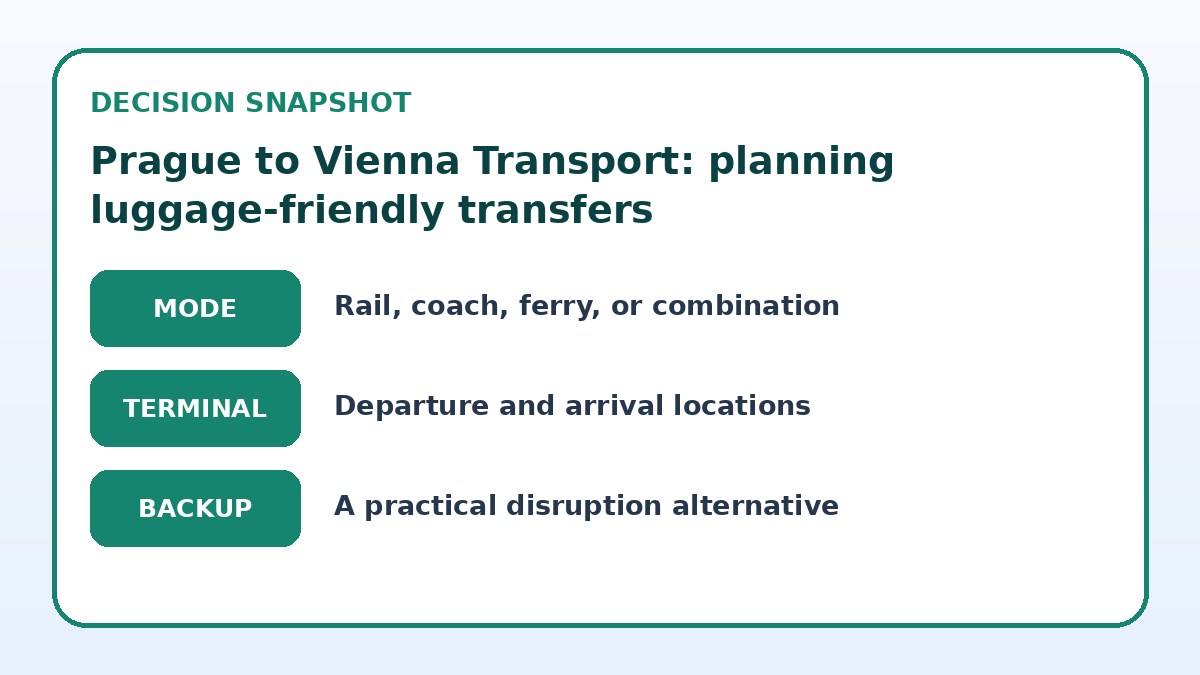
When comparing options, treat each transfer as a separate logistic task: how far from train platform to taxi rank, whether elevators reach the platforms, whether you must cross streets or climb stairs, and whether staff can help with lifting. Also consider connections—if a service appears faster on the schedule but requires a terminal-to-terminal shuttle or a long walk, that apparent advantage disappears for someone with big bags. List the station names and terminal points and draw the transfer path on a map before booking so you can judge the real effort involved.
Station facilities and accessibility to check before you book
Before you buy a ticket, confirm whether stations at both ends advertise step-free access, elevators, or ramps from street level to platforms and exits. Many major European stations provide these features but layouts differ: some platforms are reached only by stairs or narrow underpasses. Look for mention of luggage trolleys, staffed assistance desks, and short-term luggage storage or left-luggage lockers if you want to split your journey and leave bags for a few hours. If a provider’s booking page doesn’t list accessibility details or luggage services, call or email the station operator or the carrier to confirm.
Also verify the layout between the platform and onward transport options. Is the taxi rank adjacent to the station building, or does it require crossing a busy road or walking a long distance? Are regional buses departing from an attached concourse or a separate stop requiring a transfer shuttle? For travelers with heavy luggage the best options reduce the number of lift, lift-ride, or curbside transfers, and avoid narrow passages, timed shuttles, or services that demand re-checking bags.
| Approach | Best for | Tradeoff to check |
|---|---|---|
| Direct intercity train | Minimizing repeated luggage handling and avoiding intermediate transfers | May run less frequently and offer fewer time choices than connecting services |
| Connecting train or train + local transfer | Flexibility in departure times and potential cost savings | Requires extra transfers and more physical effort with heavy luggage |
| Long-distance coach | Straightforward single-vehicle journey when departure and arrival points are convenient | Depot layouts can require long walks or steps; luggage rules vary by operator |
| Private door-to-door transfer | Maximizing comfort and reducing station logistics with heavy or awkward items | Higher cost and depends on driver ability to load/unload and on local pickup rules |
Deciding between direct and connecting services
Direct trains that run Prague–Vienna without changing give the simplest luggage handling: you load once, disembark once, and walk fewer transfer segments. However, direct options may run less frequently or at less convenient times. Connecting services may offer more departure times or lower base fares but add the hassle of moving bags across platforms or between stations. When evaluating connections, factor in minimum connection times and the distance and difficulty of the transfer rather than just the timetable gap. Short layovers can be risky if you must carry heavy items between platforms or across station concourses.
If you must take a connection, plan it to minimize physical transfers—choose platforms on the same level when possible and allow extra time for luggage movement. If the connection requires switching transport types (for example, train to coach or train to airport express), verify luggage allowances and whether you’ll need to collect bags and re-check them. If assistance is important, look for services that list porter or assistance options, and confirm their availability on your travel date. Always check the provider’s final booking page for exact transfer procedures and luggage rules.
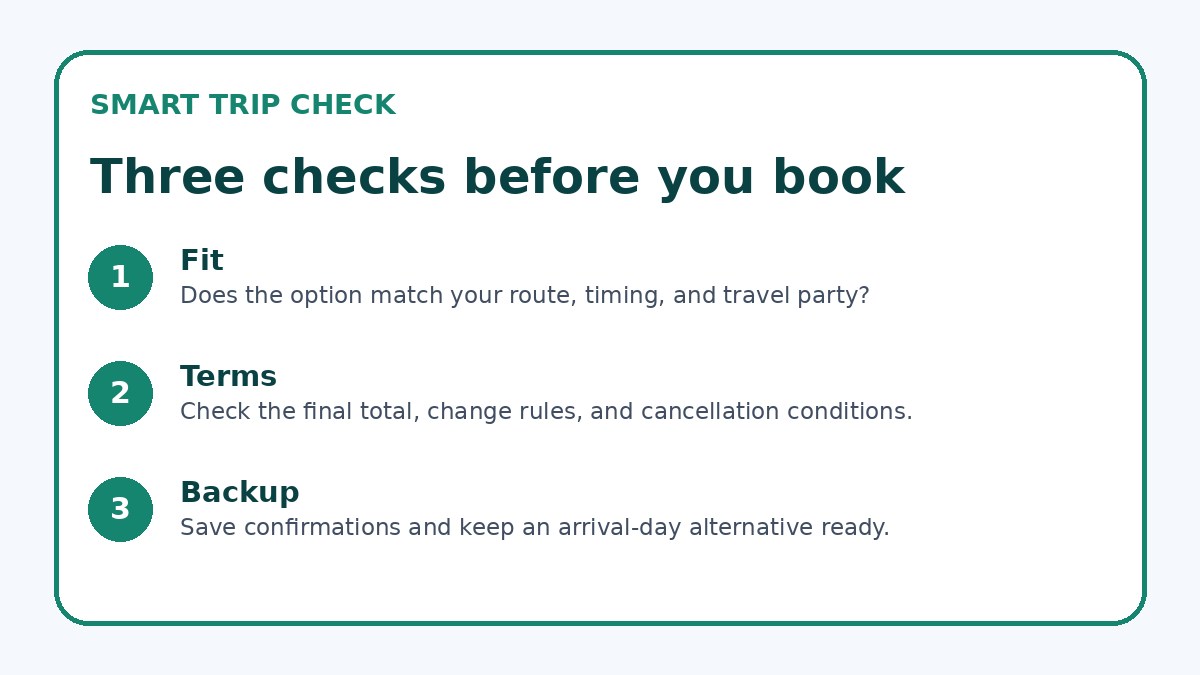
Before you book
- Confirm the exact station or terminal names for departure and arrival and map the walking route between platforms, exits, taxi ranks, and connecting services.
- Check elevator, ramp, and step-free access availability for the stations involved and ask the provider to confirm assistance options if you need help lifting.
- Verify luggage allowances and any special handling rules on the carrier’s final booking page, including limits on oversized or sporting equipment.
- If using a connection, allow extra buffer time for transferring with heavy bags and prefer connections that keep you on the same station level.
- Reserve seat locations or vehicle boarding positions that shorten the walk to the main exit when the option is available during booking.
- If hiring a private transfer, confirm the meeting point, who handles loading, and whether the vehicle has sufficient cargo space for your items.
Practical packing and day-of-travel tactics for smooth transfers
Pack to make transfers easier: use wheeled suitcases and secure straps, and distribute heavy items so you can lift without awkward twisting. Consider a smaller day bag for essentials so you don’t have to open large suitcases mid-transfer. Use visible tags and a brightly colored strap or ribbon to spot your luggage quickly on platforms or at coach bays. If you rely on a trolley or buggy at the station, arrive a little earlier to find one and be prepared to fold small wheels or retract handles as needed in narrow lifts or under stairways.
On travel day, reserve seats or services that reduce walking—for instance, choose a coach stop that unloads close to the entrance or a train car nearest the station exit if the booking system allows seat selection. If you expect difficulty lifting your luggage, arrange for on-site assistance where available and confirm meeting points with any private driver in advance. Keep digital and printed copies of booking confirmations and station maps so staff can quickly identify your transfer. Finally, build buffer time into your schedule and prioritize options that minimize the number of times you have to lift, carry, or move heavy bags.
Frequently asked questions
Is it better to take a train or coach from Prague to Vienna with lots of luggage?
For many travelers with heavy or bulky bags, trains can be easier because they typically stop at central stations with platform-level access, room for luggage in vestibules, and elevators or ramps in major stations. Coaches can work well if they serve a depot adjacent to the city center, but some coach stops require long walks or stairs between drop-off points and public transport. The best choice depends on the exact station locations, frequency of direct services, and whether you value fewer transfers over potentially lower cost. Verify station layouts and luggage rules on the carrier's booking page before you commit.
What should I ask the operator when I need help with luggage during transfers?
Ask whether step-free assistance or a porter service is available at both origin and destination, how to request it, and whether there is a charge. Confirm the location where staff will meet you (platform, concourse, or ticket hall), and whether the assistance covers loading into taxis or transfer vehicles. If you plan to connect between providers, ask how transfers are handled and whether you will need to collect and re-check your bags. Always get these details from the carrier or station operator’s official contact or final booking page.
Can I combine a train with a private transfer to make Prague–Vienna easier with extra luggage?
Yes—many travelers combine a train for the main leg with a private car for the first or final mile to avoid complex station transfers. This approach reduces the number of times you move heavy items and gives you door-to-door convenience at one end. When booking this mixed plan, align arrival times closely, allow buffer time for delays, and confirm pickup logistics with the driver, including who loads luggage and exact meeting points. Check both the train operator’s transfer details and the private transfer provider’s vehicle capacity on their booking pages.
Final planning note
Planning Prague to Vienna transport with extra luggage is less about choosing the absolute fastest mode and more about minimizing the number of times you lift, move, or re-check your items. Start by mapping station and terminal layouts, confirm accessibility and assistance options on provider booking pages, and decide whether a direct train, a mixed connection, or a private transfer best fits your tolerance for physical effort and schedule flexibility. Use the checklist to verify the critical points before you pay, and consider a door-to-door option if reduced handling and guaranteed assistance are top priorities. If you want to compare current schedules and options, sites like Trip.com can show availability, but always confirm transfer and luggage specifics on the carrier or station operator’s official page.
Continue planning
Check current options and final conditions
Use the provider page to confirm live availability, the final total, cancellation terms, and every condition that matters to your trip.
This evergreen planning guide was created with AI-assisted drafting and a structured quality review. It does not display live prices, schedules, availability, visa guidance, or provider rankings. Verify current details before booking. Some links are affiliate links; we may earn a commission at no additional cost to you.