
If you’re a business traveler juggling meetings and approvals, price alerts can save time and money — but they can also trigger impulse bookings that clash with corporate policy or travel plans. Use price alerts as a disciplined sourcing tool: set alerts for specific routes, hotels near your meeting locations, and the travel windows you actually can take. Combine alerts with firm booking rules — approval-required classes, nonrefundable limits, and a maximum acceptable layover — so alerts produce options, not panic. Treat each alert as a data point: record when it appears, how it compares to your historical baseline and corporate travel policy, then decide during a scheduled booking review. This approach keeps you responsive to good opportunities while protecting you and your employer from last-minute mistakes.
See current options before you compare the details
Availability and final conditions change. Open Trip.com now or keep reading for the practical comparison.
Set precise alerts that match your business itinerary
The value of price alerts for Paris travel deals comes from precision. Rather than monitoring every flight into Charles de Gaulle or every hotel in the city, limit alerts to the airports, times, and hotel neighborhoods tied to your meeting locations. If you expect morning meetings near La Défense, prioritize airports and train connections that minimize morning commutes. Define a travel window that reflects the earliest and latest dates you can realistically travel — not a broad month — and select fare classes or refundable options your company allows. Doing this reduces irrelevant notifications and keeps the alert list actionable.
Use filters on alert tools to exclude redeye-only itineraries, long overnight layovers, or hotel rooms that lack breakfast or flexible cancellation if those are deal-breakers. If you need a specific train connection between Gare du Nord and a meeting site, include train-plus-flight options in your search criteria rather than only flights. When provider-specific facts appear on an alert, always verify the final price, baggage rules, and corporate-relevant policies on the provider’s booking page before confirming. Trip.com can be used to cross-check availability, but always validate details with the actual airline, hotel, or rail operator.
Avoid impulse booking with structured decision rules
Impulse booking happens when an alert arrives at an inconvenient time and you don't have a prepared decision process. Set three simple rules to govern any alert-triggered purchase: an approval requirement (who signs off), a maximum acceptable itinerary complexity (number of connections, transfer times), and a refund/exchange threshold. For example, require a line manager or travel manager’s email approval if a fare is nonrefundable or outside preferred carriers. If you travel on a corporate card, ensure the cardholder’s policies are followed before booking. These rules give you a repeatable checklist to follow in seconds, removing emotional pressure.
Schedule short, frequent review windows during your workday where you clear alerts and decide which to escalate. During those reviews, compare the alert against your baseline — usual fares for that route, typical hotel rates for the neighborhood, and your company’s per diem. If an alert meets your rules, proceed; if not, archive it and reset the alert parameters if needed. Keep a log of alert dates and actions taken so you can justify decisions to procurement or finance later and refine your alert settings over time.
| Approach | Best for | Tradeoff to check |
|---|---|---|
| Immediate booking on first alert | Travelers with fixed, urgent schedules and preapproved low flexibility | Higher risk of policy exceptions, limited comparison, and potential for change fees |
| Scheduled review with approval step | Business travelers balancing cost control and schedule certainty | May miss transient, very short-lived price drops but reduces impulse errors |
| Hold alerts and wait for repeated drops | Travelers with flexible dates and budget-focused policies | Possible loss of favorable seats or rooms; requires careful monitoring |
| Automated rules-based purchasing | Frequent travelers with clear corporate thresholds and auto-approval processes | Requires upfront setup and may still buy fares that need manual review |
Ready to check the option that fits your plan?
Use your exact dates and traveler details so the provider page can show the current total and conditions.
Compare direct and connecting options realistically
For Paris travel deals, direct flights save time but sometimes cost more; connecting flights can be cheaper but increase risk of missed meetings. Don’t assume the alert tool distinguishes properly between single-connection itineraries and tight transfer times — always expand the fare details and check layover durations and minimum connection times. Compare total door-to-door travel time and likely ground transit between airport and meeting venue. If you rely on morning meetings, prioritize arrival times that give a buffer for delays rather than the absolute lowest fare.
If you consider a connecting itinerary, calculate risk by looking at the carrier’s on-time statistics for the specific segment and the minimum connection time at the connecting airport. For rail or multi-modal options into central Paris, compare station-to-meeting transit rather than airport arrival time alone. When comparing options, note which tickets are sold as protected connections and which are separate legs; verify transfer protections on the booking page before purchasing. Document which tradeoffs you accepted — lower price, longer travel, or less flexible ticket — so you can defend the choice to your travel manager.
Before you book
- Limit alerts to the airports, dates, and hotel neighborhoods tied to your confirmed meetings.
- Specify acceptable fare classes and cancellation flexibility before activating any alert.
- Require at least one written approval (email or chat) for bookings that deviate from policy.
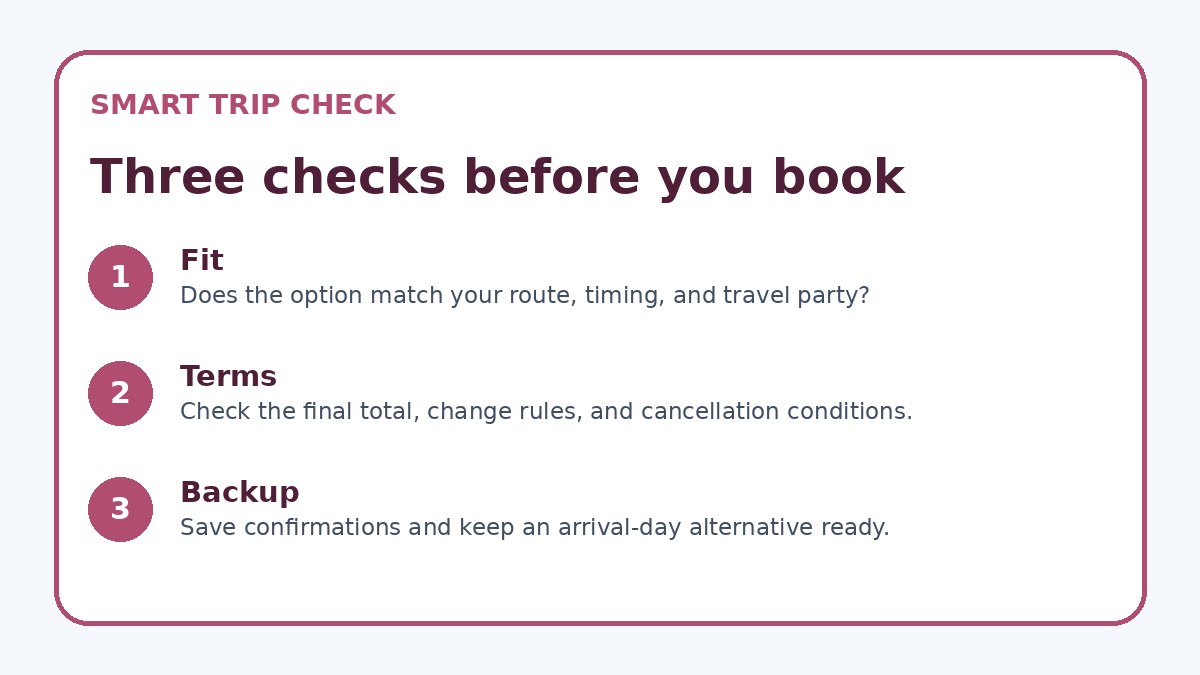
- Check provider booking pages for baggage, change fees, and refund rules before confirming.
- Log alert triggers and final booking decisions in a single spreadsheet or travel app.
- Schedule a post-trip review to refine alert parameters based on real booking outcomes.
Manage corporate policy, receipts, and post-booking contingencies
Even the best alerts can produce an inconvenient fare type: a nonrefundable rate, no seat selection, or unusual baggage rules. Before finalizing a booking triggered by an alert, confirm that the fare or room adheres to corporate expense policy and that the payment method is approved. If your company requires advance approval for certain classes, include that step in your cooling-off period. Save screenshots of the alert and the booking confirmation for reconciliation; these records clarify whether an alert offered a better-than-normal deal or an outlier that required exception handling.
Plan contingencies for schedule changes: identify alternative flights, the hotel’s cancellation terms on the provider page, and whether you can change the booking without excessive penalties. If you book a cheaper, more restrictive fare to save cost, document the potential change fees so a supervisor can evaluate true savings versus risk. After travel, review the alert’s outcome: did the price drop further, or were you correct to book? Use that review to refine alert thresholds and cooling-off rules for your next Paris trip.
Frequently asked questions
How many price alerts should I run for a single Paris trip?
Run only as many alerts as you can meaningfully review. For a typical business trip to Paris, three to five focused alerts usually suffice: outbound flight, return flight, primary hotel, alternate hotel, and an optional rail connection. Too many alerts create noise and increase the temptation to book impulsively. Keep each alert tightly scoped by date window, airport or station, and preferred fare class. If multiple stakeholders need input, consolidate alerts into one shared list so decisions are made during scheduled reviews rather than ad hoc.
What should I include in the cooling-off step after an alert triggers?
A cooling-off step should be brief but decisive: confirm itinerary details, check corporate policy compliance, and obtain required approvals. That means verifying that the travel times match meeting constraints, the fare class is allowed, and the payment method adheres to company rules. Include a time limit for the cooling-off period (for example, two business hours or until the next scheduled review) to prevent indefinite delays. Capture screenshots of the alert and the booking page during the cooling-off phase so finance can reconcile any questions later.
Can I rely on third-party alert services for corporate travel?
Third-party alert services are useful for detecting price movement, but treat them as screening tools rather than definitive booking sources. When an alert looks promising, always confirm availability, fare rules, and corporate compliance on the provider’s actual booking page before purchase. If your company uses a corporate travel management platform, sync alerts or forward promising options to that platform for approval. Mentioning Trip.com as a comparison option can help you cross-check availability, but never rely on a third-party alert alone to meet company policy or risk assessments.
Final planning note
Price alerts are powerful for business travelers heading to Paris when used with disciplined rules. They turn market movement into choices rather than pressure-inducing signals. The key is precision: narrow alert criteria to what you can actually use, require a short approval or cooling-off period, and always verify booking details and fare rules on the provider’s final page before completing a purchase. Track alert outcomes and revisit settings after each trip — that feedback loop reduces impulse mistakes and helps you confidently capture meaningful Paris travel deals while staying within corporate policies.
Continue planning
Check current options and final conditions
Use the provider page to confirm live availability, the final total, cancellation terms, and every condition that matters to your trip.
This evergreen planning guide was created with AI-assisted drafting and a structured quality review. It does not display live prices, schedules, availability, visa guidance, or provider rankings. Verify current details before booking. Some links are affiliate links; we may earn a commission at no additional cost to you.