If your priority is getting to Istanbul from Paris with minimal schedule risk and acceptable cost, decide first whether you need a flexible ticket or a lower-fare, restricted fare. For business travelers the tradeoff is clear: flexible fares and refundable options reduce disruption from last-minute meetings and itinerary changes but usually come with higher base fares and sometimes stricter baggage or connection rules. Start by specifying your exact travel dates, preferred times, and whether you require lounge access or extra baggage before you search. Then check each candidate fare’s change and cancellation conditions on the airline or travel provider’s final booking page — look for change fee amounts, how fare differences are handled, refund processing times, and whether waivers apply for irregular operations. This practical sequence — define, search, verify — will help you pick a Paris to Istanbul flight that balances schedule certainty and cost.
See live routes for your exact travel day
Compare direct and connecting choices with the same baggage and traveler details.
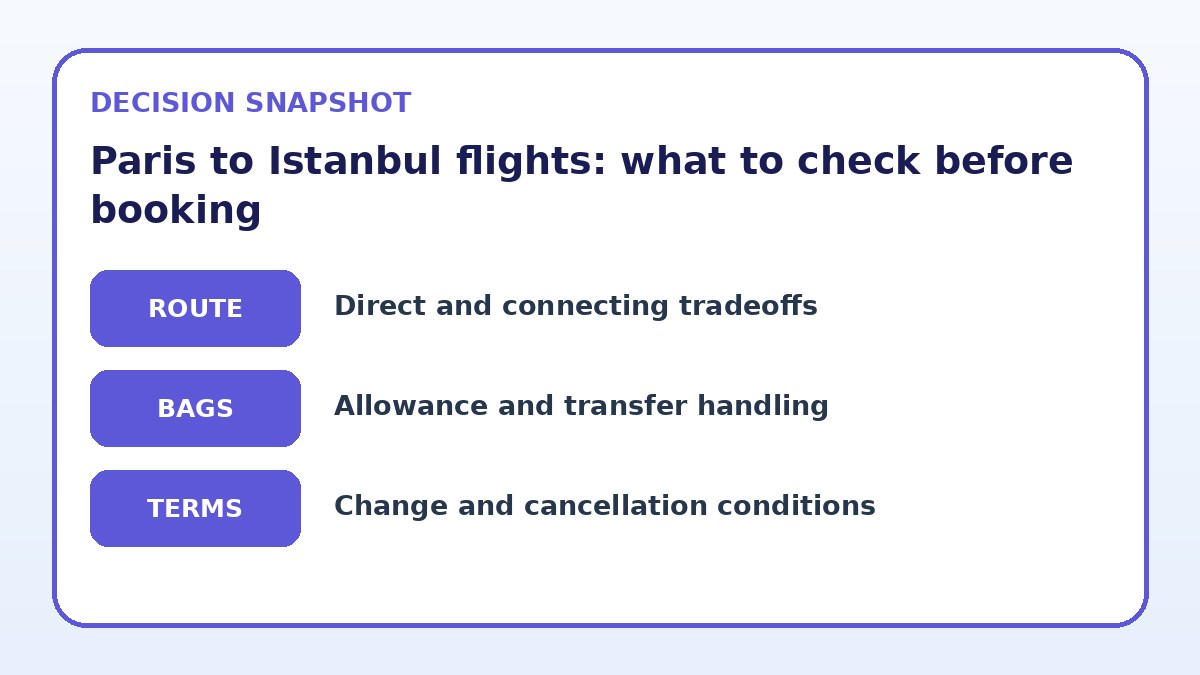
Routing and connection risk
When planning Paris to Istanbul travel, routing is a primary operational variable. Direct flights (if available on your dates) reduce the number of handoffs and the chance you’ll need to rebook after a missed connection. If your schedule includes a tight same-airline connection or an airport change in Paris or Istanbul, add buffer time to avoid stress. For itineraries with different carriers on each leg, check whether the tickets are issued on a single itinerary or as separate reservations; separate tickets typically offer less protection for missed connections and make rebooking a negotiation with each carrier.
To compare options, list candidate routings and note connection airports, minimum connection times the airline advertises, and whether both legs are on one ticket. If you often travel with carry-on only, short connections become more viable; if you need checked baggage, prefer longer layovers or single-ticket itineraries that protect bag transfer. When reviewing a specific flight, verify the provider’s published conditions about missed connections and whether they will re-accommodate you on the next flight at no extra fare. Make these checks before purchasing so you won’t be surprised if a late meeting forces a rushed transfer.
Baggage and how it affects changes
Checked baggage rules can materially affect your choice between a lower fare and a flexible fare. Many low-cost and basic economy-style fares exclude checked bags or limit weight and size — if you need to add baggage later, suppliers often charge higher change or add-on fees. For business travelers who travel with equipment, suits, or client materials, that incremental cost can eclipse any upfront savings from a cheaper fare. Also check whether the fare class allows name changes, itinerary reissues, or automatic re-routing during irregular operations; some fare buckets restrict baggage allowances after changes.
When evaluating fare options, find the baggage allowance tied to the exact fare code on the booking page and test a hypothetical change to see whether baggage rules remain intact or must be re-purchased. If you frequently change flights, choose a fare that keeps baggage included after rebooking; this simplifies logistics and avoids paying double. Remember to confirm carry-on allowances too, because a denied carry-on on a full flight can force an unplanned checked bag fee and cause missed connections or delays during tight schedules.
Compare flight-selection strategies
| Flight strategy | Best for | Risk to check |
|---|---|---|
| Buy a flexible business fare | Travelers who need free or low-cost rebooking and predictable refunds | Higher upfront fare but lower disruption cost and simpler reissue process |
| Purchase a lower restricted fare | Travelers with fixed schedules and minimal chance of change | Lower price but likely change fees, limited refunds, and stricter baggage rules |
| Book a single-ticket connection on one carrier | Travelers wanting protection for checked bags and missed connections | May be costlier than mixed-carrier itineraries but offers re-accommodation support |
| Use separate tickets to reduce cost | Flexible travelers willing to accept connection risk for savings | Cheaper fares but no through-check of bags or guaranteed protection for missed connections |
Recheck the complete itinerary
Confirm airports, connection handling, baggage, and change conditions before deciding.
Schedule fit and business priorities
Business travelers typically prioritize arrival and departure windows, the ability to recover from delays, and options for same-day return or last-minute changes. Start by listing your must-have time windows and the latest acceptable arrival or departure times. Then search for flights that match those windows, but don’t stop at fares — read the fine print about free rebooking windows, change fees, and how soon you can rebook without penalty. Some flexible fares allow unlimited free changes within a set period or permit free same-day reissues, which can be worth the premium if your schedule often shifts.
Also evaluate schedule redundancy: identify one or two alternate flights on the same day that you could move to if plans change. When booking, check the airline’s policy for exchanging to earlier or later flights on short notice; an airline that permits same-day switches for a modest fee or for free can be more valuable than a refundable ticket that is hard to reissue quickly. Finally, confirm on the provider’s booking page whether your corporate fare code, status, or travel agency booking rules alter these change privileges.
Flight details to verify
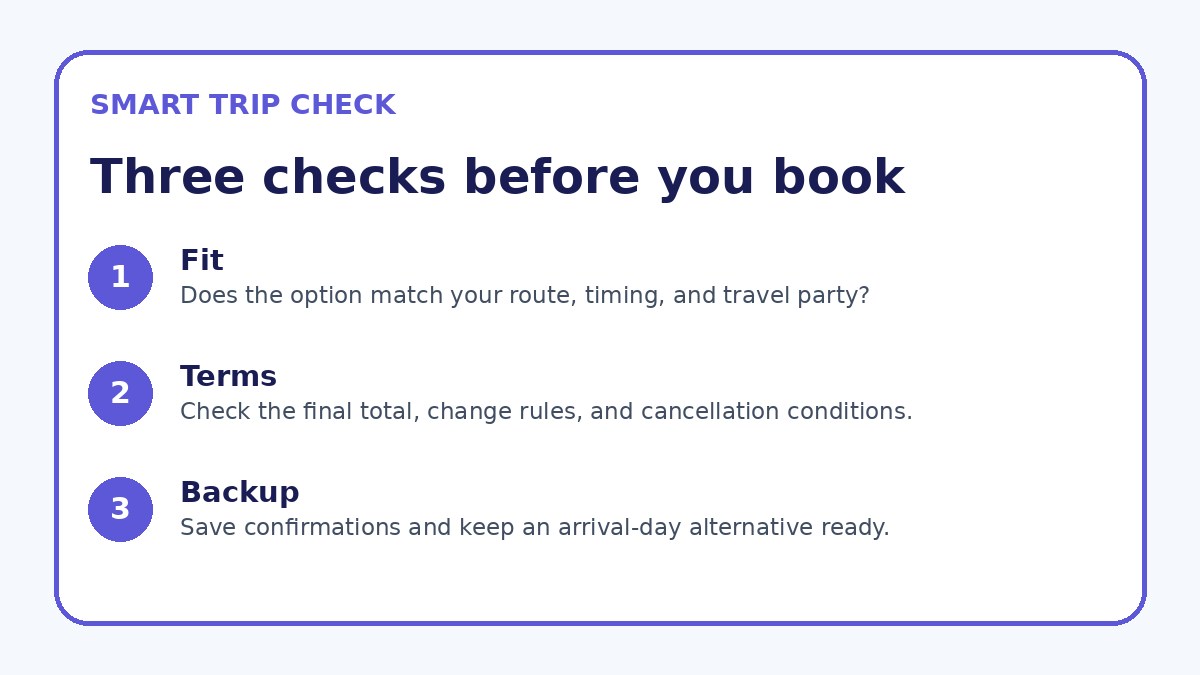
- Write down your exact travel dates, preferred departure/arrival windows, and full traveler names as on passports before searching fares.
- On the airline or reseller checkout page, confirm the fare’s change fee, whether fare differences apply, and the method and timeline for refunds.
- Check whether the itinerary is on a single ticket or multiple reservations and how that affects baggage transfer and missed-connection protection.
- Test adding or removing checked baggage in the booking flow to see how that affects price and whether baggage remains included if you later change the ticket.
- Identify at least one alternate same-day flight and note the carrier’s same-day change or standby policy for quick re-accommodation.
- Save screenshots or PDFs of the fare rules and booking confirmations so dispute resolution is supported if the provider later changes terms.
Fare conditions: change fees, refunds, and waivers
The core of your decision is understanding the fare’s change and cancellation language. Some business fares include free changes or minimal fees; others impose a fixed fee plus any fare difference. Look for three specifics: whether the fare allows voluntary changes, whether the charge is a flat fee or only fare difference, and how refunds are processed (credit voucher, back to card, or travel credit). Also check blackout dates, reissue deadlines, and whether fees vary by how close to departure you change the booking.
In addition to the published rules, search for operational waivers: airlines occasionally waive change fees for irregular operations, public health events, or certain fare classes. However, waivers are event-driven and can’t be assumed at booking. Always verify on the airline or reseller’s final checkout page how changes will be handled for your exact itinerary and passenger type. If using a corporate travel program or GDS, confirm whether your company policy overlays different change or refund treatments than the public fare.
Flight Guide questions travelers ask
Should I always pick a flexible fare for Paris to Istanbul business trips?
Not always. Flexible fares reduce the financial and logistical impact of schedule changes, which many business travelers value. However, if your meeting times are fixed and unlikely to move, a lower restricted fare can be significantly cheaper. Before deciding, estimate the probable cost of a change (fee plus any fare difference and baggage recharges) and compare that with the incremental cost of a flexible fare. Also factor in non-monetary costs: stress, missed meetings, and lost productivity. The right choice balances the probability of changes with the premium for flexibility.
How do I verify change and cancellation terms are actually applied at booking?
Always read the fare conditions presented during the final checkout on the airline’s or reseller’s site — not just search results. Look for explicit language about change fees, whether changes require a fee plus fare difference, and the refund mechanism. If using a travel agent or corporate booking tool, confirm the same details in writing. Keep copies of the fare rules and booking confirmation. When in doubt, call the airline’s customer service and request that an agent confirm the change and refund policy for your exact fare code and itinerary.
If I book a connecting itinerary on different tickets, what should I watch for?
Separate tickets mean each carrier treats its leg independently. That typically means no through-checking of baggage and no obligation for the second carrier to hold the flight if the first is delayed. To manage this risk, build generous connection buffers, buy travel insurance that covers missed connections on separate tickets, and consider carrying critical items in your cabin baggage. If time-critical, prefer a single-ticket itinerary or a flight with a proven same-airline connection to reduce the risk and simplify re-accommodation when schedules shift.
Final decision note
Choosing Paris to Istanbul flights for business travel is about managing tradeoffs: pay more for flexibility and lower disruption risk, or accept restrictions to save upfront. Start by documenting exact dates, times, and baggage needs, then compare routings and fare rules side-by-side. Prioritize single-ticket itineraries when you need protection for bags and connections; choose flexible fare classes if your meetings regularly shift. Always verify change fees, refund mechanics, and baggage treatment on the provider’s final booking page before you click purchase. If you want a quick market check, Trip.com can be an optional place to compare current availability and conditions, but confirm rules with the airline or corporate travel desk for final authority.
Continue planning
Check current options and final conditions
Use the provider page to confirm live availability, the final total, cancellation terms, and every condition that matters to your trip.
This evergreen planning guide was created with AI-assisted drafting and a structured quality review. It does not display live prices, schedules, availability, visa guidance, or provider rankings. Verify current details before booking. Some links are affiliate links; we may earn a commission at no additional cost to you.