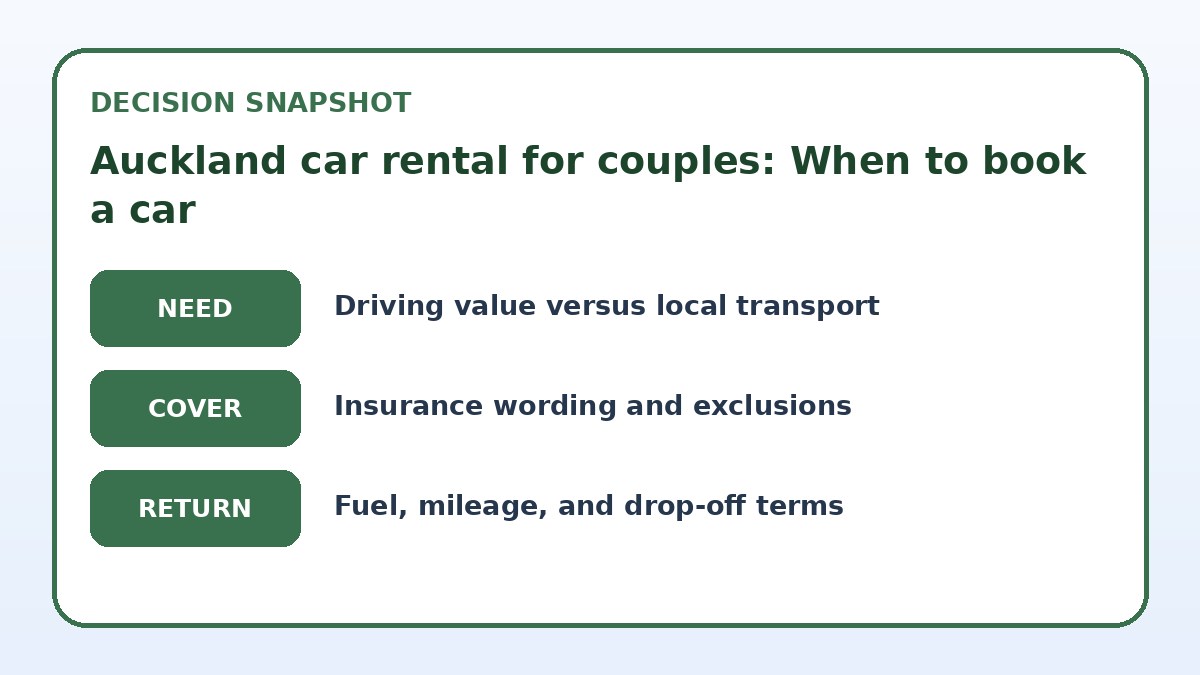
Short answer: in Auckland, a rental car helps couples most when your itinerary includes scenic day trips, flexible departure times, or stays outside the isthmus; it’s often unnecessary for a compact central stay. Before you book, think about what you want to do day by day — museums and waterfront dining inside the central city are easy without a car, while Waiheke Island, the West Coast beaches, and Greater Auckland vineyards reward having wheels. This guide gives a practical decision frame: evaluate route value, insurance and coverage wording, pickup and return friction at ports and the airport, and a reliable non-driving fallback. Use these criteria to match mobility to your couple’s priorities — comfort, spontaneity, or a lower-stress urban stay — and check provider pages for the precise insurance terms, fuel policies, and airport fees before you commit.
Route value: which couple itineraries need a car
Start by mapping your actual days rather than broad desires. If most nights are in central Auckland and your plans center on dining, museums, galleries, and the Viaduct Basin, a car adds little and complicates parking. Conversely, if you want early-morning drives to Piha or Karekare beaches, a Waiheke wine day with luggage, or a multi-day loop that includes the Coromandel or Matakana Country, a car is genuinely valuable. For couples who prefer discovering small coastal towns or sunset lookout points on their own schedule, the freedom to arrive and leave when you want can be a major relationship-saver compared with timed buses.
Next, estimate the frequency and length of drives. Short, infrequent trips can be handled with day tours or rideshares; long distances or multiple stops generally justify renting. Also consider timing: if you’re planning dawn or late-night outings where public transit is scarce, a car makes those windows accessible. Finally, factor in how much you enjoy driving together — for some couples the drive is part of the date; for others it’s a stressor. Let your likely daily mileage and desired spontaneity decide whether a car will add value or friction.
Decide whether driving earns its place
| Mobility strategy | Best for | Cost or friction to check |
|---|---|---|
| Full rental for entire stay | Couples planning multiple multi-hour day trips and remote excursions | Higher parking and airport fees, more logistics for pickup/return and insurance checks |
| City pickup only as needed | Couples based centrally who want occasional self-drive days without airport hassles | May still incur city parking costs and limited vehicle choice at short notice |
| No car: public transit + rideshares + ferries | Couples focusing on central attractions, dining, and waterfront walks | Less flexibility for remote beaches or countryside wineries and longer door-to-door times |
| Hybrid: day tours and single-day rental | Couples wanting one or two scenic drives but not a full-stay vehicle | Requires planning to fit rentals and tours into your schedule and can be pricier per day |
Check live rental choices only after the route test
Use the exact driver, dates, pickup point, and return plan to compare current conditions.
Insurance and coverage: what to check before you book
Insurance language can be confusing but is decisive. When comparing options, verify the collision damage waiver (CDW) or insurance excess level, whether third-party liability is included, and what specific exclusions apply — for example, driving on unpaved roads, crossing ferry terminals, or adding an additional named driver. Don’t rely on marketing phrases; look on the supplier’s final booking page for the excess amount and the process to buy extra protection. If you plan to use a credit card benefit or a third-party insurer, confirm whether supplier insurance is mandatory and whether the card’s coverage requires you to decline the rental company’s CDW.
Also check what happens in case of glass, tire, or underbody damage and whether roadside assistance is included or sold separately. For couples sharing a vehicle, check additional driver fees and whether both names can be on the contract without voiding coverage. If you expect to cross regional boundaries or use ferries, confirm that coverage remains valid on those routes. Get written confirmations where possible and screenshot or save the rental terms because coverage wording and exclusions are the pieces you’ll need if something goes wrong.
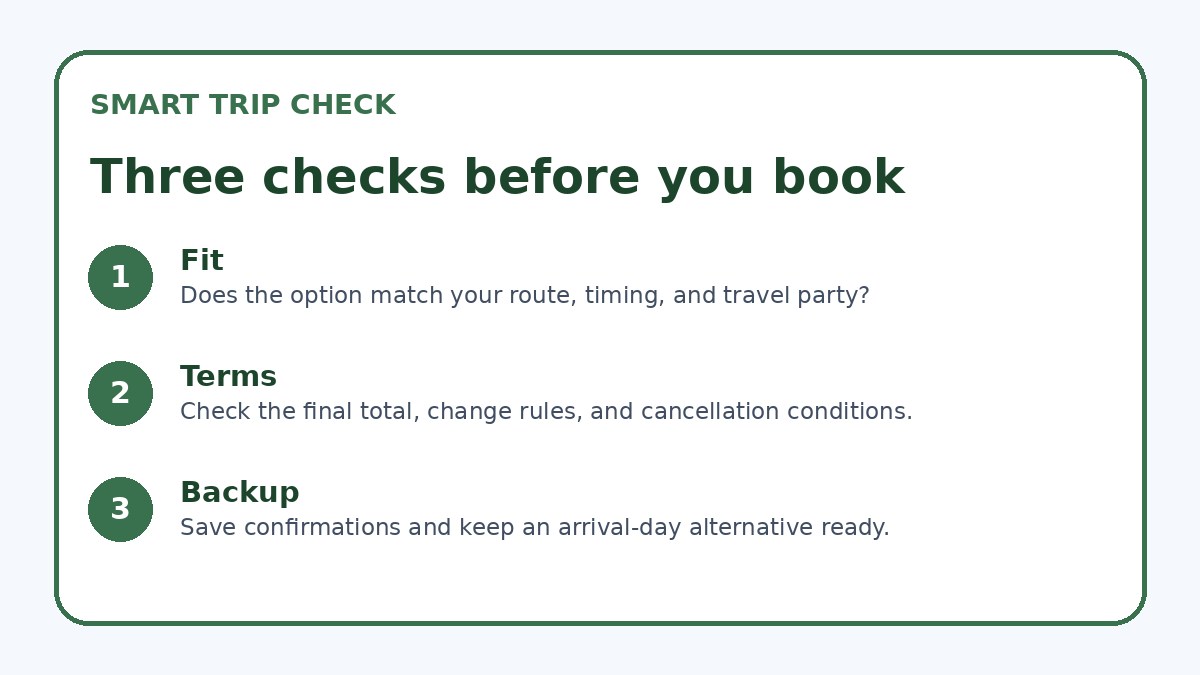
Compare the full rental conditions
Confirm insurance wording, exclusions, deposit, fuel, mileage, and return terms on the final page.
Pickup and return friction: time, location, and added fees
Logistics matter more than you think. Airport pickups can be fast but sometimes come with premium surcharges, shuttle wait times, or longer queues; city-center pickups avoid some fees but may require navigation through busy streets. For couples with tight arrival windows, determine the total time from plane to car — include immigration, luggage, shuttle or walk to the depot, and paperwork — and decide whether that timeline fits your energy levels after travel. On return days, remember end-of-day traffic and depot hours; late returns can trigger penalties, and some city locations close earlier than airport counters.
Think about parking where you’ll stay. Many central hotels charge for on-site parking or have limited spaces; on-street parking rules and meters can be enforced strictly. If you’ll be lodging in a narrow heritage neighbourhood or on an urban hill, consider whether your chosen rental car fits local streets. Also compare fuel policies and refuelling options near your final drop-off. These practical points often tip the decision: a car that feels like a logistical headache can negate any sightseeing advantage it would otherwise provide.
Car rental terms to verify
- List planned day trips with estimated start and end times to see if public transport schedules meet your needs.
- Check the rental supplier’s final booking page for exact insurance excess amounts and specific coverage exclusions.
- Compare pickup and return locations and total door-to-door time from your arrival gate or hotel to the depot.
- Confirm hotel parking availability, nightly fees, and any restrictions that affect vehicle size or overnight stays.
- If relying on a credit card or third-party insurance, obtain the issuer’s written coverage terms for rental cars and present them when booking.
- If skipping a car, save ferry timetables and prebook at least one rideshare/transfer for evening returns or early departures.
Non-driving fallback: solid alternatives if you skip the car
A good fallback plan makes skipping a rental a stress-free choice. Auckland’s central area has a compact layout with a good mix of buses, ferries, and frequent rideshares; ferries make Waiheke straightforward without a car for day trips if you avoid heavy luggage. Day tours and small-group excursions cover many popular regional routes — beaches, wine regions, and cultural sites — so you can access highlights without dealing with parking, navigation, or mainland-to-island driving. Pre-booked transfers for longer day trips provide a predictable, romantic option where both partners can relax.
Plan for last-mile flexibility with a combination of public transit, rideshare credits, and one or two guided tours. Look up ferry timetables and evening transport options for return journeys, and pre-save addresses and pickup spots in your ride app. If you want one or two self-driven outings without hiring a car for the whole trip, consider a short-term hire or car-share for specific days; otherwise, rely on taxi or shuttle services to bridge the gaps. That layered approach keeps you mobile while avoiding daily rental hassles.
Car Rental & Road Trip questions travelers ask
Can couples rely on public transport and ferries for a one-week Auckland trip?
Yes — for a week focused on central Auckland activities, dining, city beaches, and a single island day trip, public transit and ferries are practical. Ferries connect the city center with places like Devonport and Waiheke, and buses serve inner suburbs and most tourist sites. Rideshares fill gaps for late-night returns or awkward transfers. However, if your week includes several distant coastal or rural destinations, check timetables and transfer times: multiple long transfers can eat into sightseeing and may make a rental more convenient.
What specific insurance wording should couples look for on the rental page?
Look for the collision damage waiver (CDW) and the excess or deductible amount — that’s your financial exposure after a claim. Check whether third-party liability is included and whether certain damages (glass, tires, undercarriage) are excluded or require separate cover. Find terms about additional drivers, overseas licences, and ferry or off-road restrictions. The final booking page should state excess figures, the process to purchase extra protection, and any documentation needed for claims. Save screenshots or PDFs of those terms in case you need them later.
How do couples balance parking hassles against the freedom of a rental?
Weigh parking costs, availability, and your tolerance for tight urban driving. Central hotels often charge for parking or have limited spaces, and on-street parking can be timed and monitored. If your days include many short visits and evening dining in busy neighborhoods, parking will add time and expense. Conversely, if you value the ability to leave early or chase sunsets at less-visited lookouts, a car’s flexibility may be worth the extra effort. Try estimating likely parking fees for your hotels and top attractions to see if the freedom is worth the hassle.
Final decision note
For couples, the decision to rent a car in Auckland comes down to your daily rhythm and priorities. If you want flexible coastal drives, multi-stop winery days, or trips to beaches and remote lookouts, a rental pays off despite the parking and insurance checks. If your itinerary stays mostly inside the central city, or you prefer to avoid driving and parking stress, public transit, ferries, rideshares, and targeted day tours offer a comfortable and romantic alternative. Use the checklist items to confirm insurance wording, pickup logistics, and hotel parking before booking. For current vehicle availability and specific supplier terms, you can compare options on Trip.com or review provider booking pages directly to verify fees and coverage wording.
Continue planning
Check current options and final conditions
Use the provider page to confirm live availability, the final total, cancellation terms, and every condition that matters to your trip.
This evergreen planning guide was created with AI-assisted drafting and a structured quality review. It does not display live prices, schedules, availability, visa guidance, or provider rankings. Verify current details before booking. Some links are affiliate links; we may earn a commission at no additional cost to you.