For first-time visitors traveling Tokyo to Sapporo, the practical airport choice often matters more than shaving a little off the fare. Narita and Haneda both serve international and domestic connections from Tokyo, but they differ in ground transport time, how many domestic flights depart, and typical transfer complexity. This guide gives a direct recommendation up front, then walks through the key tradeoffs—routing, baggage and connection risk, schedule fit, and fare conditions—so you can compare options sensibly. Before you search for live flights, have exact travel dates, total trip length, and traveler details (number of passengers, checked bags, and onward plans in Hokkaido) ready. That information lets you filter for direct versus connecting options and read each carrier’s final booking page to confirm baggage rules and change or cancellation policies.
See live routes for your exact travel day
Compare direct and connecting choices with the same baggage and traveler details.
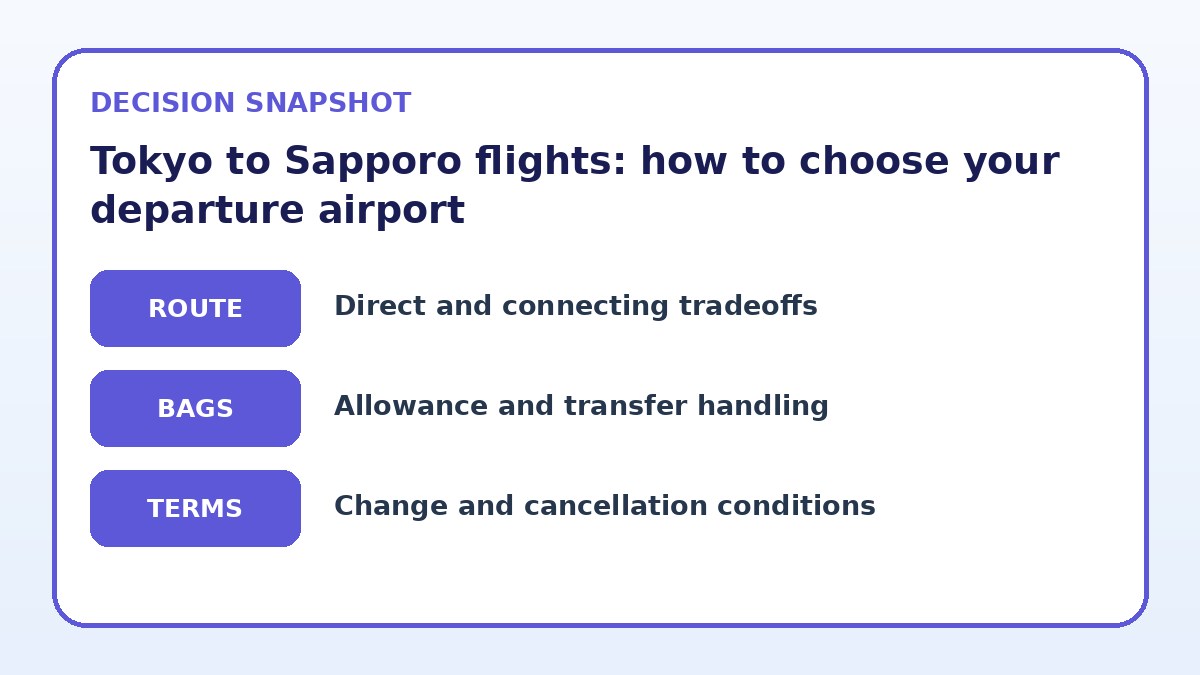
Routing: direct versus connecting and which airport makes transfers simpler
Most travelers benefit from a direct flight when going Tokyo to Sapporo because it eliminates the hassle of a domestic connection and reduces the chance of delays cascading into missed onward plans. When a nonstop is available from either Haneda or Narita, compare total door-to-door time rather than only airborne minutes. That means adding time to get to each Tokyo airport from where you will be staying so you can see the real advantage in travel time.
If a nonstop isn’t available for your dates, choose the airport that offers the shortest, most reliable transfer path between arrival and departure terminals. For travelers arriving internationally into Tokyo and connecting domestic, plan extra time for immigration, baggage re-check, and transit between terminals or between Narita and Haneda if switching airports. Before booking, map the full connection itinerary and verify whether a single ticket covers both segments or if separate tickets require reclaiming baggage and rechecking—this affects both time and risk.
Baggage and connection risk: how to reduce lost luggage and missed flights
Checked baggage policies and connection protections vary by carrier and ticket type; these are critical because extra transfers increase the chance of mistakes. If you book a single itinerary on one carrier or through an alliance, most airlines will transfer checked bags and provide missed-connection support if the first flight is delayed. If you buy separate tickets or switch from an international arrival at one airport to a domestic departure at another, you will likely need to collect and recheck bags yourself—this raises both time requirements and risk.
To reduce baggage-related stress, choose flights labeled nonstop or same-ticket connections where possible, and review each airline’s baggage allowance and transfer policy on the booking confirmation page. If your plan forces an airport-to-airport transfer across Tokyo, leave substantial buffer time between flights and consider traveling with carry-on only when feasible. For expensive or time-sensitive items, carry them in the cabin, and photograph luggage tags and important documents before checking bags to help in case of delay.
Compare flight-selection strategies
| Flight strategy | Best for | Risk to check |
|---|---|---|
| Depart Haneda on a nonstop flight | Travelers who value short transfers and minimizing ground time to downtown Tokyo | Often higher demand and potentially higher fare flexibility costs; verify carrier baggage and seat rules |
| Depart Narita on a nonstop or direct flight | Visitors with international arrivals at Narita or those prioritizing specific international-to-domestic pairings | Longer transfer to central Tokyo and potentially more ground transport uncertainty between terminals |
| Book a single-ticket connection (international to domestic) | Travelers who want checked-bag protection and missed-connection cover under one itinerary | May constrain carrier choices and limit low-fare options when flexibility is needed |
| Buy separate tickets and transfer airports manually | Price-sensitive travelers who can absorb extra transfer risk and have long layover buffers | You must reclaim and recheck baggage, and there’s no guarantee the first delay won’t cause a missed second flight |
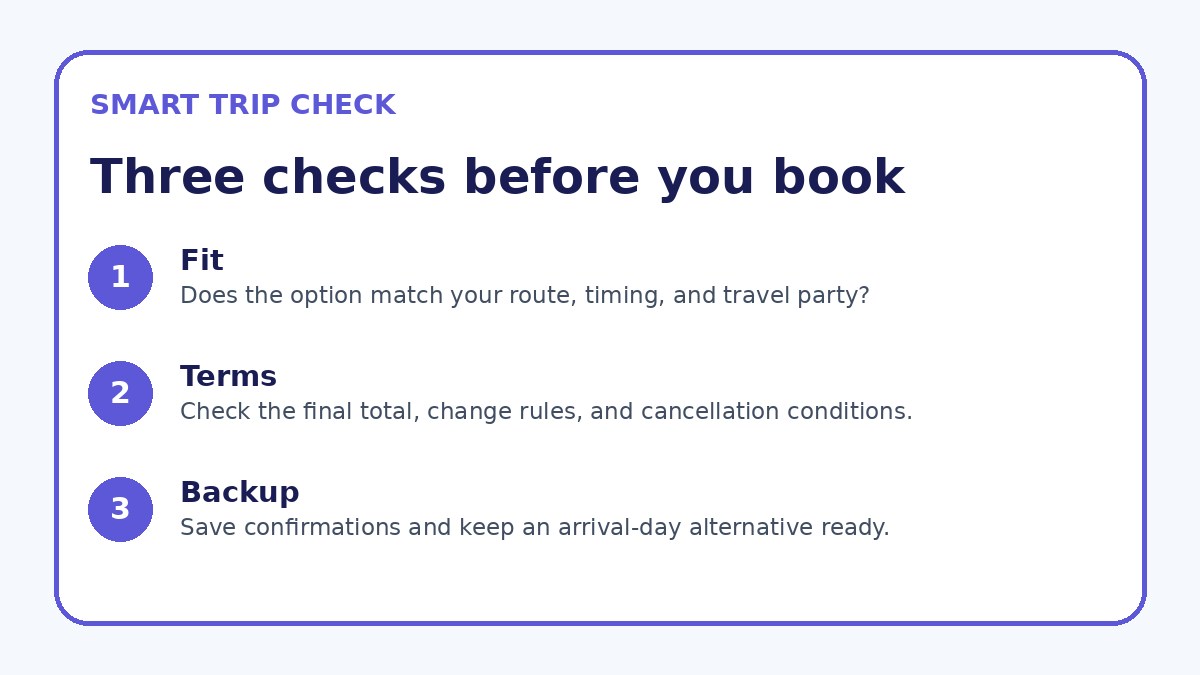
Recheck the complete itinerary
Confirm airports, connection handling, baggage, and change conditions before deciding.
Schedule fit: matching departure times to your itinerary and local logistics
Schedule fit is about more than flight times; think about how those times mesh with hotel check-out, transit options, and arrival time in Sapporo. Early-morning departures may save you daytime in Hokkaido, but they require an overnight near the departure airport or very early ground transport. Late arrivals in Sapporo may complicate transfers to remote accommodations or winter road conditions, so check local transport schedules for your arrival window.
When comparing options, use your exact dates and preferred arrival window in Sapporo to filter flights. Consider whether you will need ground transport from New Chitose Airport and how arrival time affects that connection. Also factor in recovery time after international travel if you begin your domestic leg the same day—sometimes staying an extra night in Tokyo and taking a mid-day domestic flight makes for a smoother start to your Hokkaido stay.
Flight details to verify
- Confirm exact travel dates, number of passengers, and each traveler’s passport name spelling before searching fares.
- Decide whether you need a nonstop or will accept a connection, then filter search results accordingly.
- Check the carrier’s baggage allowance, change and cancellation policies on the airline’s official booking page.
- Estimate door-to-door travel time to each Tokyo airport from your lodging and add buffer time for check-in.
- If transferring between Narita and Haneda, plan ground transport options and leave at least several hours margin.
- Photograph passports and luggage tags, and note emergency contact numbers for your airline before departure.
Fare conditions and booking details: what to verify on the final booking page
Fares can look similar across booking sites, but the conditions attached often differ—refundable vs nonrefundable, change fees, seat selection, and baggage included. Before you click purchase, check the carrier’s official booking page for the exact fare rules: what happens if you need to change dates, who pays change fees, whether a prepaid baggage allowance is included, and whether seat assignments are guaranteed. That final verification prevents unpleasant surprises when plans shift.
If you use an online travel agency to compare options, remember to click through to the airline’s confirmation page to confirm boarding pass issuance rules and check-in deadlines. For connections that cross airports or involve separate tickets, verify whether the airline will accept responsibility for missed connections. Trip.com can be used as one place to compare live availability and conditions, but always confirm critical fare and baggage details on the carrier’s official booking page before finalizing.
Flight Guide questions travelers ask
Which Tokyo airport is usually faster to reach from central Tokyo before a flight to Sapporo?
Haneda is generally closer to central Tokyo neighborhoods and tends to offer shorter surface travel time for many central hotels, which can reduce stress before a domestic flight to Sapporo. However, actual door-to-door times vary by your exact location and time of day—check transit options (train, airport express, taxi) from your hotel and factor in rush-hour traffic or service schedules. Always calculate total travel time to the airport and compare against your flight’s recommended check-in time to decide which airport is faster for you.
If I have an international arrival then a domestic flight to Sapporo, should I buy one ticket or two separate tickets?
Buying a single-ticket itinerary that covers both the international arrival and the domestic leg usually reduces baggage and missed-connection risk because the carrier will typically transfer bags and offer rebooking support for delays. Separate tickets can be cheaper but require reclaiming and rechecking luggage and provide no formal protection if an earlier flight is delayed. Before deciding, check whether the airlines involved allow interline transfers and compare the time between flights to ensure you can complete immigration and transfers comfortably.
How should I compare fares when both Haneda and Narita offer flights to Sapporo on my dates?
Compare total travel time, not just the headline fare: include ground transit to each airport, potential overnight needs, and any separate ticket transfer time. On each option, check the detailed fare conditions—bag allowance, change fees, and seat selection policies—on the airline’s final booking page, since these can change the effective cost and flexibility. Use a comparison site to surface options quickly, and then confirm the chosen flight’s full terms directly with the carrier before purchasing.
Final decision note
For first-time visitors deciding between Tokyo airports for flights to Sapporo, start with your priorities: minimizing transfers and door-to-door time usually points to Haneda, while Narita can make sense when it matches your international arrival or specific routing. Focus on direct flights when possible, and if a connection is unavoidable, prefer single-ticket itineraries to protect checked baggage and reduce missed-connection risk. Always prepare exact dates, passenger details, and baggage needs before comparing live options, and verify fare rules and baggage policy on the carrier’s booking page. That final confirmation ensures the practical choice you make aligns with your schedule and travel tolerance.
Continue planning
Check current options and final conditions
Use the provider page to confirm live availability, the final total, cancellation terms, and every condition that matters to your trip.
This evergreen planning guide was created with AI-assisted drafting and a structured quality review. It does not display live prices, schedules, availability, visa guidance, or provider rankings. Verify current details before booking. Some links are affiliate links; we may earn a commission at no additional cost to you.