Pick the neighbourhood first: for a first visit to Paris, choose a hotel in a district that saves time on the routes you’ll actually use. That means matching your likely daily loop — museum-heavy, business meetings, day trips from Gare du Nord or Charles de Gaulle, or leisurely walks along the Seine — to nearby Métro, RER, bus, or rail links. A well-located hotel lowers friction every morning and evening: fewer transfers, simpler luggage moves, and clearer arrival plans from the airport or stations. Use this guide to decide which area fits your itinerary, what to check on a hotel page (transport connections, luggage access, and flexible cancellation), and how room layout and party size change the neighbourhood choice. By the end you’ll be ready to shortlist one or two districts and open live inventories to compare specific hotels with confidence.

Check live stays in the areas that fit
Use your dates and party size to compare current rooms after you narrow the neighborhood fit.
Which neighbourhood fits your daily route
Start by mapping a typical day in Paris: list the three places you’ll visit most often and a likely evening plan. If museums and central sights dominate, the 1st–7th arrondissements keep many highlights walkable. If you plan excursions to Versailles, Charles de Gaulle, or Disneyland, favour locations with direct RER or close access to major train stations (Gare du Nord, Gare de Lyon). Business travellers should look for proximity to the relevant meeting district or to a major station to minimise taxi or Métro time between appointments.
Don’t chase the geographic centre. A neighbourhood slightly outside the centre but on a direct Métro or RER line can shave minutes off each trip and reduce transfers — especially with luggage or children. Note also that 'close to a station' on a hotel page can mean a short walk, a stair-climb, or a surface-level crossing; if mobility or sleeping near noise is a concern, verify walking route details, distance in minutes, and whether the route involves many steps or busy streets.
Choose an area-selection strategy
| Area approach | Best for | Tradeoff to check |
|---|---|---|
| Centre (1st–7th arr.) | First-time sightseers who want walking access to many landmarks | Higher tourist density and potentially smaller rooms; may be noisier and less space for families |
| Near a major station (Gare du Nord, Gare de Lyon) | Arrivals/departures or day trips by train and visitors prioritising rail links | More traffic and service shops; neighbourhoods can be less picturesque for strolling |
| Residential arrondissements (e.g., 11th, 15th) | Families, longer stays, and travellers wanting quieter nights with local cafés | Slightly longer rides to some attractions; room layouts often better but farther from tourist hotspots |
| Near RER lines (A, B) | Airport transfers or day trips to Versailles and Disneyland | Fewer central walking options; depends on how direct your RER connections are to desired sites |
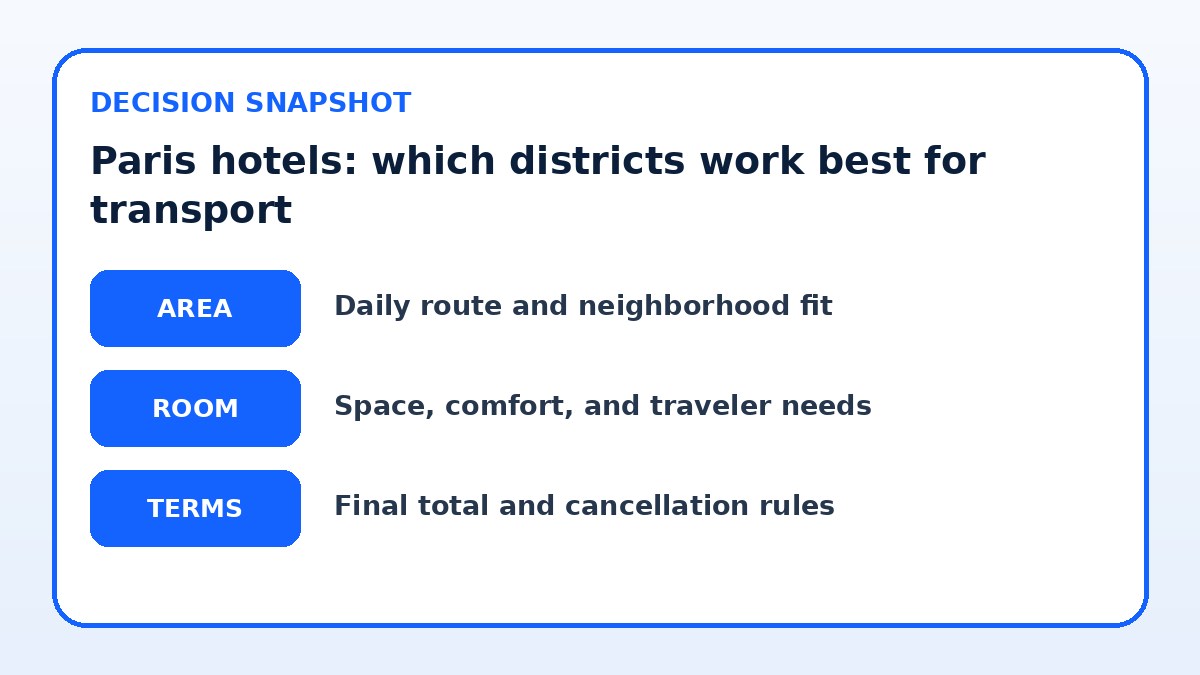
Daily-route friction: transfers, stairs, and luggage
Transfers are the real time tax in Paris. Four short transfers add up to a large chunk of a day when repeating them. Prefer areas served by a Métro line that offers one-seat rides to most of your destinations, or that interchanges conveniently with the RER lines you’ll use. If you expect to arrive or depart by train with large suitcases, choose a hotel that describes step-free access, nearby taxis, or a short walk to the station entrance; otherwise you may face heavy stairs and crowded corridors at peak hours.
Look beyond station proximity: check whether the walking route from station to hotel includes long staircases, narrow sidewalks, or busy junctions. If mobility, a stroller, or substantial luggage is involved, filter hotels for lift access or ground-floor rooms and confirm details on the provider’s booking page. For late-night arrivals, consider how lively or quiet the street is — a hotel two minutes further but on a calmer street can improve sleep quality without costing travel time during the day.
Now compare like with like
Keep the same dates, guests, room needs, and cancellation preferences while you compare the final choices.
Room and party needs: how the neighbourhood affects choices
Your party size changes what the neighbourhood should offer. Solo travellers and couples can prioritise central, compact rooms inside touristy arrondissements. Families and groups often need larger rooms, connecting rooms, or suites, which tend to be more common in quieter residential arrondissements or near major stations where buildings are larger. If you need a kitchenette or more living space, search within well-connected but less touristy areas where hotels and aparthotels offer these layouts more often.
Also account for arrival and departure logistics: if you’ll be carrying baby gear or bicycles, a hotel with an elevator and luggage storage near a major station reduces stress. For those who value nightlife or dining options steps away, central areas deliver convenience but bring more noise; residential neighbourhoods near a Métro line give quieter nights and family-friendly cafés while keeping you well connected to the city’s highlights.

Hotel booking check before payment
- List your top three daytime destinations and mark the nearest Métro/RER stations for each to identify overlaps.
- On each hotel page confirm the nearest station name, usual walking route, and whether stairs are required between station and hotel.
- Filter hotels by room type and elevator access if you have luggage, a stroller, or mobility needs and request floor level before booking.
- Check the hotel’s stated luggage storage and late-check-in policies on the booking page or by messaging the property directly.
- Compare two shortlist neighbourhoods against evening noise levels and nearby dining options by reading recent guest comments for specifics.
- Choose a booking condition (refundable or flexible change) that fits your final flight or train schedule uncertainty and verify it on the provider’s page.
Final booking terms and what you must verify
Before you hit reserve, confirm the specifics that affect your travel day. Verify the exact station name and exit closest to the hotel, confirm whether there are stairs on the walking route, check if the hotel provides late check-in, luggage storage, or porter service, and read the cancellation or modification terms for your booking conditions. When provider-specific operational details could change, always verify them on the final booking page; Trip.com is one place to compare current availability and provider policies if you wish.
Ask targeted questions in the booking interface or to the hotel directly: ‘Is there a lift to the booked room?’, ‘How many metres/minutes from the nearest station and does the route include stairs?’, and ‘Where do taxis typically pick up guests nearby?’. These concrete checks reduce surprises on arrival. Finally, pick the booking option that gives flexibility you need for your trip — refundable or free-modification options can be worth a small premium for first-time visitors still finalising plans.
Hotel Guide questions travelers ask
How do I choose the best Paris Métro line for my hotel?
Pick a line that gives you direct or single-transfer access to at least two of your most visited places. Lines that cross the city east–west or north–south typically reduce the need to change trains. When comparing hotels, map each property to the line and check interchange stations for quick transfers. Also consider RER lines if you need airport access or regional destinations; verify station names and exits on the hotel’s page, and check whether the route involves many stairs or long corridors, especially with luggage.
Is it worth staying farther from the centre if the hotel is near a Métro stop?
Yes, staying a bit farther can save time and money if the hotel sits on a fast, direct Métro line with convenient interchanges. You often get larger rooms, quieter streets, and local dining choices while still reaching central sights quickly. The tradeoff is a longer walk for some attractions; weigh that against daily comfort, sleep quality, and room size. Verify exact walking time and station access on the booking page before deciding.
What should families prioritise when booking near transport in Paris?
Families should prioritise elevator access, larger room types or connecting rooms, and hotels whose walking route from the nearest station is stroller-friendly and step-free where possible. Close proximity to a station matters less than ease of the route (stairs, curb cuts, busy roads). Also check whether the hotel offers luggage storage for nap times or late departures and whether nearby streets have family-friendly cafés and parks. Confirm these operational details directly on the booking page or with the property.
Final decision note
First-time visitors to Paris should start with the practical question: which daily routes will you repeat? Use that to pick a neighbourhood served by the Métro or RER lines that minimize transfers and stair hassles, then consider room sizes and elevator access for your party. Verify station names, walking routes, luggage options, and cancellation terms on the hotel’s booking page before committing. With one or two districts shortlisted, open live hotel inventories to compare exact room types, photos, and provider policies—Trip.com is one tool you can use to check current availability—but rely on the property’s information for operational details. This approach keeps your days simpler and your arrivals and departures less stressful.
Continue planning
Check current options and final conditions
Use the provider page to confirm live availability, the final total, cancellation terms, and every condition that matters to your trip.
This evergreen planning guide was created with AI-assisted drafting and a structured quality review. It does not display live prices, schedules, availability, visa guidance, or provider rankings. Verify current details before booking. Some links are affiliate links; we may earn a commission at no additional cost to you.