First hour after touchdown: pick the transfer that gets you from the terminal to your accommodation with the least stress. As a solo traveler in Vienna you’ll weigh luggage, timing and how comfortable you want to be navigating public transport or meeting a driver. Start by asking three quick questions: how much luggage do I have, am I arriving late or likely to face disruption, and where exactly is my accommodation relative to central stations or tram lines? Answering those decides whether a train, bus, taxi, or prebooked private transfer makes the most sense. Below you’ll find the practical recommendation up front, followed by trade-offs and planning checks so you can decide and book while your flight and accommodation details are open.
Check options for your arrival details
Use your flight, luggage, party size, and accommodation address to compare current choices.
Luggage and party size: match capacity to comfort
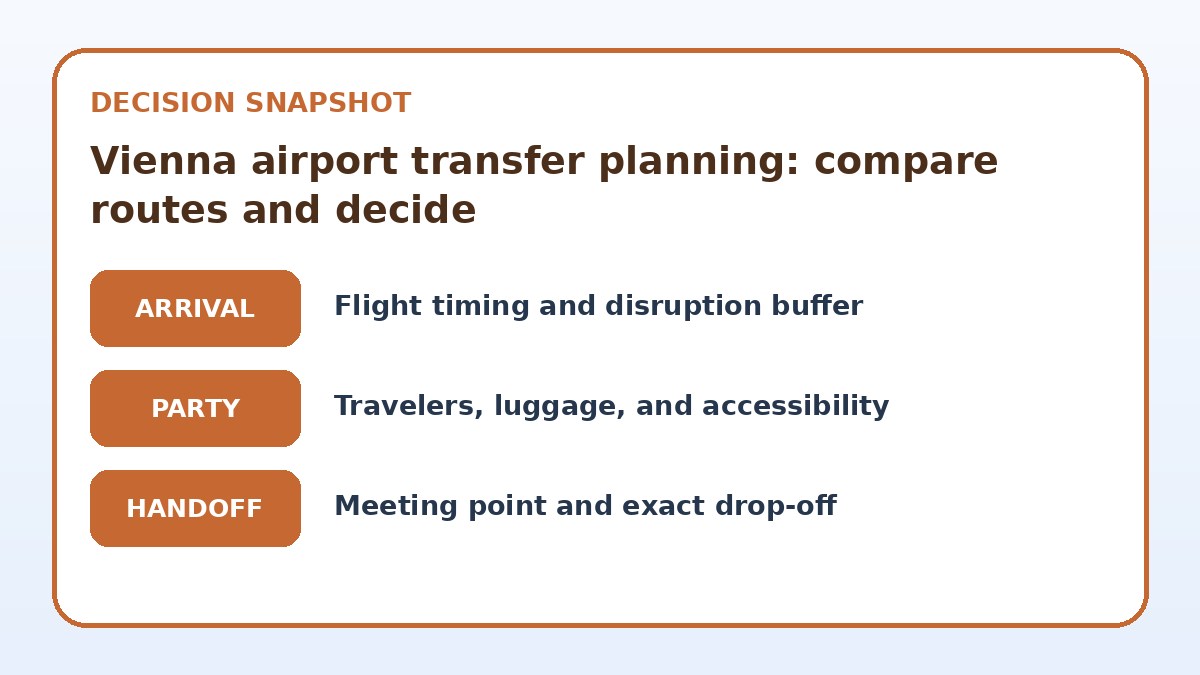
The first practical decision is how much baggage you have and whether you’re carrying awkward items like skis, a bicycle, or musical instruments. Solo travelers with only a backpack or a single carry-on pack light and will find public rail or airport bus options straightforward; these have luggage areas and frequent departures. If you have multiple large suitcases, a child seat, or items that won’t fit into overhead racks, factor that into your choice. A compact taxi might be cramped, while a prebooked private transfer or larger vehicle can be arranged to handle more or bulkier bags.
Party size matters even when you’re traveling alone because it affects cost-per-person and security of your belongings. Solo travelers sometimes split a shared shuttle with strangers to save money, but that can increase stops and handling of luggage. Conversely, choosing a private transfer or taxi keeps your bags with you and simplifies a late arrival. When comparing options, check how many suitcases a vehicle will accept and whether the operator allows oversized items; verify these specifics on the booking page before confirming.
Arrival details to have ready
- Check your flight arrival terminal and save a map screenshot of the terminal exits and taxi ranks to your phone.
- Count your bags and measure awkward items; verify vehicle luggage capacity with the transfer provider before booking.
- If arriving after midnight, confirm late-night service availability and note the nearest taxi rank as a backup.
- Save the driver’s contact number, the operator’s meeting-point instructions, and a screenshot of your booking confirmation.
- Verify drop-off permissions for pedestrian streets or hotel courtyards on the provider’s final booking page.
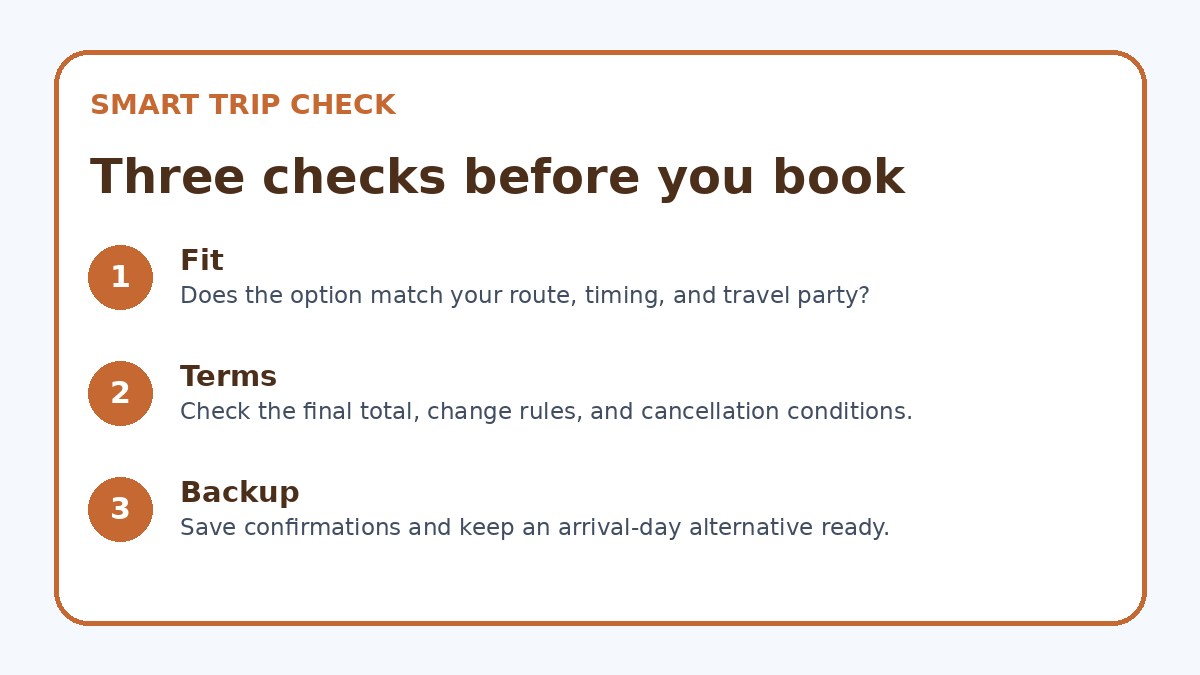
- Compare cancellation and delay policies and ensure the option you pick can handle realistic arrival-time changes.
Late or disrupted arrival: reduce uncertainty
If your flight arrives late or there’s a chance of disruption, prioritize flexibility and clarity in your transfer choice. Trains and scheduled buses have fixed departure times and may run less frequently at night; if missing the timetable would leave you stranded, a taxi or prebooked provider with flight-tracking and flexible pickup policies reduces stress. Look for transfer options that explicitly state they monitor flight times and offer a grace period for delays. If you book a fixed-time pickup, double-check the provider’s change and refund rules so you’re not penalized for an unavoidable delay.
When service disruptions are likely, choose a meeting plan with clear fallback points. For example, agree on a specific terminal exit, a numbered meeting point, or a recognizable landmark in the arrival hall. If using public transport late at night, know the location of the nearest taxi rank and confirm whether your accommodation accepts late check-ins. Keep digital copies of booking confirmations, the driver’s contact number, and terminal maps accessible on your phone so you can act quickly if plans change.
Match the transfer to your arrival
| Arrival approach | Best for | Detail to verify |
|---|---|---|
| City rail connection | Solo travelers with light luggage arriving during daytime who want predictable schedules and low hassle. | Less convenient with heavy or oversized luggage and limited late-night frequency; requires walking or short tram/bus connection to some addresses. |
| Airport bus or shuttle | Budget-focused travelers comfortable with possible extra stops and shared luggage handling. | Can be slower due to multiple pickups/drop-offs and may have limited space for large or many bags. |
| Taxi from the rank | Solo travelers arriving late, with immediate door-to-door needs, or unsure of public transport. | Potentially more expensive than public options and variable vehicle size; check luggage capacity before departure. |
| Prebooked private transfer | Those wanting a guaranteed vehicle size, meet-and-greet service, and minimal navigation on arrival. | Less flexible if arrival times change without flight-tracking policies; confirm pickup terms, waiting times, and contact details. |
Make the meeting plan clear
Check the final pickup instructions, waiting conditions, and exact drop-off coverage.
Meeting points and communication: avoid the common mix-ups
Clarity about where to meet your driver or where to catch the bus saves time and stress. Major airports have several exits, numbered meeting points, and designated taxi ranks; saying you’ll meet 'outside arrivals' is often too vague. Before you land, pin the exact terminal exit, bus stop number, or the taxi rank nearest your baggage claim. If your transfer requires calling the driver, ensure your phone will work abroad or arrange a messaging alternative. Take a screenshot of the operator’s meeting-point instructions in case you lose mobile data.
If there’s any language barrier, prepare a one-line instruction in German with your pickup details and show it to airport staff or a taxi dispatcher. For app-based rides, have your pickup pin and a photo of the vehicle or license plate available to avoid wrong pickups. If you booked through an intermediary, confirm whether the driver will display your name on a sign and what to do if the driver is late or doesn’t appear. These small steps turn potential confusion into a predictable handover.
Drop-off fit at your destination: door, tram stop, or main station?
Think about where you actually want to end up in Vienna: directly at the hotel door, at a nearby tram stop, or on foot in a central square. Central Vienna is compact and well-connected by trams and U-Bahn, so dropping at a main station or major tram stop can be convenient if your accommodation is near public transport. However, if your hotel is on a narrow, pedestrianized street or outside the tram network, a taxi or private transfer that drops you at the door will save carrying luggage over cobblestones or navigating small alleys.
When booking transfers, check whether drivers are permitted to enter pedestrian zones or must use designated drop-off points some distance away. If your accommodation has a formal check-in time or limited staff, coordinate arrival times to avoid long waits outside. Provide the precise street address and, if helpful, instructions like 'back entrance' or 'ring bell at reception.' Verify any building access constraints on the provider’s final booking page so you aren’t surprised on arrival.
Airport Transfer & Local Mobility questions travelers ask
Should I prebook a transfer or wait to decide after I land?
Prebooking gives you certainty about vehicle size and a contact if you prefer a meet-and-greet, which is useful for heavy luggage or night arrivals. Waiting can save money if you’re traveling light and confident in public transport, but it increases the risk of limited options at busy times. If you prebook, check whether the operator tracks flights and what their waiting or delay policy is. If you decide on arrival, locate the official taxi rank or the nearest public-transport stop to avoid unlicensed drivers.
How do I choose between arriving at a main station or a door drop-off?
Pick a main station or tram stop when your accommodation is in central Vienna and you’re comfortable carrying luggage a short distance or using trams. Choose door-to-door if your hotel is outside the tram/U-Bahn network, on a narrow street, or if you value minimal walking with bags. Also consider check-in time: if reception is closed, a door drop may leave you waiting outside. Always confirm whether drivers can enter pedestrian zones or must use a designated nearby drop-off—verify this on the booking page or with your hotel.
What should solo travelers keep ready on their phone to speed an airport pickup?
Keep a screenshot of your booking confirmation, the driver’s phone number, the terminal map, and a short instruction with your pickup point. Save your accommodation address and a brief note of nearby transport stops in case the driver needs directions. If you have limited roaming data, download offline maps and an image of the hotel’s entrance or key landmark. These items let you resolve confusion quickly and make it easier for a driver or airport staff to point you in the right direction.
Final decision note
For solo travelers arriving in Vienna, the practical choice comes down to luggage, arrival time, and how much walking or transfers you want. Rail services offer a straightforward and cost-effective route for light packers arriving during the day, while taxis and private transfers reduce uncertainty for late arrivals or heavy luggage. Airport buses balance cost and convenience but may add stops. Before booking, verify vehicle capacity, meeting-point details, flight-tracking or delay policies, and drop-off permissions on the provider’s final booking page. For current availability and conditions, you can compare options on platforms such as Trip.com, then pick the transfer that matches your comfort and budget.
Continue planning
Check current options and final conditions
Use the provider page to confirm live availability, the final total, cancellation terms, and every condition that matters to your trip.
This evergreen planning guide was created with AI-assisted drafting and a structured quality review. It does not display live prices, schedules, availability, visa guidance, or provider rankings. Verify current details before booking. Some links are affiliate links; we may earn a commission at no additional cost to you.