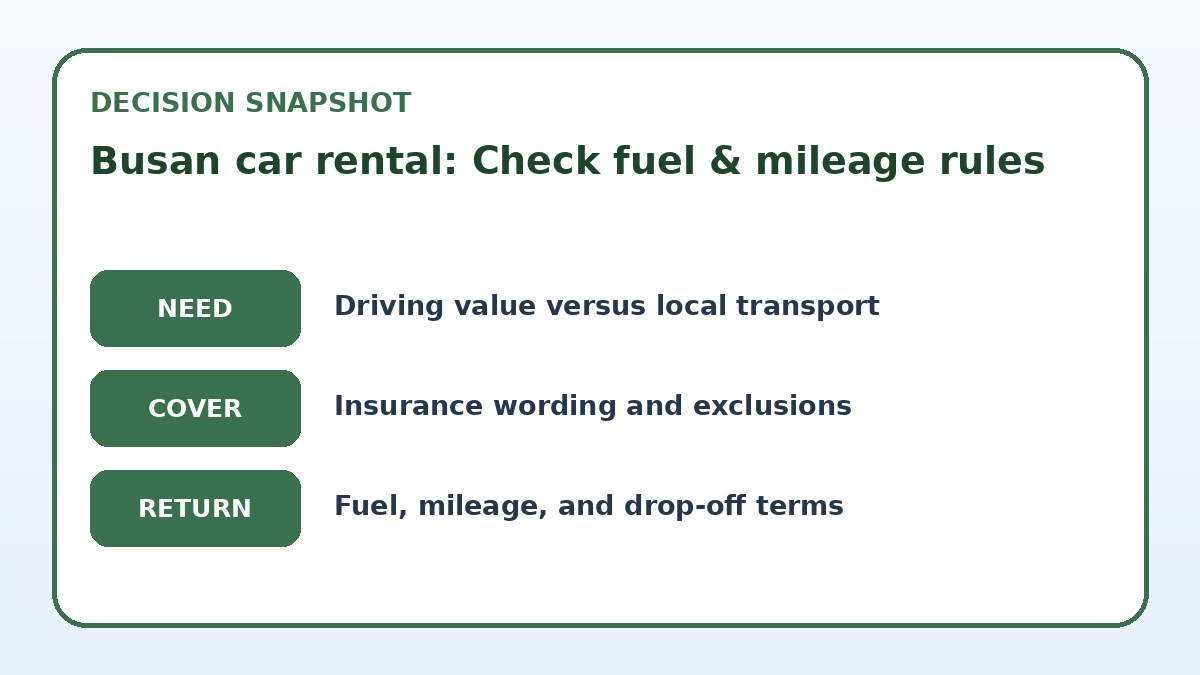
If your family trip to Busan includes beaches, temples and the odd sleepy seaside town, the decision to drive is often as much about hassle as convenience. In plain terms: renting a car can open access to quiet coastal stretches and outlying attractions but it also adds tasks most families dislike—reading fuel and mileage fine print, understanding insurance jargon, and managing pickup and return logistics. Before you click Reserve, check three things on the rental page: the fuel policy (full-to-full vs. prepay), any per-kilometre mileage caps or surcharges, and the precise insurance cover and excess. This article helps families decide whether driving genuinely improves their Busan plans, shows what to verify at booking, compares four mobility approaches, and offers a clear non-driving fallback so you can make a confident choice.
Does driving improve your Busan family itinerary?
Start by matching your day plans to what driving actually unlocks. If your family wants easy access to Haeundae and Nampo-dong with minimal transfer time, public transport and taxis cover those urban routes well. Driving shines when you plan multiple day trips to coastal cliffs, seaside villages, or national parks outside central Busan where public links are infrequent. Consider how many days you’ll depart the city center: a single rental day to reach a scenic bay may justify the effort; a continuous ten-day rental might feel like carrying extra logistics for limited gain.
Also measure the value of flexibility against the cost of attention. With kids in tow, the ability to stop for breaks, carry bulky gear, and leave on your own schedule is a real quality-of-trip improvement. But every rental requires managing pick-up paperwork, monitoring mileage and fuel status, and navigating unfamiliar roads. If your ideal days are tightly scheduled around restaurants, museums or evening markets in the city, the benefit of a car drops—sometimes dramatically—because parking, congestion, and return timing become daily sources of stress rather than convenience.
Decide whether driving earns its place
| Mobility strategy | Best for | Cost or friction to check |
|---|---|---|
| Self-drive rental | Families wanting full schedule control and easy access to remote coastal or rural spots. | Adds pickup/return work, fuel and mileage risk, parking hassles, and responsibility for any damage or fines. |
| Public transport + taxis | Urban-focused families who want to avoid paperwork and parking while keeping flexible short transfers. | Less flexibility for distant day trips and potential time lost on schedules, especially with young children. |
| Private day tours or driver-for-hire | Families who want guided access to out-of-city attractions without driving or managing car policies. | Higher per-day cost than a self-drive but removes fuel/mileage worries and most insurance responsibilities. |
| Hybrid approach (short rental days) | Families who want a car for a couple of specific excursions and public transport otherwise. | Requires precise planning to avoid costly rentals on high-traffic days and can complicate luggage/logistics. |
Check live rental choices only after the route test
Use the exact driver, dates, pickup point, and return plan to compare current conditions.
What to verify about fuel and mileage before booking
Fuel policy is simple in wording but can be costly in consequence. Look for exact phrasing: 'full-to-full' means you should return with the same tank level to avoid the supplier’s refuelling charge; 'prepaid' or 'fuel included' often means you buy a full tank at pickup and won’t be refunded for unused fuel. The rental page should state whether refuelling charges are based on a per-litre rate or a flat penalty—if this detail isn’t visible, request it before booking. For families making short, local trips, a full-to-full model paired with a nearby low-cost station is usually cheaper and more transparent.
Mileage rules govern how far you can drive without extra costs. Some rates include unlimited kilometres, others set a daily or total cap with a per-kilometre surcharge. Confirm whether mileage is counted per calendar day, per 24-hour period, or across the whole rental. If you plan day trips outside the city—especially longer circuits to Jinhae, Geoje, or more distant coastal spots—estimate the round-trip kilometres and compare that to the cap. If mileage overage charges are high, an initially cheaper rate will quickly become more expensive than an unlimited option.
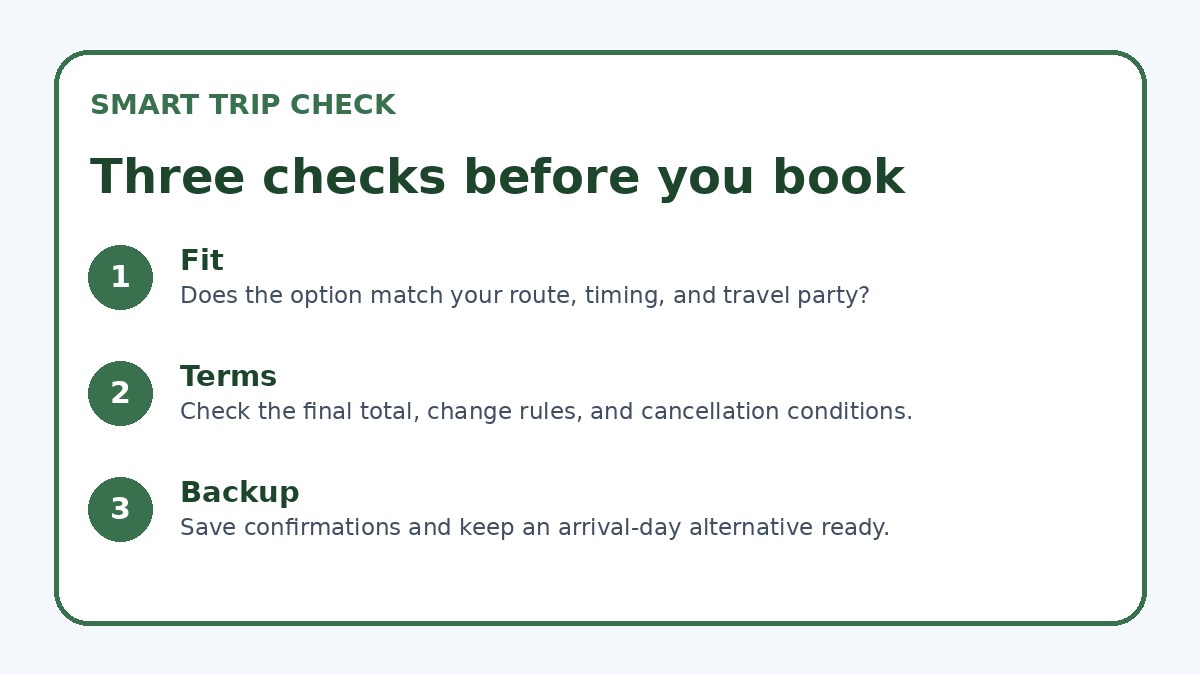
Compare the full rental conditions
Confirm insurance wording, exclusions, deposit, fuel, mileage, and return terms on the final page.
Insurance wording and pickup/return friction to watch
Insurance descriptions often hide important qualifiers. Check the exact coverages listed on the final booking page: liability limits, collision damage waiver (CDW) terms, theft protection, and whether the quoted rate reduces the excess (deductible) or simply shifts liability. Watch for named exclusions like gravel or underbody damage, and confirm whether adding a second or young driver is allowed and at what cost. If the booking page uses broad phrases like 'comprehensive insurance included,' request the detailed policy wording or a PDF quote—this is the document you will need when assessing the potential excess you’d be charged after any damage.
Pickup and return friction is about practical family time. Verify pickup location logistics—airport counters can be busier but may offer longer hours, whereas out-of-town branches sometimes close early or require shuttle transfers. Ask whether the supplier requires a credit card imprint, whether electronic check-in is offered, and whether they accept after-hours returns with documented procedures. Before accepting the vehicle, take timestamped photos of every side, the dashboard mileage, and fuel gauge; save those images and any emailed condition report. These steps reduce disputes and speed up return processing when the children are tired and you want to leave quickly.
Car rental terms to verify
- Read the complete fuel policy on the final booking page and confirm whether it is full-to-full, prepaid, or charge-on-return with a per-litre rate.
- Confirm whether the quoted rate includes unlimited kilometres or a specific cap; calculate your expected kilometres and potential overage costs.
- Download or request the insurance policy wording showing excess, covered damage types, and any named exclusions before you confirm.
- Check pickup and return hours, after-hours return procedures, and whether an airport shuttle or branch transfer is required.
- Verify accepted payment methods and card holds; ensure your credit card limit covers the possible security deposit or excess hold.
- Take and save timestamped photos of the vehicle condition, dashboard mileage, and fuel level at pickup and return to avoid disputes.
A workable non-driving fallback and decision checklist
If the balance of hassle and cost doesn’t favor driving, plan a clear fallback using public options. Busan has dense metro and bus connections within the city plus reliable intercity buses and trains to nearby destinations; taxis and ride-hailing fill shorter gaps, and private day tours can deliver complicated out-of-city itineraries without driving. For families, this often simplifies mornings: no pickup paperwork, no responsibility for damage, and less time spent searching for parking. Budget for occasional taxi legs to save time when moving between stations with luggage or tired kids.
Before finalizing your choice, create a simple decision checklist: total kilometres estimated versus cap, net cost including potential fuel top-ups and mileage overages, exact insurance excess amounts, and pickup/return time windows. If your math shows a strong chance of overage fees, or the insurance excess remains high for a budget rate, choose the non-driving plan or upgrade the rental to a clearer policy. If you still prefer to rent, book with a supplier that lets you review the full policy PDF at checkout; if that isn’t available, call or chat with the supplier and save the transcript or email confirmation.
Car Rental & Road Trip questions travelers ask
How do I estimate if a mileage cap will be a problem for our Busan itinerary?
List every planned day trip and estimate round-trip kilometres for each. Use map tools to get point-to-point distances and add local driving allowance for stops and detours. Sum those kilometres and compare against the rental cap; if the sum approaches or exceeds the cap, ask the provider about per-kilometre overage rates. Because some contracts count mileage per calendar day and others per 24-hour period, confirm their counting method on the booking page. If you expect frequent long drives, an unlimited option often simplifies budgeting even if the base rate looks higher.
What wording should I look for in the insurance section to avoid surprises?
On the final booking page, search for precise terms: 'collision damage waiver (CDW) with specified excess', 'theft protection', and 'third-party liability limits'. Avoid vague phrases like 'insurance included' without amounts. Check for exclusions—things like underbody, windshield, or gravel damage may be excluded or charged separately. Confirm whether adding young or additional drivers is allowed and whether that changes the excess. If the policy is summarized, request the full PDF wording or an emailed policy reference before you complete the booking.
If we choose not to drive, how can we replicate the benefits of a rental in Busan?
Use a layered approach: rely on Busan’s metro and city buses for core urban mobility, and book taxis for door-to-door convenience with luggage or tired children. For day trips that would have required a car, search for private day tours or driver-for-hire services that can drop you at scenic spots without you needing to manage fuel or insurance. Pre-booking train or express bus seats to nearby towns reduces travel uncertainty, and combining transit with targeted taxi segments often gives similar flexibility to a car while avoiding the rental’s administrative burden.
Final decision note
For families, the core question isn’t whether you can rent a car in Busan but whether driving meaningfully improves your days when you account for fuel and mileage rules, insurance details, and pickup/return hassle. If your plan includes multiple long day trips to coastal or rural attractions, a car can be worth the effort—just verify fuel policy, mileage caps, and the excess on the insurance before you book. If most time is inside central Busan, public transport plus taxis or occasional private tours often give comparable convenience with far less administration. Before you commit, make the verification calls or request policy PDFs and keep screenshots of all booking pages; Trip.com can be used as a place to compare real-time availability, but always confirm the exact terms on the supplier’s final booking page.
Continue planning
Check current options and final conditions
Use the provider page to confirm live availability, the final total, cancellation terms, and every condition that matters to your trip.
This evergreen planning guide was created with AI-assisted drafting and a structured quality review. It does not display live prices, schedules, availability, visa guidance, or provider rankings. Verify current details before booking. Some links are affiliate links; we may earn a commission at no additional cost to you.