Practical answer first: for most business travelers who value predictable door-to-door time, minimal transfer friction, and a workspace-friendly environment, the Northeast Corridor high-speed rail option typically wins. It places you in city-center terminals on both ends, avoids airport security queues and long check-in windows, and often offers reliable onboard Wi-Fi and power for work. That said, the right choice depends on where in New York City you start, where in the DC area you must arrive, whether you need strict flexibility for last-minute changes, and how much luggage or equipment you’re carrying. This article walks you through the factors that matter—terminal fit, luggage and transfer friction, timing flexibility, and a disruption backup—so you can choose the most practical intercity option for a business trip between New York City and Washington, DC.

Terminal fit: start and finish where business happens
When choosing between rail, coach, and air, map the exact door-to-door route from your meeting address to the travel terminal. Rail stations are typically downtown, which saves time and taxi or rideshare costs compared with airports that are farther from central business districts. If your morning starts near Manhattan’s Penn Station, for example, a rail departure could mean a short walk or a single-surge-free short ride, whereas flying requires an extra journey to an airport plus security buffers. Consider which DC arrival point gets you nearest your meeting—some suburban airports require long ground transfers that negate any airborne time saved.
For business travelers who must reach a suburban office park or a specific client site, terminal fit can flip the decision. A flight into a close-in regional airport might cut overall ground time despite airport processes, especially when paired with a fast onward shuttle or executive car. Always sketch both legs—origin to terminal and terminal to final destination—and compare realistic transfer times at different times of day. That side-by-side map of door-to-door travel often determines the most practical mode more than advertised ride times alone.
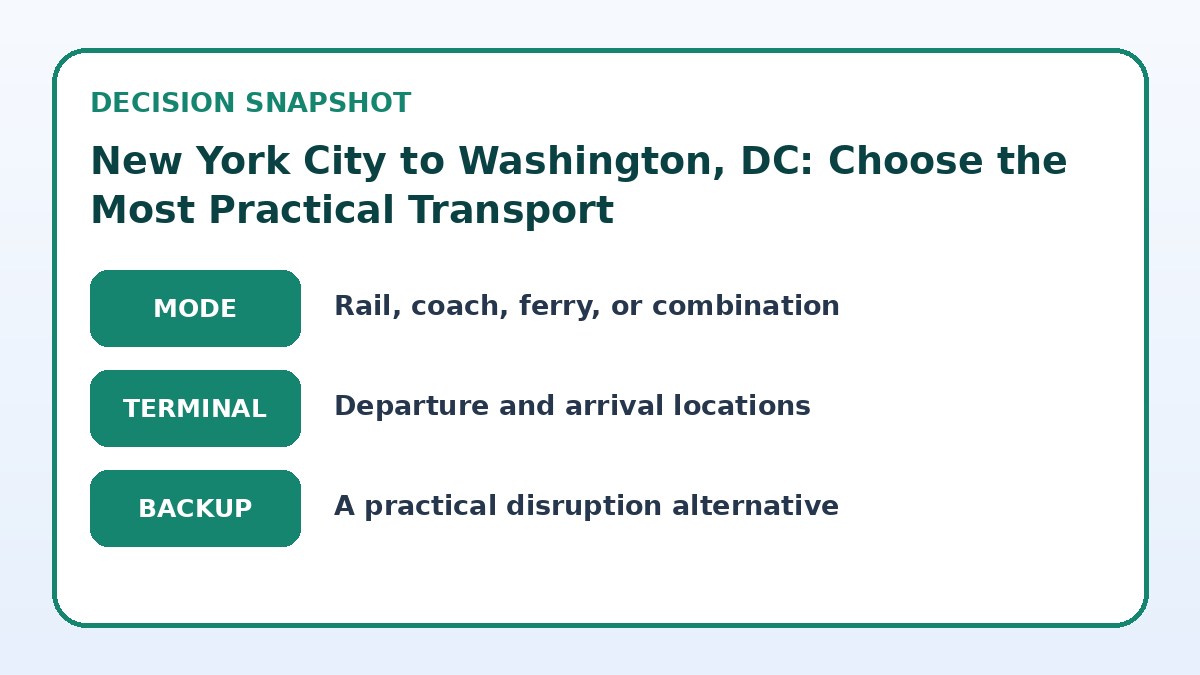
Choose the end-to-end journey plan
| Journey approach | Best for | Friction to check |
|---|---|---|
| Rail-first approach (train as primary mode) | Downtown-to-downtown business trips prioritizing predictable door-to-door time and onboard workability. | May require extra ground transfer if your origin or destination is far from major stations; check foot distance and first/last-mile options. |
| Air-first approach (flight when pure travel time is essential) | Situations where the air-leg drastically shortens en route time and the meeting location is near the arrival airport. | Adds significant airport processes and ground transfers that can erode downtown-to-downtown advantage; verify total door-to-door time. |
| Coach-first approach (intercity bus as primary mode) | Low-luggage, cost-conscious travelers who need flexible boarding and simple luggage handling. | Slower average speeds and fewer onboard work amenities; schedules may be less frequent during off-peak hours. |
| Combined multimodal approach (mix train, coach, air, and rideshare) | Complex itineraries where terminal fit or unusual start/end locations require mixing modes for overall efficiency. | More moving parts increase the chance of missed connections; requires careful buffer planning and verified transfer options. |
Check live intercity options
Look beyond the ride itself and compare terminals, transfers, luggage, and arrival fit.
Luggage and transfer friction: how much gear are you carrying?
Business travelers with only a laptop and a briefcase will tolerate more transfer steps than someone hauling multiple checked bags, a sample crate, or delicate equipment. Rail tends to be forgiving: you can keep work items at your seat, stow briefcases overhead or under the seat, and step off quickly at arrival. Coaches usually allow easy carry-on access and simpler boarding, but onboard workspace and privacy are limited. Air travel requires checked baggage processes and stricter carry-on size rules—factor in the time to collect luggage at arrival when estimating total journey time.
Think through the physical movements at each transfer point: elevator or escalator access, distance from platform to exit, baggage trolleys, and whether you’ll need assistance. If you expect to move between terminals or ride busy city transit on arrival, lightweight, rolling luggage and easy-access laptop sleeves reduce friction. When booking, verify on the provider’s final booking page what counts as carry-on, whether priority boarding or early disembarkation is offered, and where luggage is stored so you can plan movements without unpleasant surprises.
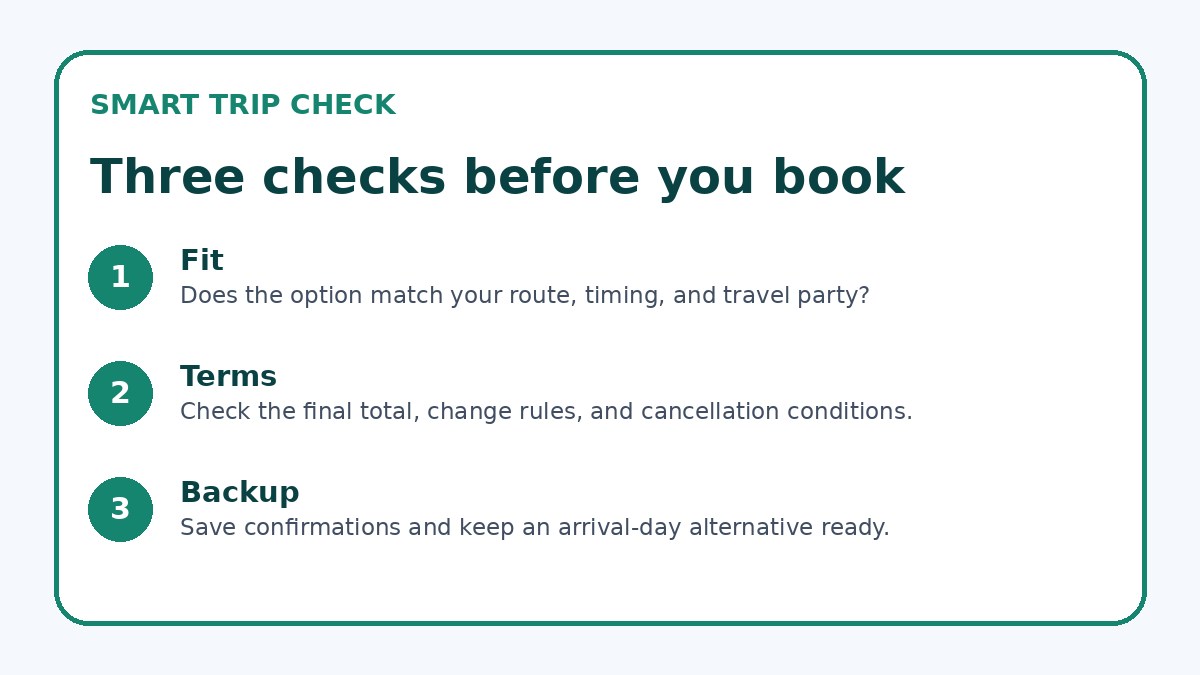
Timing flexibility: scheduled service versus last-minute agility
Matching your level of schedule rigidity with the transport’s flexibility is crucial. Frequent rail and coach services give many departure choices, letting you shift to a later option within a day if meetings run long. Some rail fares offer flexible change policies; others do not. Air travel can be the least change-friendly without paid flexibility, and airport check-in windows add mandatory lead time. When your itinerary is fluid—back-to-back meetings, potential delays, or same-day returns—prioritize modes with multiple daily departures and reasonable ticket-change terms.
Also consider how travel time variability affects your buffer planning. Road-based options face traffic-related uncertainty during peak commuting hours; check typical traffic patterns for your planned travel window. Rail services on dedicated corridors are less subject to road traffic but can be affected by infrastructure works or signal issues. For each candidate option, determine how many later departures exist and how easily you can rebook; verify the provider’s change and cancellation terms on their booking page so you know precisely what flexibility you’re buying.
Compare the practical alternatives
Use the final page to confirm what is actually offered on your dates and save a workable fallback.
Intercity travel checklist
- Map true door-to-door time by adding origin-to-terminal and terminal-to-destination transfers for each mode you consider.
- Confirm luggage rules and where carry-on or checked items are stored on the provider’s official booking page.
- Compare the number of viable same-day departures and the provider’s change/cancellation terms before finalizing a ticket.
- Plan a specific disruption backup: identify the next departures, alternate modes, and phone numbers to contact.
- Book first/last-mile rides with refundable or flexible options when meeting times are tight to preserve adaptability.
- Pack for transfer friction: use lightweight rolling luggage, a quick-access laptop sleeve, and a compact power bank.
Disruption backup: prepare a realistic plan B
No matter how reliable a mode seems, have a clear disruption backup. For rail travelers, a contingency might be the next scheduled train, a coach alternative, or a rideshare for shorter hops; for air travelers it may be the next flight or a same-day rail option. Identify the fastest practical alternative in advance and note where you’d reroute—downtown rail terminals often have multiple afternoon departures, whereas airports can be subject to weather or air-traffic delays. The goal is a pre-planned response that saves decision time when you’re already stressed.
Part of a good backup plan is knowing where to find real-time updates and how to act on them. Save the provider’s mobile app and customer-service contacts, check live transport alerts, and have key local contacts—your hotel’s front desk or a travel assistant—ready. If you rely on booked ground transport for connections, leave extra buffer and consider refundable or flexible ground options in case your primary mode is disrupted. Trip.com can be used to compare current availability and booking conditions, but always verify final terms and rebooking rules on the provider’s official page before relying on them.
Rail & Intercity Transport questions travelers ask
If my meeting is in downtown DC, is rail always the fastest overall option from NYC?
Not always, but often. Rail typically reduces city-center transfer time because major train stations sit close to downtown business districts. However, evaluate the entire door-to-door journey: if your origin in New York or your final meeting point in DC is far from a rail terminal, or if you have unusually light luggage and a nearby airport, a flight could be competitive. Always map actual transfer times, factor in check-in or security for flights, and verify schedules and rebooking terms on provider pages before deciding.
How much extra time should I allow between a meeting and a scheduled departure to avoid stress?
Allow buffer based on transfer complexity: for city-center rail departures, a 30–60 minute window from meeting end to scheduled train may be sufficient if your meeting site is very close; for flights, plan at least 90–120 minutes for domestic departures to cover security and check-in. If traffic, parking, or long luggage collection could be factors, add more time. Tailor the buffer to how reliably you can leave the meeting and to whether you need time to collect colleagues or equipment.
What’s the most reliable way to work en route between NYC and DC?
Rail is usually the most reliable for uninterrupted work: trains often provide wider seats, tables, stronger mobile signal corridors, and more usable power outlets than coaches, and you avoid inflight electronics restrictions. If you choose coach, pick a service marketed for business travelers with onboard Wi-Fi and power, and sit in less-trafficked sections. For air travel, working is possible but segmented by security and boarding; verify the airline’s inflight Wi-Fi availability and whether the aircraft supports laptop-friendly power.
Final decision note
Choosing the most practical transport between New York City and Washington, DC for business travel comes down to matching door-to-door reality with your priorities. If you need predictable travel time and a workspace-friendly environment, rail usually offers the best balance. If your origin or destination sits nearer an airport, or pure airborne speed matters, consider flights after mapping total transfers. Coaches can work when luggage simplicity and flexible boarding matter most. Whatever you choose, verify luggage policies, schedule flexibility, and rebooking terms on the provider’s booking page, prepare a clear disruption backup, and plan first/last-mile logistics to keep the trip focused on work rather than travel friction.
Continue planning
Check current options and final conditions
Use the provider page to confirm live availability, the final total, cancellation terms, and every condition that matters to your trip.
This evergreen planning guide was created with AI-assisted drafting and a structured quality review. It does not display live prices, schedules, availability, visa guidance, or provider rankings. Verify current details before booking. Some links are affiliate links; we may earn a commission at no additional cost to you.