
If you and your partner are weighing options for Melbourne to Adelaide transport, the practical takeaway is simple: pick the ticket type whose change-and-refund rules match the level of certainty in your plans. Trains and coaches often offer fixed schedules with limited-change discounted fares alongside more flexible full-fare tickets. Flights usually have the widest range of flexibility options but also complex fee structures for changes and name corrections. Renting a car gives complete schedule control but shifts all cancellation and insurance responsibility onto you. Before you book, identify the single decision that would force a change to your itinerary—an unpredictable work call, an event window, or medical contingency—and use that scenario to choose the minimum flexibility you need, then verify the exact change, refund, baggage, and seat rules on the ticketing page before purchase.
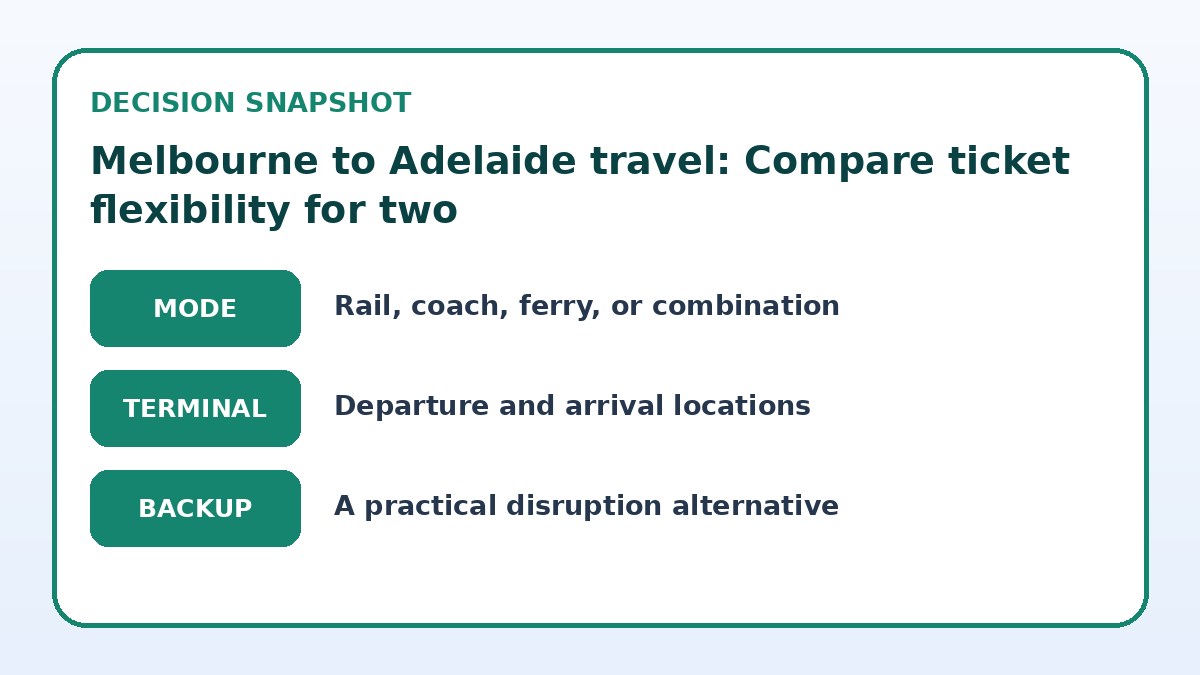
See current options before you compare the details
Availability and final conditions change. Open Trip.com now or keep reading for the practical comparison.
How ticket flexibility works across travel modes
Flexibility is a shorthand for change and cancellation rights, but those rights are structured differently by mode. Rail services typically sell a spectrum of fares: low-cost non-changeable tickets, moderately flexible fares with free date changes but seat restrictions, and full-fare open tickets that allow refunds or unlimited changes. Coaches follow a similar tiered approach but often have looser carry-on rules and more frequent stop patterns. Airlines layer in more variables—fare families, fare rules per segment, and the distinction between refundable, changeable-with-fee, and basic-restriction fares—and they may treat domestic and international segments differently within the same booking.
For couples, the key is understanding which component locks your plans. A cheap non-changeable train ticket might be fine if your dates are fixed; a refundable flight could be the sensible safety net when one partner’s work is unpredictable. If you plan mixed-mode travel—train to a regional airport, then a flight—each leg's rules apply independently unless a single provider or agency offers protected connections. Always check whether an extra fee applies for name corrections, passenger swaps, or refunds, and whether refunds go back to the original payment method or as travel credit.
Comparing real-world tradeoffs for couples
Cost, convenience, and certainty pull in different directions. Lower-cost tickets lower upfront spend but increase the risk of paying change fees or losing value entirely if plans shift. Higher-priced flexible tickets let you adjust travel without stress but they increase the upfront expense and can make budgeting harder if you’re splitting costs. For couples sharing one calendar and one budget, decide whether you value predictable cost or predictable plans more. If one partner has a variable schedule—shift work, freelance projects, or parental duties—the flexible ticket becomes insurance against disruption.
Another tradeoff is comfort versus redundancy. A direct train or flight with limited-change fares can be the fastest option, but if cancellations happen you may face long waits or overnight stays. Purchasing more than one ticket type for the same journey—such as flexible outward travel and cheaper return—can balance cost and contingency. Consider how refunds are handled: immediate bank refunds simplify reimbursement between partners, while travel credit can complicate splitting funds and future planning.
| Approach | Best for | Tradeoff to check |
|---|---|---|
| Buy two flexible single tickets | Couples with unpredictable schedules who prefer separate control over each traveller | Higher total cost but simpler individual changes and refunds |
| One joint flexible booking | Couples who travel together and want to keep changes coordinated | Can be costlier than split bookings and sometimes forces both to move if only one needs a change |
| Cheaper non-changeable fares for both | Couples with fixed plans and firm commitments | Lowest upfront cost but highest risk of losing value if plans change |
| Mix flexible outward and cheap return | Couples wanting protection on arrival dates and savings on the return leg | Provides partial flexibility; requires careful calendar coordination to avoid extra fees |
Ready to check the option that fits your plan?
Use your exact dates and traveler details so the provider page can show the current total and conditions.
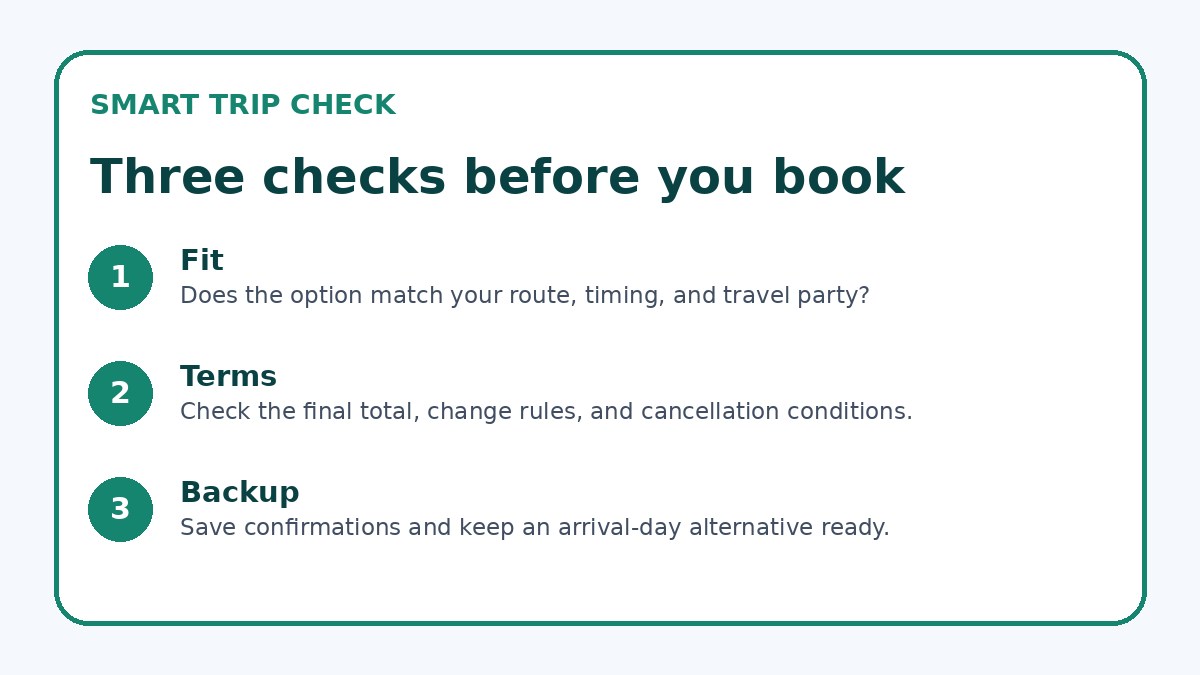
How to evaluate fare rules before you buy
Start by identifying the critical terms: change fee, fare difference, refund policy, name-change allowance, and transfer protections for multi-leg itineraries. Read the provider's final booking page; that is the legally binding summary of what you are buying. If booking through an agent or third-party site, verify the same rules on the operator’s site because agent policies can add extra fees or limits. Note whether flexibility applies per passenger—some fares allow one passenger on a shared booking to change while the other remains fixed—or whether the whole booking is treated together.
Also pay attention to the fine print about timing: many change penalties depend on when you request a change relative to departure, and some refundable fares only refund to the original payment method if canceled a certain number of days before travel. If you plan to use travel insurance, check whether the fare type meets the insurer’s criteria for cancellation coverage. For couples, clarify how refunds and credits are issued so you can plan reimbursements and shared budgeting without surprises.
Before you book
- Decide which single event would force you to change travel dates and choose ticket flexibility to cover that scenario.
- Read the operator’s final booking page and screenshot or save the fare rules showing change, refund, and name-change policies.
- If combining legs across providers, confirm whether any tickets offer protected connections or if you’ll be responsible for missed connections.
- Compare how refunds are issued—bank return, card reversal, or travel credit—and agree how you’ll split any travel credit between you.
- Check if a third-party booking adds fees or different change windows compared with booking direct with the carrier.
- Set calendar alerts for the last free-change deadline and for insurance claim windows if you’ve purchased travel protection.
Practical booking scenarios for couples
Scenario planning helps couples translate rules into decisions. If both partners’ schedules are stable—fixed leave dates and confirmed events—a cheaper non-changeable train or flight might be a logical choice. If one partner has a high likelihood of needing to swap dates, choose a fare that allows free date changes or modest administrative fees; that may cost more upfront but reduce stress and out-of-pocket costs later. When one of you must travel separately on short notice, compare whether splitting a booking (two separate tickets) or keeping a joint flexible booking provides better protection and simpler change processes.
For mixed transport options, factor in connection risk: if you’re taking a train to meet a flight, decide whether to allow a longer buffer or book a protected through-ticket if available. Couples who prefer spontaneity can book a flexible outward ticket and a cheaper return, or reserve refundable hotels and flexible car hire to match ticket flexibility. Whatever you decide, communicate responsibilities—who monitors delays, who handles changes, and how costs will be shared—so a single unexpected change doesn’t create confusion or resentment.
Frequently asked questions
Should couples book one joint ticket or two separate tickets for Melbourne to Adelaide travel?
There’s no single answer; it depends on your priorities. A joint ticket keeps reservations together and simplifies seating and carriage choices, which helps couples who always travel as a pair. But joint bookings can make changes awkward: some operators require the whole booking to be changed, potentially increasing cost if only one passenger needs to move. Two separate tickets give each traveller autonomy to change or cancel without affecting the other, which is useful if one partner’s schedule is less certain. Before booking, check whether the fare rules apply per passenger or per booking and whether seat assignments are linked—this will guide which approach fits you best.
How do change fees and fare differences work when switching dates?
Most carriers charge a change fee plus any fare difference when you move to a higher-priced service; sometimes the fee is waived for flexible fare classes. The exact amounts and whether a fee applies at all vary by ticket type, booking platform, and timing of the change. Some fares allow free date changes within a window or permit changes without fees if you rebook into the same fare band. Always inspect the final booking page for the precise policy: it will state whether fees, fare differences, or administrative charges apply, and whether refunds are full, partial, or issued as credit. Use that information to model the potential cost of a likely change before you commit.
Can travel insurance replace ticket flexibility for couples?
Travel insurance can complement ticket flexibility but rarely replaces it completely. Standard policies may reimburse non-refundable costs for covered reasons—medical emergencies, certain work issues, or specified events—but policies exclude many common disruptions and require documentation and claims processing time. Insurance typically won’t help with a simple change of heart or employer scheduling unless those circumstances are covered. For couples, insurance is useful as a backstop against major covered losses, while flexible fares offer immediate control before and at the time of travel. Always read both the insurance policy and the ticket’s fare rules to understand what is reimbursable and what must be handled via the carrier’s change and refund processes.
Final planning note
Choosing the right tickets for Melbourne to Adelaide travel as a couple is an exercise in matching rules to real-life uncertainty. Start by identifying your biggest risk: which partner’s calendar is most likely to shift and what event would force a date change. That single decision will steer you toward refundable or changeable fares, split bookings, or mixed flexibility strategies. Always verify the carrier’s final booking page for the exact change, refund, and name-change terms before paying, and agree with your partner how you’ll split costs and responsibilities if plans change. With that preparation, you’ll avoid most surprises and keep the trip focused on shared time rather than administrative headaches.
Continue planning
Check current options and final conditions
Use the provider page to confirm live availability, the final total, cancellation terms, and every condition that matters to your trip.
This evergreen planning guide was created with AI-assisted drafting and a structured quality review. It does not display live prices, schedules, availability, visa guidance, or provider rankings. Verify current details before booking. Some links are affiliate links; we may earn a commission at no additional cost to you.