
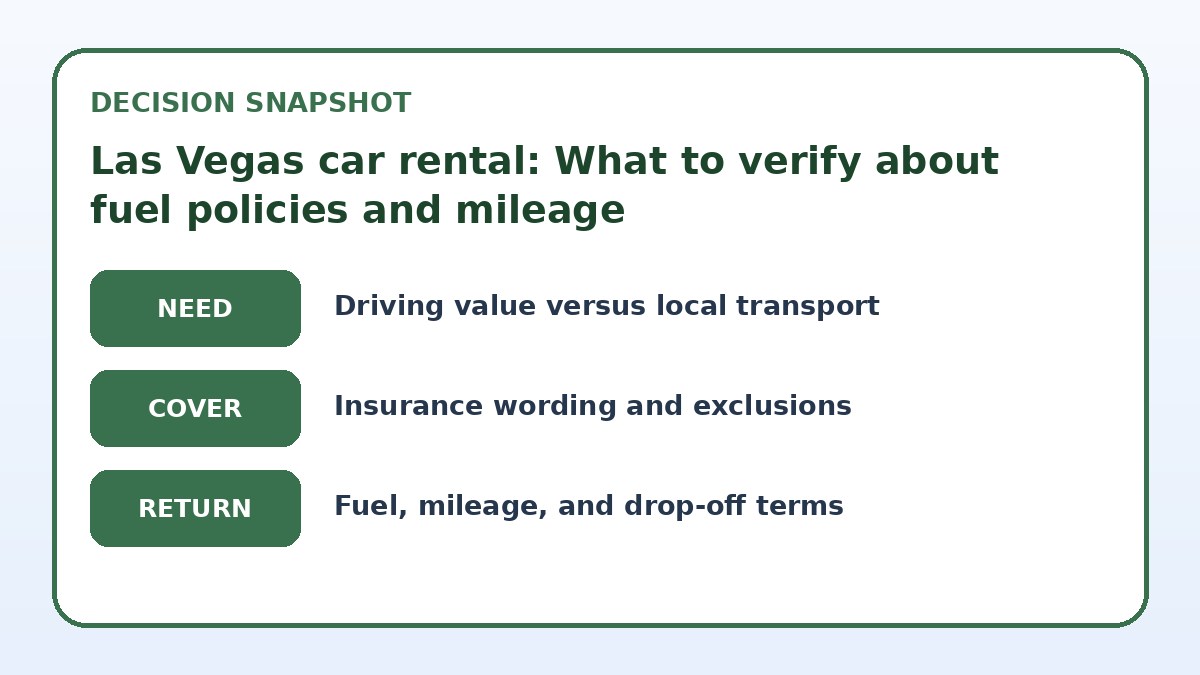
If you’re renting a car in Las Vegas for work, check the fuel and mileage rules before you complete the booking. The practical step: decide whether you’ll return the car with a full tank or use the rental company’s prepaid/refill options, and confirm any mileage caps if your itinerary includes long drives to places like Red Rock Canyon or Hoover Dam. These two items—fuel policy and mileage allowance—are the pieces most commonly overlooked and they directly affect final charges and expense reports. Also verify what documentation the rental company requires for damage and fuel disputes so you can resolve issues with your employer or card provider quickly. Doing this before you book avoids last-minute surprises, simplifies expense reconciliation, and keeps your focus on meetings, not receipts.
See current options before you compare the details
Availability and final conditions change. Open Trip.com now or keep reading for the practical comparison.
How fuel policies work and which to choose
Rental companies typically offer three common fuel approaches: full-to-full, pre-purchase (prepaid), and return-as-is with an excess-refueling charge. Full-to-full means you pick up the car with a full tank and return it full; this is usually the simplest and often the most cost-transparent for business travelers because you only pay for the fuel you use at public pumps. Prepaid fuel lets you buy a tank of fuel at pickup; it can be convenient if you want to avoid refueling on a tight schedule but may result in paying for unused fuel which is rarely refunded at fair market value.
Return-as-is or same-as-pickup often results in the highest fees: the company refuels at their partner price per gallon plus a service fee. For short, local business trips around Las Vegas where you can refuel before return, full-to-full is often the best balance of control and cost. If your schedule prevents a convenient refill and you value time over slight extra cost, prepaid fuel can be reasonable—just verify the refund policy and how unused fuel is credited on the final invoice to your corporate account.
Mileage rules, caps, and long-drive planning
Not all rentals include unlimited mileage. Some domestic rentals that are intended for short city use may impose daily or total mileage caps and charge per-mile beyond the allowance. If your business itinerary includes trips outside the metro area—conferences in Henderson, site visits near Boulder City, or day trips to outdoor areas—it’s essential to check whether unlimited mileage is included in the rate or offered as an upgrade. Ask explicitly how the company counts mileage (odometer at pickup versus GPS), because different practices change how your route and detours affect the bill.
When estimating distances, factor in driving to and from the airport, travel between meetings, and any planned side trips. If a mileage cap looks tight, compare the cost of the per-mile overage to the incremental cost for unlimited mileage; often the upgrade is cheaper when daily drives exceed moderate distances. For cross-jurisdictional travel—for example, a one-way trip into California or Utah—confirm whether geographic restrictions, one-way fees, or special mileage rules apply and note them in your expense forecast.
| Approach | Best for | Tradeoff to check |
|---|---|---|
| Full-to-full fuel policy | Travelers who can refuel before returning and want cost transparency | Requires time to find a pump and refuel at return; small risk of fuel stations being closed late-night. |
| Prepaid fuel | Busy travelers who value time and convenience over potential small refund issues | Often nonrefundable or refunded at an unfavorable rate for unused fuel; harder to reconcile on expense reports. |
| Return-as-is with refueling charge | Those unable to refuel and willing to accept a convenience fee for time savings | Typically the most expensive per-gallon rate and includes service fees that inflate the final bill. |
| Unlimited mileage upgrade | Itineraries with long drives or uncertain distances | Higher base rate but prevents per-mile overage charges; may be unnecessary for short city-only trips. |
Ready to check the option that fits your plan?
Use your exact dates and traveler details so the provider page can show the current total and conditions.

What to document and keep for expense reports
Capture the rental agreement page that lists the fuel policy, mileage terms, and any add-on charges. Use your phone to photograph the odometer reading and fuel gauge at pickup and again at return; multiple time-stamped photos reduce the risk of disputed charges. Save the final receipt that breaks out fuel charges, refueling fees, and mileage overages separately so your finance team can code expenses correctly. If your corporate card or travel policy requires specific vendor lines or invoice details, verify that those elements appear on the provider's confirmation before accepting the vehicle.
If you encounter a mismatch—such as being charged for less fuel than your photos show—escalate immediately at the rental desk and request a written adjustment or incident number to reference with your company. Retain emails or chat transcripts from the rental company, and make a short note of staff names and times. These records make it far easier to dispute charges or get reimbursed by your employer than relying on memory alone.
Before you book
- Read and photograph the fuel policy section of the rental agreement before you accept the keys.
- Take time-stamped photos of the fuel gauge and odometer at pickup and again at return.
- Confirm whether unlimited mileage is included or note the per-mile overage rate for your itinerary.
- Verify how prepaid fuel refunds unused portions and where refund details appear on the final invoice.
- Check with your corporate travel or expense policy which receipts and agreement pages are required for reimbursement.
- If you plan a one-way or interstate drive, ask about geographic restrictions, drop-off fees, and special mileage rules.
Decision criteria for business travelers
Decide based on time, convenience, and cost predictability. If you have spare time before returning the car and local access to reasonably priced pumps, full-to-full usually saves money and produces straightforward receipts. If your schedule is tight—late-night flights or meetings that prevent refueling—prepaid fuel or an arrangement with your company to cover the potentially higher refuel fees may be worth the convenience. Ask how unused prepaid fuel is handled: some providers do not refund remaining fuel, while others issue a partial credit only on request.
For longer drives or multi-city itineraries, prioritize unlimited mileage or confirm the per-mile rate to prevent unexpectedly high overages. If your employer requires pooled billing or direct invoicing, make sure the rental’s billing method lines up with corporate payment requirements before accepting the vehicle. Ultimately, choose the option that minimizes administrative friction for expense reporting while keeping out-of-pocket surprises small relative to the value of your time.
Frequently asked questions
Should I always choose prepaid fuel for a tight Las Vegas schedule?
Prepaid fuel can save time at the end of a busy trip, but it is often more expensive if you return the car with unused fuel because refunds are uncommon or partial. Evaluate whether you can reasonably refuel before returning the car—airport and city pumps are widely available but may be inconvenient depending on your flight time or meeting schedule. For corporate trips, check whether your company prefers itemized pump receipts; prepaid fuel may complicate reimbursement. If time is the primary constraint and you accept paying a premium for convenience, prepaid is reasonable—just document the transaction for expense reporting.
How do I handle a mileage charge dispute with a rental company?
First, present your pickup-time-stamped photos showing the odometer reading to the rental office and ask for the charge breakdown. If the counter staff cannot resolve it, request an incident or dispute reference number and a written note in your rental record. Save all receipts, emails, and photos, then notify your employer’s travel or finance team and your corporate card provider with the documentation. If the company’s final invoice still lists an incorrect charge, escalate using the rental company’s dispute channels and include your evidence; many disputes are resolved when supported by clear documentation.
Does choosing a larger vehicle affect fuel and mileage rules for corporate billing?
Vehicle class affects fuel consumption and may influence which fuel policy is most economical for your trip; larger or premium vehicles often use more fuel, making full-to-full refueling costs higher. Some corporate programs restrict allowable vehicle classes or require pre-approval for upgrades, so check your company’s policy before booking. Mileage rules themselves are usually applied regardless of vehicle size, but per-mile costs for overages are the same; the main difference is expected fuel usage. Include anticipated fuel consumption in expense estimates and get approval if the chosen class increases projected trip costs.
Final planning note
For business travelers in Las Vegas, the simplest planning step is to confirm fuel policy and mileage terms before you book. Choose full-to-full if you can refuel conveniently and want clear, pump-based receipts; consider prepaid fuel only when time savings outweigh potential refund headaches. If your itinerary includes long drives, secure unlimited mileage or calculate overage costs against the upgrade fee. Photograph odometer and fuel levels, save the rental agreement pages, and verify what documentation your employer needs to reimburse the charges. These precautions reduce disputes, keep expense reports tidy, and let you focus on your work rather than unexpected rental fees.
Continue planning
Check current options and final conditions
Use the provider page to confirm live availability, the final total, cancellation terms, and every condition that matters to your trip.
This evergreen planning guide was created with AI-assisted drafting and a structured quality review. It does not display live prices, schedules, availability, visa guidance, or provider rankings. Verify current details before booking. Some links are affiliate links; we may earn a commission at no additional cost to you.