Practical answer first: use price alerts, but treat them as information—never an automatic trigger to buy. For a business trip to Kaohsiung, create alerts for specific flight windows and hotel room types, then compare exact inclusions, refund rules, and change fees before committing to a bundled package or separate bookings. That measured approach keeps your itinerary aligned with meeting times and approval processes while still capturing deal opportunities. This article shows which elements to compare when judging a package versus booking components separately, how to set alerts so they help rather than push you, and what final checks to perform on the provider’s booking page. Follow these steps to preserve flexibility and stay within corporate travel policies while using alerts to inform timely, rational decisions.
Test package value fairly
| Booking approach | Best for | Tradeoff to check |
|---|---|---|
| Book flights and hotels separately | Need maximum flexibility and exact control over fare classes and room types | More time researching; may miss packaged conveniences like transfers or bundled extras |
| Buy a flight+hotel package from one seller | Simple procurement and single-vendor support for changes or bundled add-ons | Package rules may be less flexible and harder to compare term-for-term with separate bookings |
| Use a corporate travel platform with negotiated bundles | Compliance with company policy and centralized invoicing | Less price variety; negotiated bundles may have stricter change rules or limited availability |
| Purchase a basic bundle and add refundable upgrades separately | Lower base cost while preserving options for critical flexibility | Requires careful coordination and can be more expensive if upgrades are needed at the last minute |
Check current package and separate options
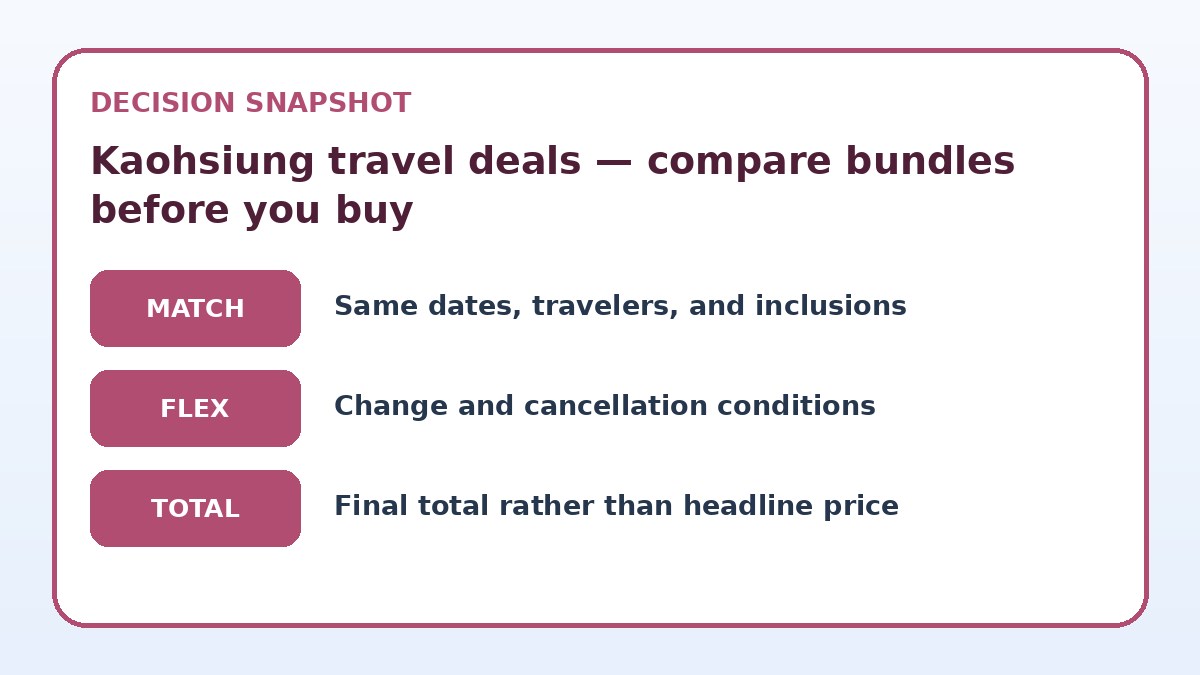
Use identical dates, travelers, room needs, baggage, and flexibility so the comparison stays meaningful.
What to compare before judging a package useful
Before considering a bundled flight+hotel offer for Kaohsiung, list the specific elements that matter for your trip: exact travel dates and times, number of travelers, seat class, checked baggage, hotel room type and board basis, cancellation and change rules, and any ground transfers. Matching these elements between the bundle and separate bookings lets you compare apples to apples rather than being misled by headline prices that omit fees or limit flexibility.
Also check corporate policy constraints and expense rules: allowable fare classes, preferred hotel categories, per diem limits, and required invoicing. If your employer needs specific receipts, VAT invoices, or third-party booking codes, verify that the bundle provides them. When a bundle fails to meet one of these conditions, its lower headline price may be irrelevant to your actual business needs.
How to set price alerts that avoid impulse buys
Design alerts with decision triggers and filters that reflect business priorities, not curiosity. For flights, set alerts by fare class, maximum acceptable connection time, and minimum transfer buffer for same-airport connections; for hotels, filter by room type, flexible cancellation, and breakfast inclusion if required. Use multiple alert sources and label each alert with the decision threshold you’ll use to act—this turns noise into organized inputs tied to a purchase strategy.
Control notification cadence to reduce reactive booking: batch alerts into summary emails or a single app check once or twice a day, and disable instant push unless a price crosses your predefined threshold. Maintain a short written rule (for example: “Buy only if price falls X% and refundable option available”) to defeat impulse responses. Keep screenshots of alert hits and time stamps if you need to justify a purchase under corporate review.
Look past the headline total
Compare inclusions and change conditions before deciding whether a package is genuinely useful for this trip.
Deal comparison checklist
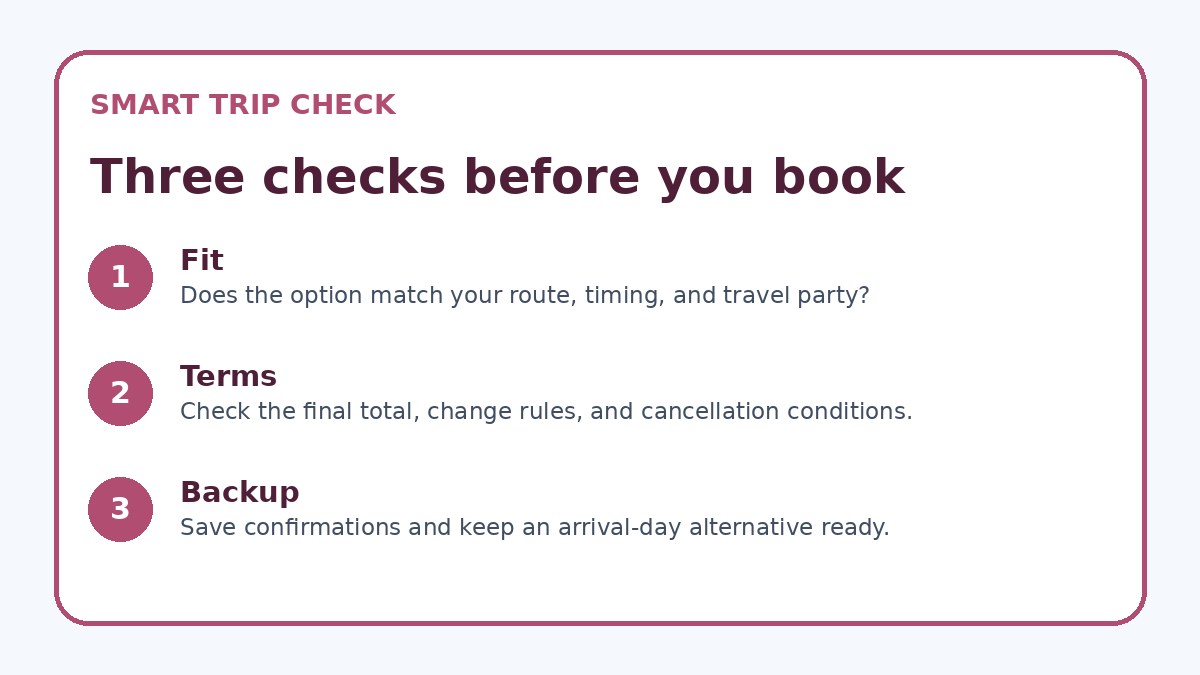
- Create separate price alerts for outbound and return flights with clear max-connection and minimum-connection time filters.
- Set hotel alerts that specify room type, refundable rate, and included breakfast or meeting facilities if required.
- When an alert hits your threshold, capture a screenshot and create a short comparison row showing dates, fare basis or room rate name, baggage, and cancellation terms.
- Confirm corporate policy allowances and pre-approval requirements before clicking purchase; if needed, attach comparison to the approval request.
- On the provider’s booking page, verify fare basis, change fees, refund method and invoicing options before entering payment details.
- If you decide to buy, save confirmation emails, supplier contact info, and the reservation edit/cancel link immediately for quick changes later.
Evaluating inclusions, flexibility and traveler-specific value
When a bundle seems cheaper, check what’s actually included. Does the fare include checked bags or only carry-on? Is the hotel rate a refundable or prepaid nonrefundable room? Does the package include airport transfer or rely on public transport? For a business traveler, flexibility often outweighs a minor price advantage—priority change terms, no-fee name changes, and free rebooking windows are frequently worth paying for.
Think about time costs too: a slightly more expensive flight that reduces connections or departs at a convenient hour can save an entire workday. Similarly, a hotel closer to meeting locations may cut taxi time and preserve evening productivity. Quantify these values roughly—transport time, expected taxi or ride-share cost, and potential overtime—so you can include them when comparing the bundle against separate reservations.
Final terms to verify on the provider’s booking page
Never finalize a purchase based solely on an alert screenshot. On the provider’s final booking page, verify the exact fare basis code, baggage allowance, name-change and rebooking fees, cancellation penalties, and what documentation will be issued for expense purposes. If the bundle includes transfer vouchers, check the supplier’s contact detail and refund policy for unused transfers. This step prevents unpleasant surprises when your itinerary changes.
Also confirm refund timelines and credit policies—whether refunds are instant, processed to the original payment method, or issued as vouchers, and how long they take. If the booking requires special invoicing for corporate expense, ensure the supplier can produce it and note any extra lead time. If you need to, open a chat or call to have key points written into the reservation notes before payment.
Travel Deals & Booking Strategy questions travelers ask
How should business travelers pick alert thresholds without missing necessary flexibility?
Choose thresholds that reflect total trip costs, not just headline savings: include the likely cost of baggage, taxi or transfer, and any fee to change dates. For example, set an alert that triggers only if a refundable fare or a fare with acceptable change fees drops by a percentage you predefine, or if a prepaid nonrefundable price becomes significantly lower than the refundable option after accounting for potential change costs. Keep one alert for refundable fares and one for nonrefundable fares so you can compare both scenarios when deciding.
If a package looks cheaper, what exact items do I verify to avoid false savings?
Compare identical dates, traveler names or traveler counts, seat classes, baggage allowances, hotel room types and board basis, included transfers, and the change/cancellation terms. Check whether the bundle’s price includes taxes and service charges and whether refunds are issued to the original payment method or as vouchers. If any item differs between the bundle and assembling the same components separately, calculate the true out-of-pocket and time costs before assuming it’s a saving.
Can I rely on price-alert emails as proof for corporate approval?
Price alerts are useful supporting evidence but rarely sufficient alone. Save screenshots showing the offer, timestamped alert emails, and a concise comparison that lists identical dates, inclusions, and cancellation terms. Add a note explaining why the alert met your decision criteria—refundability, acceptable connection times, or total expected cost. Attach the provider’s final booking page screenshot showing the fare basis and refund terms, since approvers may require provider-confirmed conditions rather than alert notifications.
Final decision note
Price alerts are powerful tools for Kaohsiung travel deals, but their value depends on disciplined use. For business travelers, structure alerts with explicit thresholds and filters that reflect corporate policy, meeting schedules, and personal time costs. When a price move looks attractive, run a quick but exact comparison of inclusions and terms between the bundle and separate bookings, and verify everything on the provider’s final booking page before paying. That process preserves flexibility, ensures compliance, and prevents impulse purchases that create headaches later. With these steps, you can use alerts to capture opportunities while keeping your business trip reliable and professionally justified.
Continue planning
Check current options and final conditions
Use the provider page to confirm live availability, the final total, cancellation terms, and every condition that matters to your trip.
This evergreen planning guide was created with AI-assisted drafting and a structured quality review. It does not display live prices, schedules, availability, visa guidance, or provider rankings. Verify current details before booking. Some links are affiliate links; we may earn a commission at no additional cost to you.