Practical answer first: if you want low daily friction and flexible cancellation, prioritize neighborhoods with frequent public transport links and lots of hotel options—Eixample, Gothic Quarter (Barri Gòtic), El Born, and Poblenou cover most solo-traveler needs. Choose Eixample if you want central grid streets, reliable transit stops, and many hotels that list free cancellation or flexible rates. Pick Gothic Quarter/El Born for walkability and nightlife but expect smaller hotels and more variability in cancellation policies. Poblenou is quieter with modern midrange hotels and often clearer flexible policies aimed at business stays. Before you look at specific properties, decide which trade-offs matter: walking vs transit, nightly routine, and how flexible the booking terms must be (full refund vs partial, free modification window). This article guides you through neighborhood fit, daily-route friction, room and party needs, and how to evaluate final booking terms so you can shortlist an area with confidence.

Check live stays in the areas that fit
Use your dates and party size to compare current rooms after you narrow the neighborhood fit.
Neighborhood fit: start with how you’ll spend each day
Begin by mapping what you plan to do each day and where those activities cluster. If most of your time will be museum- and architecture-focused—Sagrada Família, Passeig de Gràcia, and Eixample—staying in Eixample saves transit time and gives you a long list of hotels that often offer flexible business-friendly rates. If you plan to spend evenings at tapas bars and smaller galleries, the Gothic Quarter and El Born keep you on foot for long stretches; smaller properties here can have more restrictive cancellation rules because inventory is tighter.
Solo travelers who alternate day trips (Montserrat, Sitges) with city days should favor neighborhoods with direct metro and train access. Poblenou and some parts of Sant Martí connect well to the train network and airportside transit while offering newer hotels that cater to flexible, business-style bookings. Decide whether you prefer staying in the tourist center for convenience or a quieter neighborhood for safer overnight walking—this decision shapes the type of flexible rate you should expect and the number of hotels to compare.
Choose an area-selection strategy
| Area approach | Best for | Tradeoff to check |
|---|---|---|
| Eixample (central grid) | Solo travelers wanting simple navigation and many flexible-rate hotels | More hotels to compare; higher variability in exact cancellation windows across properties |
| Gothic Quarter / El Born (historic center) | Walkable evenings and cultural immersion within easy walking distance | Smaller properties with potentially stricter terms and less uniform refund policies |
| Poblenou / Sant Martí (quiet, modern) | Quieter nights, newer hotels, and clearer business-style flexible options | Further from central tourist sites; may need more transit time for major attractions |
| Near Sants/Train Hub | Travelers planning day trips and who value simple changes for travel connections | Fewer boutique walking options; some hotels tie flexibility to business-rate conditions |
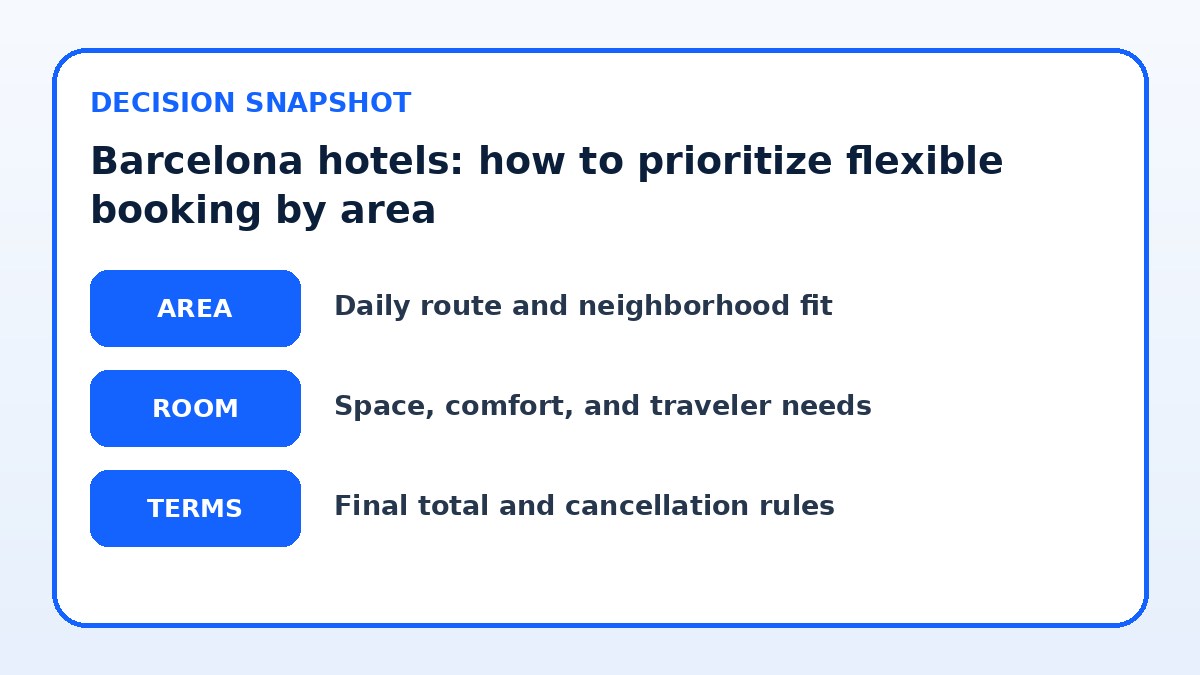
Daily-route friction: transit, walking, and safety at night
Daily-route friction is the time and effort it takes to get from your room to your activities. Barcelona’s grid in Eixample reduces navigation stress and often lowers walking time between metro stops, which can matter if you prefer changing plans last-minute. When flexible booking matters, properties in transit-rich areas usually offer more flexible options because they compete on convenience; that increases your chances of finding refundable or modifiable rates without sacrificing location.
In contrast, the Gothic Quarter’s maze of narrow streets is highly walkable but harder to navigate after dark, and smaller hotels there may have more restrictive cancellation terms. El Born sits between those extremes: highly walkable, lively at night, and with boutique hotels that sometimes use more complex policies—verify the exact cancellation window. For quieter evenings and simpler late-night returns, Poblenou’s wider streets and modern layout reduce friction and can be a safer bet if you value straightforward booking terms.
Now compare like with like
Keep the same dates, guests, room needs, and cancellation preferences while you compare the final choices.
Room and party needs: what flexible booking covers
Decide the room and party setup before you compare rates: are you booking a single room, expecting to use a desk for remote work, or hoping to meet other travelers in a hostel setting? Many hotels offer refundable single rooms but restrict flexible options for specific room types like suites, connecting rooms, or rooms with breakfast included. If workspace and a quiet room are essential, look for properties advertising business amenities—those often have corporate-style flexible rates but check whether the flexible option applies to the exact room category you want.
If you’re open to hostels and guesthouses, be aware they sometimes differentiate refund rules by bed type (private vs dorm) and may impose stricter modification windows. Read the fine print about occupant limits and whether adding nights or late check-outs is allowed under the flexible rate. When comparing options across neighborhoods, note whether flexible terms apply uniformly across room types or if flexibility is gated behind a higher-tier room; that will influence both total cost and suitability for your solo travel needs.

Hotel booking check before payment
- List your top three daily anchors (museum, beach, train station) and pick neighborhoods that minimize transfers between them.
- Filter hotel results for refundable or free-cancellation rates and open the policy text to read deadline and refund method.
- Confirm that the flexible rate applies to the exact room type and occupancy you need, not only to a generic room category.
- Note whether modifications must go through the booking platform or directly with the hotel and save the required contact details.
- Screenshot or download the booking confirmation and cancellation policy page immediately after reserving for quick reference.
- If flexibility is critical, compare the refundable option’s penalty vs travel insurance coverage to decide which is more cost-effective.
Final booking terms: what to verify before you click reserve
Before booking, verify three specific things on the provider’s final page: exact cancellation deadlines and refund process, whether modifications are allowed without penalty, and what happens for no-shows. Don’t assume the words “free cancellation” mean the same across properties—check whether the free window ends at a local time or a set number of days before arrival, and whether taxes or service fees are refundable. For refundable rates, confirm the refund method and timing (credit card reversal, voucher, or account credit).
Also confirm any conditions attached to flexible rates: some require a deposit, or they convert to nonrefundable within a short window. If you book through a third party, double-check whether changes must go through that reseller or directly with the hotel—this affects how quickly you can modify a booking. If you want an extra layer of flexibility, consider a short cancellation window combined with travel insurance that covers last-minute interruptions; always read the hotel or booking platform’s policy and save screenshots of the confirmation page.
Hotel Guide questions travelers ask
How far in advance should I book a Barcelona hotel if I want flexible cancellation?
There’s no one-size-fits-all window, but aim to book as soon as you’ve narrowed your neighborhood to secure rooms with flexible terms—popular areas can sell out. When flexibility matters, check the cancellation deadline on the property page: some flexible rates allow cancellation until a few days before arrival, others require a longer notice. If your plans are uncertain, prioritize refundable rates even if the hotel inventory is ample; you can always rebook or change areas later. Whatever you choose, save the full policy wording from the booking confirmation to avoid surprises.
Are refundable rates always better for solo travelers in Barcelona?
Refundable rates reduce financial risk but aren’t always the best choice. If your schedule is fixed and you’re confident in travel dates, a nonrefundable deal could be cheaper—but only choose that when price matters more than flexibility. For most solo trips where last-minute changes, health issues, or itinerary shifts are possible, refundable or modifiable rates provide valuable peace of mind. Also weigh the difference in room types: sometimes the flexible option requires a different room category; compare that room’s features before deciding.
What specific policy details should I verify to avoid surprises when canceling?
Read the cancellation window precisely: check the local time and the final day you can cancel for a full refund. Verify whether taxes, service fees, or third-party booking fees are refundable and how refunds are processed (credit card reversal vs voucher). Look for clauses about deposits, no-shows, and partial refunds if you shorten your stay. If the booking comes through an OTA, confirm whether modifications must go through that platform or the hotel directly, and save customer-service contacts. If anything looks ambiguous, ask the hotel or provider for written clarification before you pay.
Final decision note
Shortlisting an area in Barcelona before opening live inventory makes comparing flexible booking terms much easier. Start by choosing the neighborhood that matches your daily anchors and tolerance for walking or transit; Eixample, Gothic Quarter/El Born, Poblenou, and areas near train hubs each offer distinct trade-offs. Once you’ve selected an area, filter for refundable or modifiable rates, read the policy specifics for your exact room type, and confirm how changes are handled. Save confirmation screenshots and the provider’s contact details. If you want another quick cross-check of inventory and flexible options, you can look at Trip.com as one of several places to compare current availability, but always verify final policy language on the hotel or booking page.
Continue planning
Check current options and final conditions
Use the provider page to confirm live availability, the final total, cancellation terms, and every condition that matters to your trip.
This evergreen planning guide was created with AI-assisted drafting and a structured quality review. It does not display live prices, schedules, availability, visa guidance, or provider rankings. Verify current details before booking. Some links are affiliate links; we may earn a commission at no additional cost to you.