If your trip to Jeju is primarily business-focused—meetings, hotel nights near a conference center, or a mix of urban appointments—deciding where to pick up your rental car matters. Driving can give you schedule control and access to scattered meeting locations or factory visits, but it also adds pickup and return friction, unfamiliar roads, and insurance choices to weigh. This guide gives a practical answer up front: choose airport pickup when your schedule starts or ends at Jeju Airport and you need immediate mobility; choose city pickup when most appointments sit inside Jeju City or you want to avoid additional airport wait time and potential vehicle queues. Below you'll find the route-value logic, insurance language to verify, pickup/return friction to plan for, and a non-driving fallback that works for tight business itineraries.

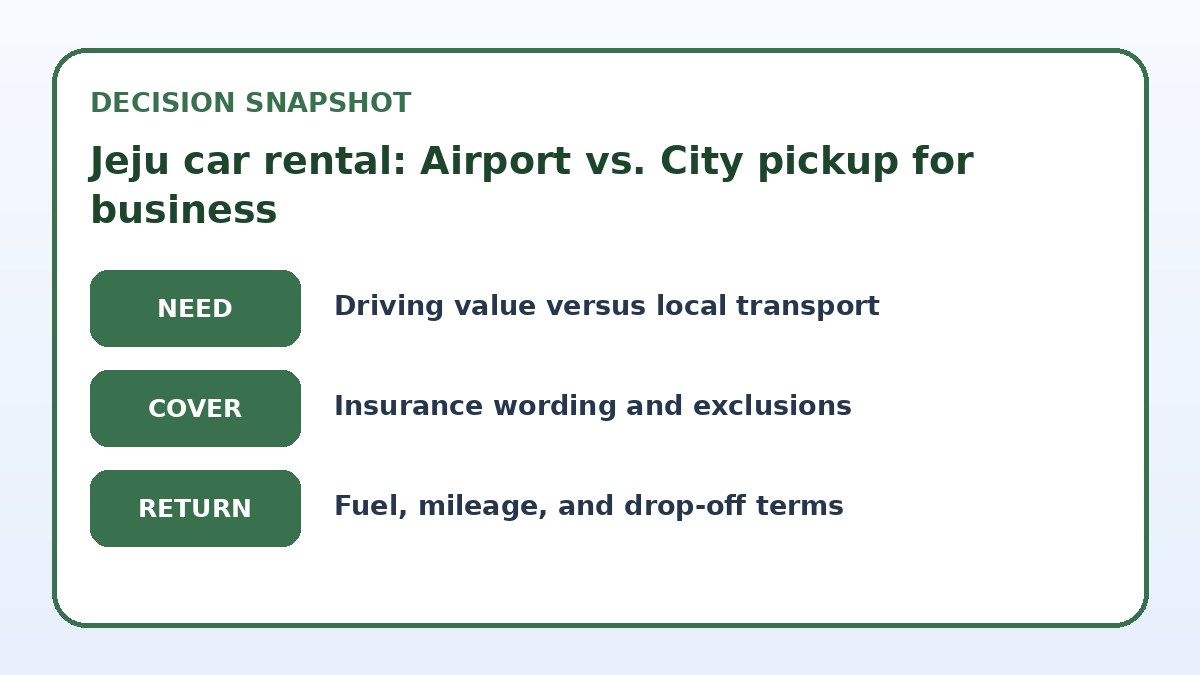
Does driving improve a short business trip in Jeju?
Start by mapping where you need to be. Driving genuinely improves itineraries that include multiple appointments spread across the island—factory visits, field inspections, or meetings outside Jeju City—because it reduces dependence on fixed public transport timetables and gives flexibility to adjust meeting times. For short, tightly scheduled downtown visits or single-venue conferences, driving can add unnecessary time for parking, vehicle handover, and unfamiliar navigation.
Consider also time-of-day traffic and where your accommodations are located. If most appointments are within a single neighborhood or near conference hotels, walking, taxis, or short rides may be faster and simpler. If your plan includes evening site visits, remote client locations, or airport-to-hotel logistics without a reliable transfer, a rental lets you keep control. Use a route map of your appointments to estimate incremental door-to-door minutes versus taxi or shuttle options.
Decide whether driving earns its place
| Mobility strategy | Best for | Cost or friction to check |
|---|---|---|
| Airport pickup (round-trip to airport) | Arrivals/departures tied to the airport and early first-day meetings. | Quick airport mobility but possible queue times and necessity to return the car before departure. |
| City pickup (collect near hotel or conference area) | Trips with meetings concentrated in Jeju City or long downtown stays. | Less terminal hassle but may require a transfer to the airport for departure. |
| One-way rental (pickup city, drop at airport or vice versa) | Linear itineraries that start in one area and end at the airport without backtracking. | Saves time but can incur one-way fees and requires confirming availability in both locations. |
| No-drive approach (taxis, private transfers, buses) | Short or tightly scheduled business trips where driving adds overhead. | Simpler logistics but less schedule flexibility and possible higher per-trip costs. |
Check live rental choices only after the route test
Use the exact driver, dates, pickup point, and return plan to compare current conditions.
Route value and practical tradeoffs between airport and city pickup
Airport pickup scores when your first and last travel legs meet at Jeju Airport: you get immediate mobility and avoid baggage transfers to other collection points. It’s also practical if your schedule includes early-morning site calls that would be difficult with public transport. The tradeoff is potential waiting time at the rental desk and the need to return to the airport before your departure window; if your final meeting runs long, you’ll face time pressure to return the car and make your flight.
City pickup pays off when your business activity is concentrated in the city—fewer kilometers overall and less airport congestion during peak times. You may avoid terminal queues and reduce the time you spend onboarding the vehicle on arrival day. However, city locations sometimes have smaller fleets or different vehicle types available, and returning the car to the city when your departure is from the airport can add another transfer step. Compare expected mileage, how many pickups/returns you need, and whether one-way rental policies apply.

Compare the full rental conditions
Confirm insurance wording, exclusions, deposit, fuel, mileage, and return terms on the final page.
Insurance wording and other coverage checks to verify before booking
Insurance language can be dense; focus on three items: the excess (the amount you’re responsible for after a claim), whether theft and third-party liability are covered, and any territory limits or road restrictions. On the final booking page of any provider, verify whether loss damage waiver (LDW) or collision damage waiver (CDW) is included or optional, the size of the security deposit, and whether additional drivers are covered without extra fees. For business travelers, ensure the policy allows commercial use if you’ll be using the car for client meetings or driving to commercial sites.
Also check whether local road types are excluded from coverage—some contracts limit coverage on unpaved roads or certain remote areas—and whether there are age limits or international driving permit requirements. If you plan to ferry the vehicle or take it off main roads, confirm that those actions are allowed. If anything on the contract is unclear, contact the rental provider and ask them to show the exact wording on their booking confirmation page before you commit.
Car rental terms to verify
- Map all meeting locations and hotel(s) to see whether most points cluster inside Jeju City or are spread across the island.
- On the provider’s booking page, check and save the exact wording for LDW/CDW, liability limits, excess amount, and permitted drivers.
- Confirm pickup and drop-off hours and the physical location (terminal desk, off-site shuttle, or city storefront) before arrival.
- Photograph the rental vehicle on pickup from multiple angles and keep the check-in report until final billing is settled.
- If planning a one-way rental, verify one-way availability and fees and ask whether fuel or mileage policies differ.
- Build buffer time into meeting schedules to allow for vehicle handover, parking, and unexpected traffic delays.
Pickup/return friction and a fallback for non-drivers
Pickup and return take time: desk lines, vehicle inspection, signature pages, and explaining insurance add up, and returning a car under time pressure can be stressful. Plan an extra 30–60 minutes at both ends for handover; photograph any existing vehicle damage and keep the check-in/out report. If returning to a different location than pickup, confirm one-way arrangements in advance and whether that triggers additional charges or requires reservation notice.
If you decide not to drive, build a practical non-driving fallback. Use taxis or app-based rides for point-to-point trips inside Jeju City, and reserve private transfers for early-morning or late-night site visits. For intercity hops or rural access, combine scheduled buses with pre-booked local taxi pickups for the final leg. Share meeting addresses and realistic time buffers with hosts to account for variable transfer times. Trip.com can be a place to compare current availability for cars and transfers, but always verify exact pickup/return terms on the provider’s booking page.
Car Rental & Road Trip questions travelers ask
Will I save time by picking up at Jeju Airport instead of in the city?
Picking up at the airport saves time when your first meeting or departure aligns with flight timings because you avoid a transfer into the city. However, airport desks can have queues, and off-airport shuttles may add wait time. To decide, estimate door-to-door minutes from arrival gate to your first meeting versus from the city pickup location. On the rental site, check desk location, queue expectations, and whether express or pre-assigned vehicles are offered to reduce handover time.
What insurance terms should I never skip checking before I drive in Jeju?
Don’t skip verifying the excess amount you’d pay after a claim, whether third-party liability and theft are included, and any exclusions for road types or commercial use. Also confirm whether additional drivers are covered and whether an international driving permit is required for your nationality. The exact contract wording on the provider’s booking page is the authoritative source; if anything is ambiguous, request written clarification from the provider before confirming the reservation.
If I choose not to rent a car, what’s the most reliable way to reach remote business sites?
For remote sites, a mix of scheduled intercity buses plus a local taxi for the final mile is often reliable and predictable. For time-sensitive early starts or late returns, pre-book a private transfer or arrange a round-trip taxi through a local operator to guarantee availability. Share clear directions and realistic timings with your host so they can advise on local traffic patterns or possible parking constraints at the site.
Final decision note
For business travel in Jeju, the right pickup choice depends on where your appointments are located and how much time you can allocate to vehicle handover. Airport pickup gives immediate mobility for flight-aligned schedules; city pickup minimizes terminal hassle when meetings are concentrated downtown. One-way rentals can stitch together a linear itinerary at the cost of possible fees, while a no-drive approach reduces logistics but trades flexibility. Before booking, map your route, confirm insurance wording and pickup/return hours on the provider’s booking page, and have a fallback transfer plan for tight schedules.
Continue planning
Check current options and final conditions
Use the provider page to confirm live availability, the final total, cancellation terms, and every condition that matters to your trip.
This evergreen planning guide was created with AI-assisted drafting and a structured quality review. It does not display live prices, schedules, availability, visa guidance, or provider rankings. Verify current details before booking. Some links are affiliate links; we may earn a commission at no additional cost to you.