Practical answer: renting in Seoul can help if you need to move lots of luggage between dispersed locations, but only if the rental contract and insurance explicitly cover additional baggage and roadside events. Before you decide to drive, read the insurance wording for 'personal effects', 'third-party liability', 'loss or damage to customer property', and any exclusions for roof racks or cargo boxes. If the policy excludes luggage or limits coverage per item, the convenience of a car quickly becomes risky. Many travelers assume basic CDW or liability covers their suitcases — it often does not. The right choice depends on route value (are you leaving the dense central districts?), pickup and return friction (will you arrive by subway or need to navigate airport logistics?), and whether a robust public transport or courier alternative offers lower hassle. This guide explains what wording to look for, how to compare options at booking, and a fallback plan if driving is the wrong fit.
Decide whether driving genuinely improves your Seoul itinerary
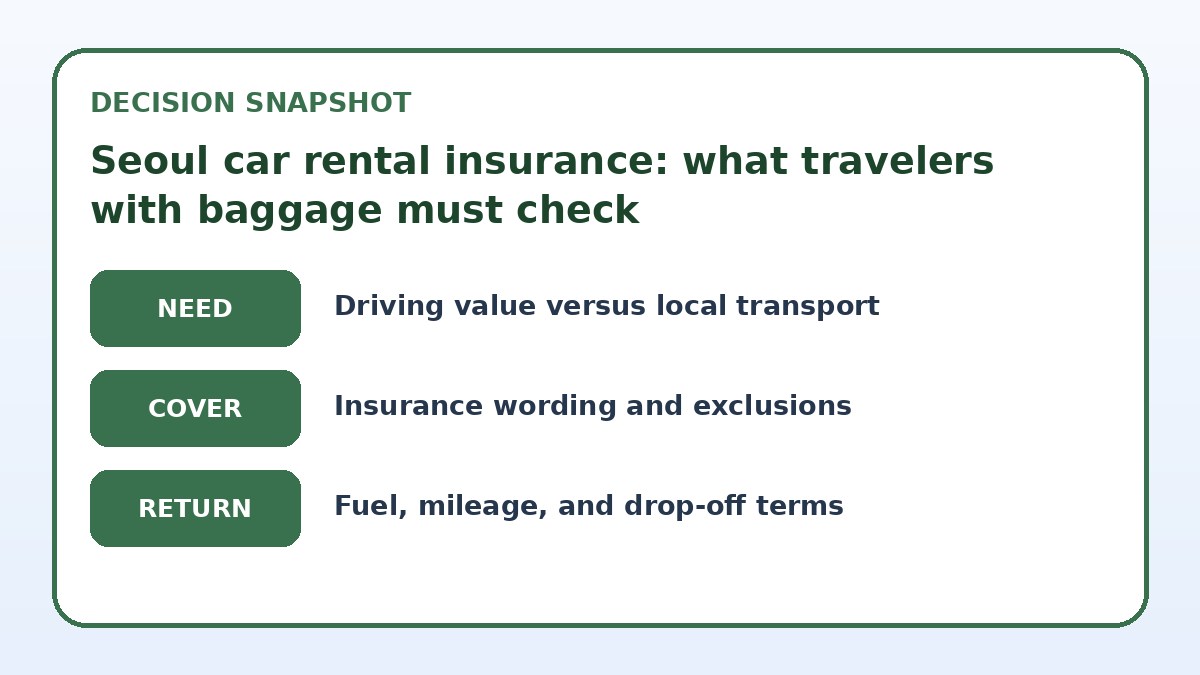
Start by mapping where you need the car to go. Seoul's central neighborhoods — Jongno, Myeongdong, Gangnam — are well served by subway and taxis; driving through them can mean slow traffic and scarce parking. A car pays off if your plan includes multiple suburban or nearby provincial stops where public transport is slow or impossible with many bags. Consider arrival: if you land at Incheon with multiple suitcases and onward public transport is cumbersome, a rental can reduce transfers. Balance that convenience against parking availability at each stop; a central hotel may charge for parking or be difficult to access with large luggage.
Think about the physical handling of luggage: will you be lifting bags into trunks or onto roof boxes? That matters for both safety and insurance. If your trip involves regular trunk access for big suitcases, making shorter hops between destinations, a car can save time. But if you plan long walking segments in Seoul's dense districts, the car often becomes a liability. Choose driving when the route value — defined by fewer public-transport options, multiple suburban destinations, or bulky gear — clearly outweighs parking, traffic, and insurer baggage exclusions.
Decide whether driving earns its place
| Mobility strategy | Best for | Cost or friction to check |
|---|---|---|
| Rent a car with explicit luggage cover | Travelers needing frequent inter-suburban moves with heavy bags | Higher upfront clarity but may carry extra insurance add-ons and parking hassles in Seoul. |
| Rent standard car and rely on personal insurance/cash deductible | Those willing to self-insure low-value luggage and tolerate potential claims hassle | Lower rental cost but risk of large out-of-pocket loss and complex claim processes. |
| Use taxis and public transit with couriered luggage | Arrivals to central Seoul or city itineraries with bulky items handled ahead | Less control over timing for deliveries and possible coordination with hotels or couriers. |
| Hire a moving/porter service or specialized airport transfer | Groups or families with many heavy or bulky items who want door-to-door service | Convenient but sometimes more expensive and requires booking and confirmation in advance. |
Check live rental choices only after the route test
Use the exact driver, dates, pickup point, and return plan to compare current conditions.
Understand insurance wording that matters for extra luggage
Policies use varied phrases: 'personal effects', 'customer property', 'baggage', or 'contents'. Always locate the section that defines those terms and any per-item or total limits. Pay attention to exclusions for theft from an unattended vehicle, which many policies disallow unless the vehicle was locked and luggage stored in a locked boot. Also watch for clauses that reduce cover if the luggage was visible in the cabin versus stored in a closed trunk or if a roof box was used without specific rental-provider authorization.
Look for deductible or excess amounts for luggage claims and whether those are separate from vehicle damage excesses. Some contracts require you to notify local police and the rental company within strict time windows to keep the claim valid. When wording is vague, ask the rental provider to add a written endorsement or to point to a clear policy PDF that mentions 'loss or damage to customer property' and that specifies limits for baggage. If the provider cannot provide clear, itemized wording, treat the coverage as unreliable for high-value items.
Compare the full rental conditions
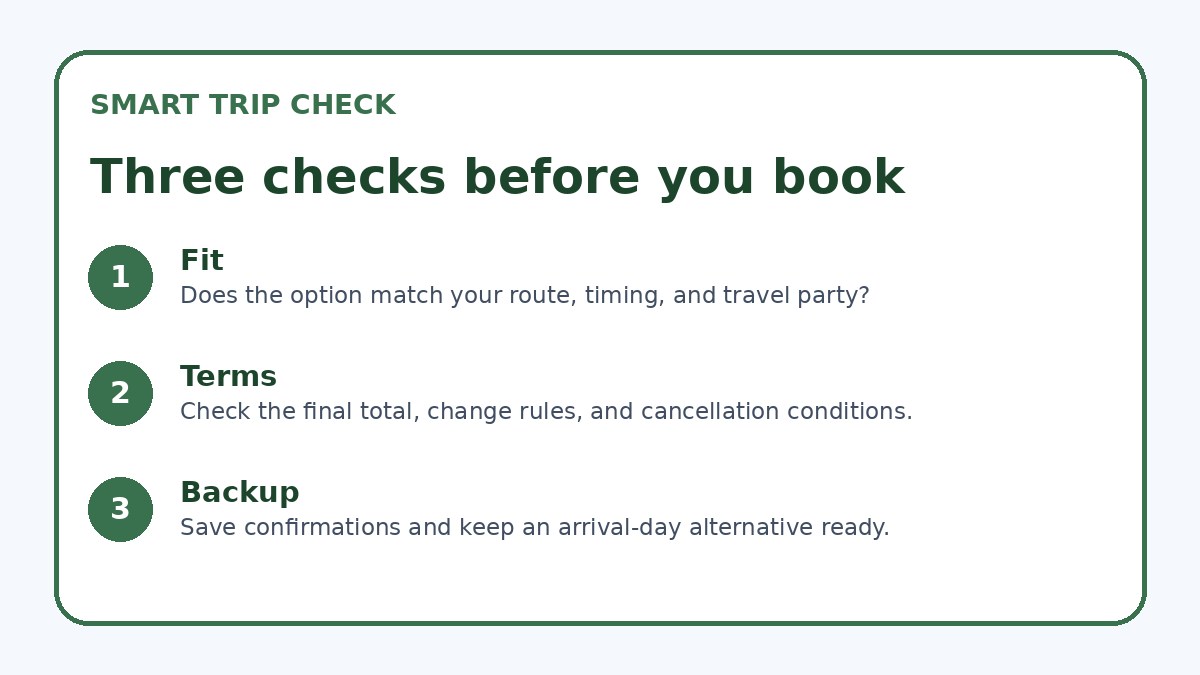
Confirm insurance wording, exclusions, deposit, fuel, mileage, and return terms on the final page.
Pickup and return friction: where insurance phrasing affects your day
Pickup and return logistics influence whether insurance protections are usable. At airports and busy downtown counters, staff may be rushed; you need time to inspect the car and document any pre-existing damage or missing items. If the insurer requires a signed condition report, make sure you receive that copy and photograph trunk and roof-box seals. If the contract requires items to be stored out of sight, verify whether your planned stops can meet that requirement — leaving luggage in plain view while you grab food could void cover.
Returning a car with a roof box or with bags on rear racks can trigger extra checks. Some rentals require staff inspection at return; others accept drop-box returns but then process damage claims later, which complicates proving luggage loss. Clarify whether you must be present for the final inspection to avoid disputes. Also confirm the provider's documented procedures for theft or damage claims, including how to file police reports, the timeframe for notification, and whether you can buy a supplementary personal effects cover at pickup.
Car rental terms to verify
- Read the rental contract section labeled 'personal effects' or similar and note per-item and total limits for baggage.
- Confirm whether theft from an unattended vehicle is excluded and what conditions (locked trunk, covered roof box) preserve cover.
- Ask for a written endorsement or policy PDF at booking that explicitly mentions luggage coverage and any excesses.
- Photograph the vehicle, trunk space, and any installed roof or rear carriers at pickup and keep timestamps.
- Clarify the required claim process: police report, rental company notification window, and documentation you must submit.
- Compare door-to-door time and total logistics cost for a rental versus courier plus taxi/public transit before booking.
Non-driving fallback: practical alternatives when insurance won't cover your bags
If insurance excludes luggage or demands a high excess, choose low-friction alternatives. Airport-to-hotel luggage delivery services, private couriers, or porter services can move heavy suitcases ahead of you; many Seoul hotels accept deliveries and store luggage. For city travel, consider combining an airport limousine bus or AREX train with a taxi for door-to-door segments instead of a full rental. This reduces handling while avoiding the insurance uncertainty and parking friction of a car.
When ground mobility between neighborhoods is needed but a rental is risky, use a mix of taxis and public transit. Korea's taxis are abundant and can handle several large suitcases; they also avoid parking hassles. For intercity moves, express buses and trains accept luggage with few formalities. Before booking any non-driving option, check size and weight rules with the provider, and compare total door-to-door time and cost against the convenience of a rental that explicitly covers your baggage.
Car Rental & Road Trip questions travelers ask
Will standard Collision Damage Waiver (CDW) cover my suitcases if they’re stolen from a rental car in Seoul?
CDW primarily covers damage to the rental vehicle, not personal property. Many CDW or loss-damage waivers exclude or limit cover for customers' personal effects unless a specific clause or supplementary 'personal effects cover' is purchased. Read the rental terms to locate an explicit mention of 'personal effects' or 'customer property' and check any per-item caps or exclusions for unattended vehicles. If that wording is absent or unclear, request written confirmation from the provider before accepting luggage-dependent plans.
If my policy says luggage is covered with conditions, what common caveats should I watch for?
Common caveats include requirements that luggage be stored out of sight (in a locked trunk), that the vehicle be locked and windows closed, and that you must report theft within a strict timeframe to both the police and the rental company. Policies often exclude losses from leaving valuables visible or unattended, or from using non-authorized roof racks. Also note separate deductibles for baggage claims and whether criminal reports and original receipts are required to substantiate value.
Can I add a temporary personal effects policy at pickup if the contract is vague?
Many rental agencies sell add-on cover that explicitly protects personal effects, and some third-party insurers offer short-term travel or gadget policies that include baggage. Always verify the add-on's exact wording at pickup: confirm what it covers (theft, accidental damage), any item limits, and claim procedures. If the agency cannot provide a clear, written amendment to the contract, consider arranging a courier or alternative transfer for high-value items instead of relying on an ambiguous add-on.
Final decision note
Driving in Seoul with extra luggage can be a genuine convenience when your route includes suburban stops, multiple hotels, or bulky equipment. The deciding factor is clear insurance wording: confirm that 'personal effects' or 'customer property' are covered, note per-item limits and excesses, and understand exclusions for unattended vehicles and roof storage. If the contract is vague, insist on written clarification or buy an explicit personal-effects extension at booking. When luggage coverage can’t be secured or excesses are high, prefer courier delivery, taxis plus public transit, or a booked porter service—these often reduce claim risk and simplify arrival logistics. Before you book, verify coverage details on the rental provider’s final booking page and consider Trip.com or another comparison site to view current availability and policies.
Continue planning
Check current options and final conditions
Use the provider page to confirm live availability, the final total, cancellation terms, and every condition that matters to your trip.
This evergreen planning guide was created with AI-assisted drafting and a structured quality review. It does not display live prices, schedules, availability, visa guidance, or provider rankings. Verify current details before booking. Some links are affiliate links; we may earn a commission at no additional cost to you.