
If you’re deciding how to fly from Seoul to Bangkok on your first trip, start by choosing whether you prioritize speed and simplicity or flexibility and potentially lower fares. Direct flights cut the number of steps between airports and usually mean less chance of missed connections and lost luggage. Connecting itineraries can open more schedule choices, different airports, and sometimes lower base fares, but they add complexity: extra time, immigration/transfer procedures, and more points of potential delay. Read on for practical criteria to compare options, what to check on the airline’s booking page, and simple rules to apply when booking. Use the quick checklist at the end to finalize your choice before buying a ticket.
How to evaluate total travel time beyond flight duration
Flight duration is only part of the story. For a true picture of how long your journey will take, compare door-to-door time: add travel to the Seoul airport you’ll use, recommended check-in or arrival windows, scheduled flight time, minimum connection times if applicable, and typical land travel from Bangkok’s arrival airport to your accommodation. If a connecting itinerary has a short layover but saves little in scheduled flight time, the extra risk and arrival fatigue may outweigh any perceived benefit.
Also consider airport options. Seoul is served by multiple airports with different ground-transport options; Bangkok likewise has more than one major airport with varied transfer times into the city. When you compare itineraries, map out the whole route so you can see if a longer airborne time is offset by faster ground connections. That full-route view is the most practical way to judge how each option will affect your day and your first impressions of Bangkok.
Comfort, stress and who’s traveling with you
For solo, light-pack travelers, a single connection might be an acceptable tradeoff for a cheaper seat or a preferred departure time. But if you are carrying checked luggage, traveling with children, or have mobility needs, the convenience of a direct itinerary becomes far more valuable. Direct flights reduce the number of times bags are handled and cut the need to re-clear security or immigration during transfers, lowering stress and the chance of missing onward connections.
If comfort during the flight matters—seat pitch, in-flight service, meal timing—compare the aircraft type and cabin layout offered on each option. Some connecting routes use long-haul aircraft on one leg and smaller jets on another, which affects legroom and amenities. Also assess overnight vs daytime connections: an overnight connection might mean sleeping on the plane or in an airport, while a daytime layover could be used for a short city visit or airport lounge time if schedules permit.
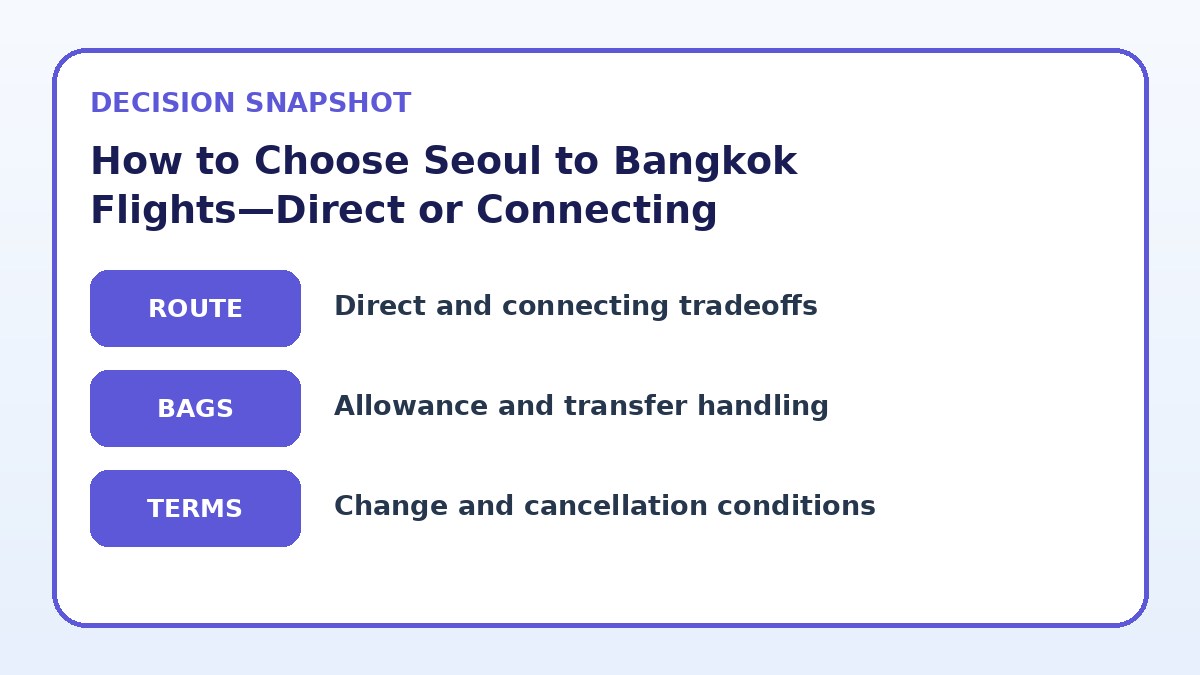
| Approach | Best for | Tradeoff to check |
|---|---|---|
| Direct flight | Travelers prioritizing simplicity, shorter transfer steps, and predictable arrival times | Often fewer schedule choices and sometimes higher base fares compared with multi-leg routes |
| One-stop connecting flight on single ticket | Those wanting more schedule flexibility while keeping some protection for missed connections | Longer travel time and a greater chance of disruption, though baggage usually transfers automatically |
| Separate tickets with self-transfer | Price-sensitive travelers who are comfortable managing transfers and longer buffers | Higher risk of missed connections and needing to re-check luggage, with no carrier responsibility for missed onward flights |
| Multi-stop routings with overnight layover | Visitors who want to break the journey, see an extra city briefly, or reset time zones | Adds travel complexity, possible costs for transit accommodation, and extra baggage handling steps |

Risk of disruption and how to manage it
Connecting itineraries inherently introduce more points of potential delay: a late incoming flight, ground handling slowdowns, or terminal transfers can all put a connection at risk. When you’re booking, pay attention to whether the legs are on the same ticket and whether the carrier guarantees baggage transfer. If they’re separate tickets, plan for much longer buffers and understand you may need to re-check luggage and clear immigration.
To reduce disruption risk, prioritize single-ticket connections with realistic minimum connection times stated by the airline or airport. Consider travel insurance that covers missed connections and check airline policies for rebooking on delayed flights. Before you finalize your booking, verify on the airline or online travel agency booking page which airport terminals you’ll use, the minimum connection time, and the airline’s baggage transfer rules—these specifics change and are essential to confirm.
Before you book
- Confirm whether the itinerary is on a single ticket (protects you if a connection is missed) before booking.
- Add realistic ground travel time to and from each airport to calculate true door-to-door time.
- Open the fare rules on the airline’s final booking page to verify baggage allowance and change or cancellation fees.
- Note terminal numbers for each leg and research transfer procedures between terminals at the connecting airport.
- If using separate tickets, allow at least double the airline’s minimum connection time and plan for re-checking luggage and immigration.
- Compare total trip cost including checked bags, seat selection, and any required transit visas, not just the base fare.
Price tradeoffs and what to compare on booking pages
A lower base fare on a connecting route can look tempting, but you must compare the total cost: add baggage fees, seat selection, change or cancellation fees, and any transit visas or airport transit fees that might apply in a connection country. Cheaper tickets sometimes carry stricter rules that make later changes costly. Use the booking page to expand the fare rules, baggage allowances, and change/cancellation policy before committing.
Also check what the carrier includes—meal service, seat assignments, and in-flight entertainment—as these affect the travel experience, especially on longer schedules. If you plan to arrive early in Bangkok and need a guaranteed arrival time, a slightly higher fare on a direct flight may be worth it. When comparing, open the fare conditions on the airline’s final booking page and confirm baggage transfer policies, connection acceptance in the same reservation, and whether separate tickets are involved.
Frequently asked questions
Are direct flights from Seoul to Bangkok always faster overall than connecting options?
Direct flights typically reduce the number of airport procedures and the potential for missed connections, so they often produce a shorter and less stressful journey. However, a connecting itinerary could have a shorter scheduled airborne time depending on routing and departure/arrival airports; total travel time depends on door-to-door factors such as ground transit, check-in windows, and layover lengths. For first-time visitors, evaluate full travel time and practical transfer steps rather than comparing only flight hours on schedules.
How much connection time should I allow when booking through a connecting airport?
Aim for more than the airline’s stated minimum connection time, especially if you need to change terminals, re-clear security, or collect and re-check baggage. For first-time visitors who prefer lower stress, adding an extra cushion—several hours on top of the published minimum—helps absorb delays and immigration lines. If legs are on a single ticket, airlines often protect you, but you’ll still want enough time to move between gates or terminals comfortably and handle unexpected slowdowns.
If I find a cheaper connecting itinerary, how do I check whether it’s a good deal?
Look beyond the headline fare: open the booking page and add fees for checked baggage, seat selection, and potential change or cancellation costs to the total. Confirm whether the legs are on one ticket or two separate tickets; separate tickets increase transfer complexity and risk. Also factor in ground transfers between airports, the risk of missed connections, and whether the connection requires immigration clearance. Balance the money saved against extra time, stress, and possible additional expenses.
Final planning note
Choosing between direct and connecting Seoul to Bangkok flights comes down to how you weigh time, convenience, and flexibility. If you want the simplest, least stressful arrival and are traveling with luggage or companions, a direct flight usually gives clearer benefits. If schedule constraints or fares push you toward a connection, prefer single-ticket itineraries, allow generous connection buffers, and confirm baggage transfer policies on the carrier’s final booking page. For first-time visitors, prioritize a straightforward travel day over minor savings. When you’re ready to compare live availability and conditions, Trip.com or the airline’s own site can show current options—use them to verify the exact fare rules and terminal details before you book.
Continue planning
Check current options and final conditions
Use the provider page to confirm live availability, the final total, cancellation terms, and every condition that matters to your trip.
This evergreen planning guide was created with AI-assisted drafting and a structured quality review. It does not display live prices, schedules, availability, visa guidance, or provider rankings. Verify current details before booking. Some links are affiliate links; we may earn a commission at no additional cost to you.