For most business travelers making the Dubai to Abu Dhabi run, the most practical choice is the option that minimizes door-to-door friction: the fewest transfers, predictable timing, and simple luggage handling. That often means balancing a private or app-based car for a straight door-to-door transfer against a scheduled coach or any rail leg that reduces traffic risk but adds transfer steps. Start by mapping your exact door-to-door time requirement, how much luggage or kit you carry, and whether you need flexible return windows. Then weigh terminal fit (where services drop you off in each city), luggage/transfer friction, schedule reliability during your travel window, and a clear disruption backup plan. This article walks you through those criteria, shows how to compare approaches, and gives a practical checklist for booking and contingency planning so your intercity trip supports — not disrupts — the business day.
Terminal fit: where your trip starts and ends
Terminal fit is about more than a central station name — it's about the exact building or curb where you will be picked up or dropped off, how far that is from your meeting or hotel, and whether the arrival point requires another short transfer. For a business traveler, a taxi or private car that drops you directly at a hotel entrance or office building typically beats an intercity coach that stops at a bus station several kilometres from your meeting. When you consider rail or any scheduled public service, map the final-mile options at both ends and factor walking time, local taxi availability, and elevator or accessibility needs if you have bulky luggage or equipment.
When comparing options, check whether scheduled services use out-of-town terminals or dedicated intercity hubs, and whether those hubs have convenient onward connections. Some services advertise a central city stop but actually use peripheral terminals to bypass congestion; that could add an extra transfer leg that negates any in-vehicle time savings. Make a quick sketch of your door-to-door journey: mark the pick-up/drop-off points, then estimate transfer seconds and minutes. That visual helps you see if a service is truly convenient or merely fast between terminal A and terminal B.
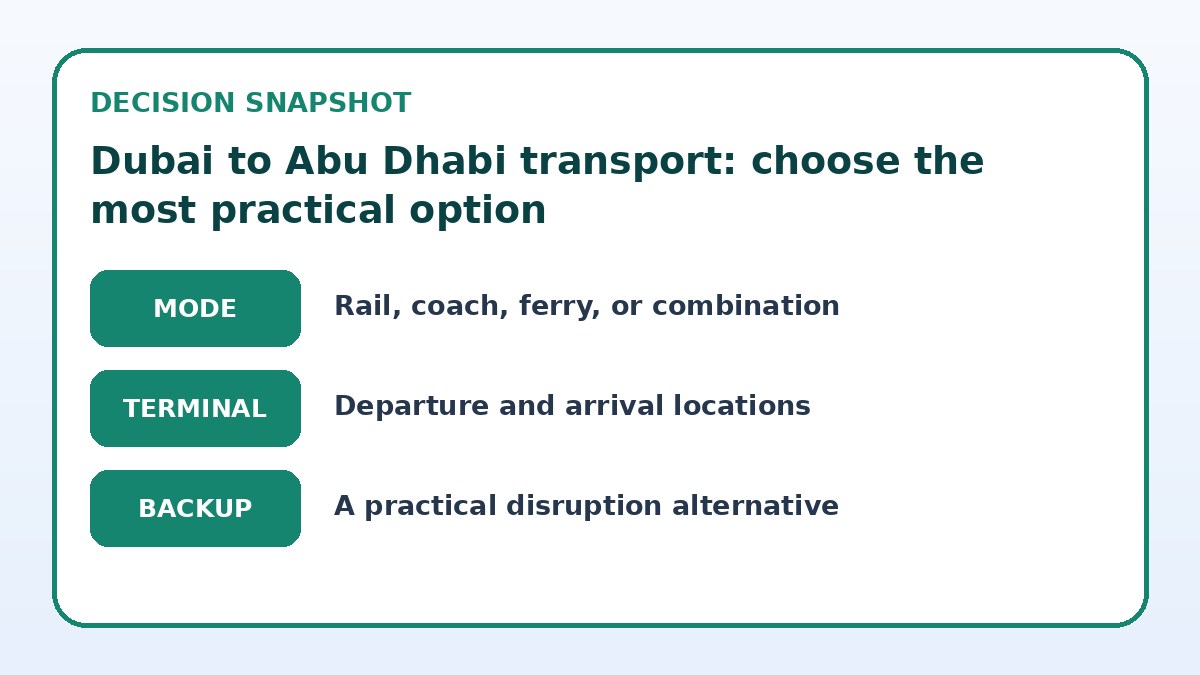
Choose the end-to-end journey plan
| Journey approach | Best for | Friction to check |
|---|---|---|
| Private car or chauffeur | Travelers prioritising door-to-door convenience, no transfers, and flexible departure times. | Higher per-trip cost and potential exposure to road congestion without timetable guarantees. |
| Scheduled express coach | Those who prefer a simpler booking process and lower fuss with a single scheduled vehicle. | May require a station transfer or last-mile taxi, adding time and luggage handling steps. |
| Rail or mixed rail+taxi | Commuters prioritising predictable timetable legs that avoid some road congestion risks. | Often needs taxi transfers at both ends and more luggage handling between modes. |
| Hybrid plan (coach/rail + app car) | Flexible professionals balancing cost, predictability, and last-mile convenience by combining modes. | Requires careful timing and buffer management to avoid missed connections or duplicated travel time. |
Check live intercity options
Look beyond the ride itself and compare terminals, transfers, luggage, and arrival fit.
Luggage and transfer friction: keep it simple
Luggage friction is a practical pain point. Business travelers with a single carry-on and briefcase value minimal handling; those transporting larger cases, equipment, or presentation materials need explicit handling assurances. Private cars or chauffeur services usually allow you to keep items with you and avoid baggage storage policies, while scheduled coaches or rail services can have luggage bays, platform steps, or baggage check rules. Before booking, confirm the exact luggage policy on the provider’s booking page and whether transfers require moving bags across platforms, long ramps, or shuttle buses.
Also consider how many times you’ll hand off luggage. Each additional transfer adds time, risk, and stress. If you can accept a short walk from a station, a coach or rail option may be acceptable and cost-effective; if not, choose point-to-point car services or a hotel-arranged transfer. For hybrid trips — for example, rail for the main leg plus a taxi at each end — plan the transfer timing buffer carefully so luggage reloading doesn’t become a bottleneck before a meeting.
Timing flexibility and predictability
Business schedules demand predictability more than raw savings. Assess whether you need fixed departure times or on-demand departure flexibility. Scheduled services can be reliable if they run frequently and adhere to timetables, but road conditions between Dubai and Abu Dhabi can affect coach and car travel differently depending on time of day. If your meeting start time is immovable, a slightly longer but timetable-guaranteed service with fewer road variables may be preferable; conversely, if you need evening flexibility, an on-demand car gives control.
When comparing options, also consider check-in or boarding windows and how tolerant they are of late arrivals. Scheduled services may require earlier arrival to pass through a station or platform; private cars typically reduce that buffer. Build a realistic buffer into your travel plan for pre-meeting arrival, and choose the option that yields the most dependable arrival probability for your acceptable buffer. If you must be contactable en route, verify onboard mobile connectivity or whether drivers accept stop requests en route where safe and legal.
Compare the practical alternatives
Use the final page to confirm what is actually offered on your dates and save a workable fallback.
Intercity travel checklist
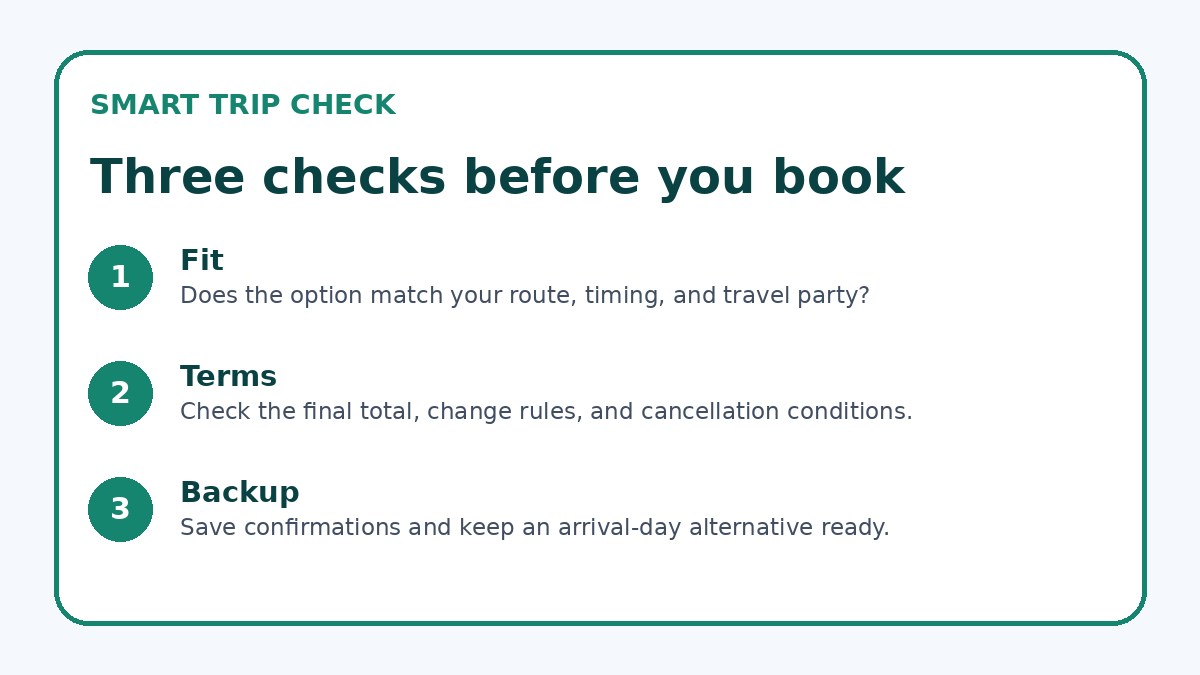
- Map your door-to-door route and measure walking and transfer distances between pick-up/drop-off points.
- Confirm luggage allowances and any bulky-item handling rules on the provider’s final booking page.
- Block a realistic pre-meeting buffer for arrival and allow extra time for transfers or peak traffic.
- Save the provider’s exact drop-off/pick-up location and a local contact number in your phone.
- Prepare a disruption plan: an alternate departure option, ride-hailing app, and a secondary contact.
- Verify change and cancellation terms before booking so you can adapt if schedule changes occur.
Disruption backup: practical contingency planning
A disruption backup is not just insurance — it’s an actionable alternate plan that you can execute quickly. For road travel consider a contingency route or a different departure window. For scheduled services, identify the next available departure and the simplest way to bridge missed connections: an app-based car, nearby taxi rank, or hotel shuttle. Keep contact numbers and an alternate app ready on your phone, and know the physical location of the nearest taxi stand or ride-hailing pickup point at both ends.
Also prepare digital and physical contingencies: a charging pack, printed meeting address and directions, and a secondary contact in Abu Dhabi who can receive a delayed arrival message. If you rely on a specific terminal or platform, verify its real-time status on the provider’s booking page before leaving and consider using a booking comparison tool like Trip.com to check current availability, but always verify details on the provider’s final booking page. Finally, allow time in your schedule for last-mile delays and confirm refund/change policies when you book, so you can pivot if needed.
Rail & Intercity Transport questions travelers ask
Is driving myself between Dubai and Abu Dhabi the best option for a tight meeting schedule?
Driving yourself gives control over departure time and door-to-door routing, which can be useful for tight schedules. However, control doesn’t remove traffic risk. If you drive, plan your route with real-time traffic monitoring, allow a generous buffer for peak periods, and account for parking and building access at your destination. If you prefer to avoid the hassle of parking and navigation, consider a private car service so you can work or rest during the journey and arrive ready for the meeting.
Can a scheduled coach or rail leg be reliable enough for business travel?
Yes — scheduled services can be reliably integrated into business travel if they run frequently enough, stop conveniently, and you allow comfortable buffers for boarding and transfers. They work best when the pick-up and drop-off points are near your origin and destination or when a short, guaranteed taxi transfer closes the gap. Before booking, check how many transfers the journey requires and whether those transfers add unpredictable time or handling complexity for luggage and devices.
What should I check right before leaving to minimise disruption risk?
Check the provider’s live status and booking confirmation for any last-minute changes, then verify the exact pick-up/drop-off point and the driver or vehicle contact if provided. Confirm your ride-hailing app is logged in and has payment set up, and charge your phone and any critical devices. Have a printed or offline copy of your meeting address and an alternate contact in Abu Dhabi. If you’re using a scheduled service, check the next departures so you can pivot quickly if needed.
Final decision note
Choosing the most practical Dubai to Abu Dhabi transport for business travel hinges on reducing door-to-door friction and ensuring predictable arrival. Make your decision by mapping where service terminals actually drop you, measuring luggage and transfer friction, and matching the option to how rigid your schedule is. Prioritise services that minimise handoffs if you carry critical equipment or prefer to arrive without extra moving parts. Always build a clear disruption backup — an alternate operator, a ride-hailing app, or an adjusted departure time — and verify essential policies and terminal details on the provider’s final booking page. With a simple checklist and contingency plan, your intercity trip can support a productive business day rather than complicate it.
Continue planning
Check current options and final conditions
Use the provider page to confirm live availability, the final total, cancellation terms, and every condition that matters to your trip.
This evergreen planning guide was created with AI-assisted drafting and a structured quality review. It does not display live prices, schedules, availability, visa guidance, or provider rankings. Verify current details before booking. Some links are affiliate links; we may earn a commission at no additional cost to you.