
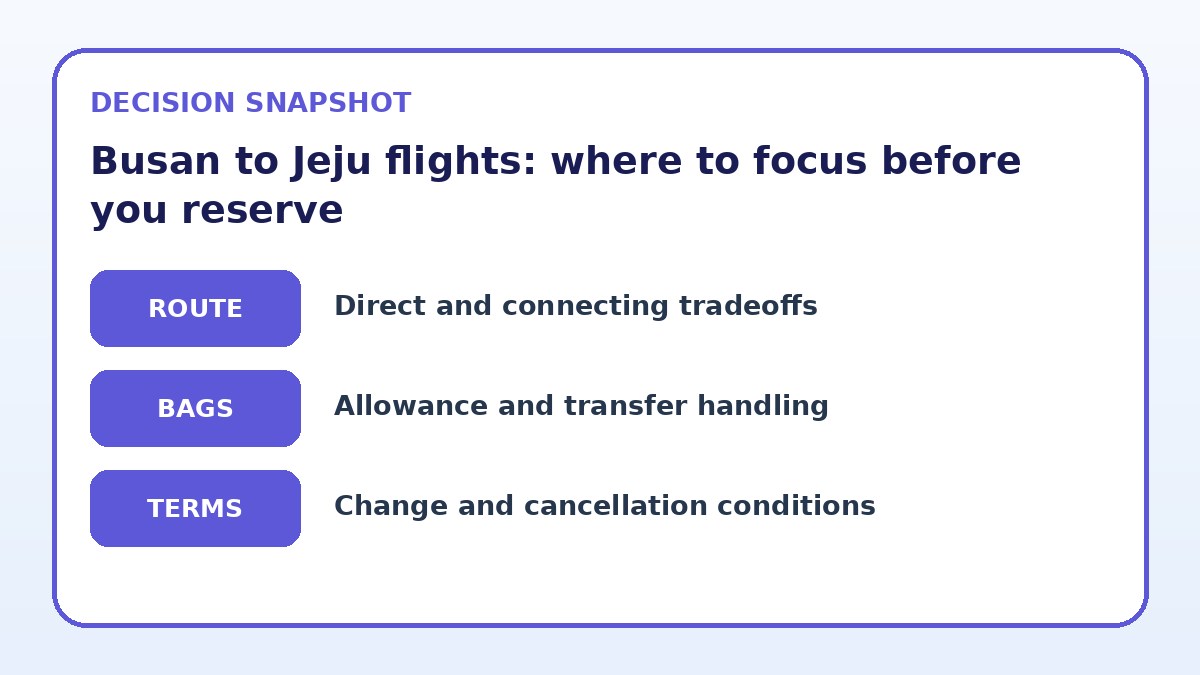
If you need to travel from Busan to Jeju on business, the sensible first step is a compact pre-booking checklist that prioritizes time, flexibility and minimal transit friction. Before you click ‘buy’, confirm whether the flights are direct or require a connection, what the airline’s change/cancellation and baggage rules are, and how airport transfers will fit with your meeting schedule. Business trips often hinge on a single meeting or deadline, so practical details—boarding proximity, luggage handling, and punctuality history—matter more than marginal fare differences. This article gives a ready-to-use checklist, explains tradeoffs when you compare direct versus connecting flights and flexible fare options, and points out which provider-specific details to verify on the airline or booking page, including seat selection, carry-on allowances, and real-time schedule confirmations like those shown on Trip.com.
See current options before you compare the details
Availability and final conditions change. Open Trip.com now or keep reading for the practical comparison.
Decide direct versus connecting flights
On the Busan–Jeju route you’ll commonly see both direct services and itineraries that include a connection. For a business traveler, the chief decision criterion is time reliability: direct flights reduce the number of variables that can delay you, while connecting flights sometimes open more schedule choices or lower fares. When evaluating options, estimate total door-to-door time—include transfer, security, and local transport—to see whether a shorter flight segment with a long connection is truly faster than a longer direct sector.
Tradeoffs matter: connecting itineraries can be useful if they create an early departure or late return that direct services don’t offer, or if they allow loyalty program benefits. However, connections increase the risk of missed meetings if the first leg is delayed. When comparing, look for realistic minimum connection times at the specific airports involved, and prefer single-ticket itineraries if you must risk a tight transfer, because single-ticket protection typically simplifies rebooking.
Prioritize fare rules and flexibility
A lower fare can be attractive but often carries restrictive change and cancellation rules. For business travel, prioritize tickets that allow schedule changes with reasonable fees, or that offer refundable or partially refundable options if your plans may shift. Look for explicit change-fee waivers or corporate fare options that include free name changes or rebook windows. When assessing value, calculate the effective cost of paying a higher fare versus the expected cost of potential changes.
Always read the fare conditions on the airline’s final booking page before purchase. Verify precisely what is allowed: how many free changes, whether the fare difference applies, if refunds are credited as vouchers only, and deadlines for free rebooking or cancellations. If your company has a travel policy or corporate rate, confirm how those terms interact with the fare class you choose so approvals and expense reporting remain straightforward.
| Approach | Best for | Tradeoff to check |
|---|---|---|
| Direct flights | Minimizing transfer risk and total travel complexity | May offer fewer departure times or slightly higher fares than connecting options |
| Connecting itineraries | Greater schedule flexibility and possible lower fares | Increased transfer time and more points of failure if delays occur |
| Flexible refundable fares | High-importance trips where plans may change | Higher upfront cost compared with restrictive economy fares |
| Basic non-refundable fares with add-ons | Cost-sensitive travelers who can lock plans in advance | Fees for changes, cancellations, and seat selection can add up |
Ready to check the option that fits your plan?
Use your exact dates and traveler details so the provider page can show the current total and conditions.
Airport logistics and ground transport
Factor in ground travel at both ends. In Busan, confirm which airport the flight departs from and how long it takes from your meeting location or hotel, including morning traffic patterns. On arrival in Jeju, know the distance to your meeting venue or hotel and the typical taxi or shuttle options; some business addresses are far from the main terminal. Pick flight times that provide buffer for immigration or security delays and give you time to arrive at meetings relaxed rather than rushed.
Also check airline check-in timelines and whether online check-in or priority lanes are available with your fare or loyalty status. If you must travel with equipment—laptop bags, presentation cases, or product samples—verify carry-on rules and whether priority boarding helps secure overhead space. Confirm whether airport services like fast-track security or dedicated transfer desks are available and whether they require advance booking or add-on fees.
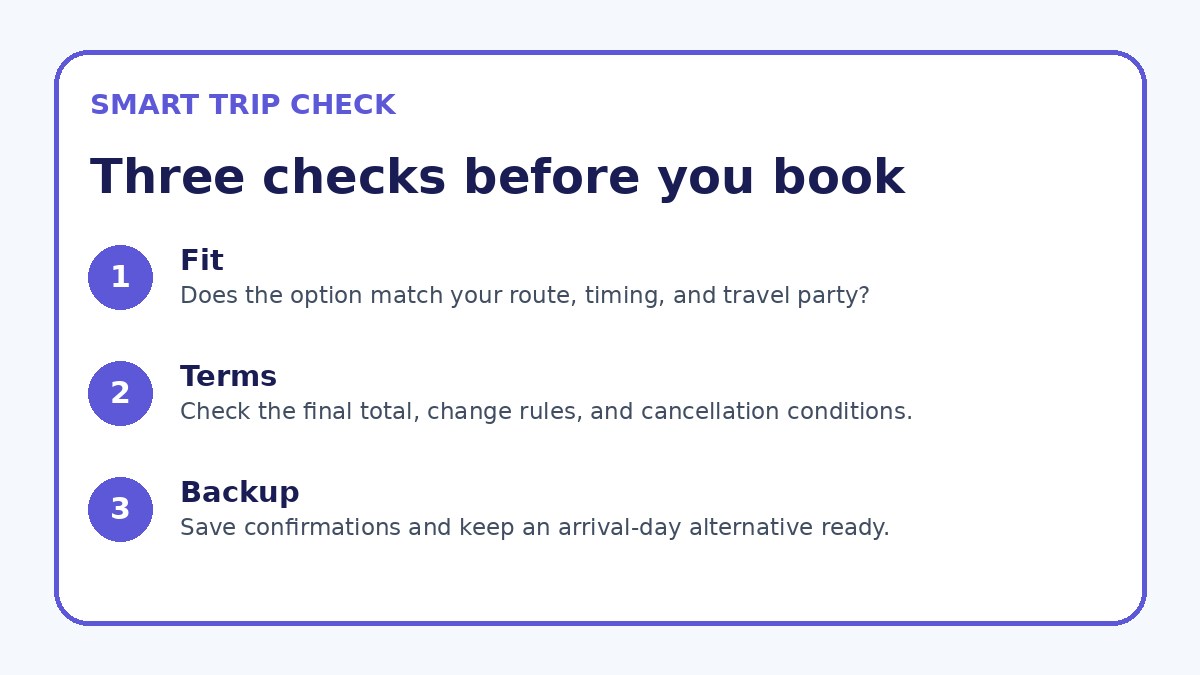
Before you book
- Confirm whether the itinerary is direct or has connections and note each airport involved to plan ground transfers accordingly.
- Read the fare conditions on the airline’s final booking page: change, cancellation, refund method, and any reissue fees.
- Verify carry-on and checked baggage allowances, including size and weight limits and the cost of additional items.
- Check seat selection rules and fees; reserve a seat if proximity to the aisle or exit row matters for work equipment access.
- Match flight times to ground travel: estimate door-to-door time including peak traffic, security, and time needed for presentations.
- Ensure booking details feed into your expense/travel management system and save booking references and contact numbers for quick rebooking.
What to verify on the provider booking page
When you reach the airline or booking provider page, verify the precise flight routing and whether any segment is operated by a different carrier. Confirm baggage allowances for carry-on and checked items, seat selection fees, and whether meals or amenities are included. If the itinerary involves connections under different carriers, look for notes about separate tickets or the need to reclaim and recheck luggage—these are crucial details that affect transfer time and risk.
Also check the fare rules for changes, cancellations, refunds, and reissue fees. Confirm check-in windows, boarding times, and any vaccine or entry document requirements that might affect your trip (if applicable). For corporate travelers using a travel management tool, match booking references and ensure they feed into expense systems. If you want a quick cross-check of available schedules and conditions, comparing listings on Trip.com can be helpful, but always treat the airline’s page as authoritative for final rules.
Frequently asked questions
Should I prioritize direct flights from Busan to Jeju for a half-day meeting?
Prioritizing direct flights is usually wise for half-day meetings because they reduce transfer risk and give you greater schedule certainty. Direct services minimize the number of potential delay points and simplify baggage handling, which matters when every minute counts. However, if direct schedules don't match your required departure or return windows, a carefully chosen connecting itinerary with adequate layover time can still work—pick a single-ticket connection where the carrier protects missed transfers and ensure you have buffer time before your meeting.
How do I choose the right fare class for corporate travel on this route?
Choose a fare class that balances flexibility with cost according to your company’s travel policy. If your schedule is fixed and risk of change is low, a standard economy fare with basic change options can be fine. If the meeting is mission-critical or timing uncertain, select a fare with lenient change and cancellation terms or a refundable option. Always verify corporate rate conditions and whether loyalty status or company agreements provide seat selection, baggage, or priority boarding benefits that make a lower fare more workable.
What documents and checks should I confirm before flying for business?
Before flying, confirm identification and any necessary travel documents required by the carrier or airports involved, and verify check-in windows and boarding deadlines. For domestic routes like Busan to Jeju, standard photo ID is typically required—check the airline page for specifics. Also confirm equipment restrictions (battery rules for devices), any insurance or corporate travel approvals needed, and how to contact the airline or travel manager if rebooking becomes necessary. Save digital and printed copies of booking references for quick access.
Final planning note
For business travelers between Busan and Jeju, a focused pre-booking checklist reduces uncertainty and preserves your time. Start by deciding whether the simplicity of direct flights outweighs any scheduling limits, then prioritize fare rules that protect you from last-minute changes. Add ground-transport timing, baggage and seat rules, and corporate approval flow as non-negotiable checks before purchase. Use the airline’s booking page as the final source for route, baggage, and fare-condition details; treat third-party sites like Trip.com as useful comparison tools but verify final terms with the carrier. A short verification routine before you book saves stress, protects meeting time, and often costs less than correcting mistakes after purchase.
Continue planning
Check current options and final conditions
Use the provider page to confirm live availability, the final total, cancellation terms, and every condition that matters to your trip.
This evergreen planning guide was created with AI-assisted drafting and a structured quality review. It does not display live prices, schedules, availability, visa guidance, or provider rankings. Verify current details before booking. Some links are affiliate links; we may earn a commission at no additional cost to you.