If you’re in Boston on business, decide first whether driving actually improves your schedule. For central meetings and Logan Airport arrivals, parking, congestion, and city short trips often make ride-hailing, transit, or a mix of walk-and-ride better choices. But if your itinerary includes suburban client visits, multiple stops across the metro area, or tight schedules that require door-to-door control, a rental can be the smarter option. The key determinants are fuel policy, mileage allowances, insurance coverage wording, and pickup/return friction—each can change the total cost and convenience dramatically. Read on for a quick decision framework, what exact contract lines to verify on the booking page, and practical alternatives if you decide not to drive.

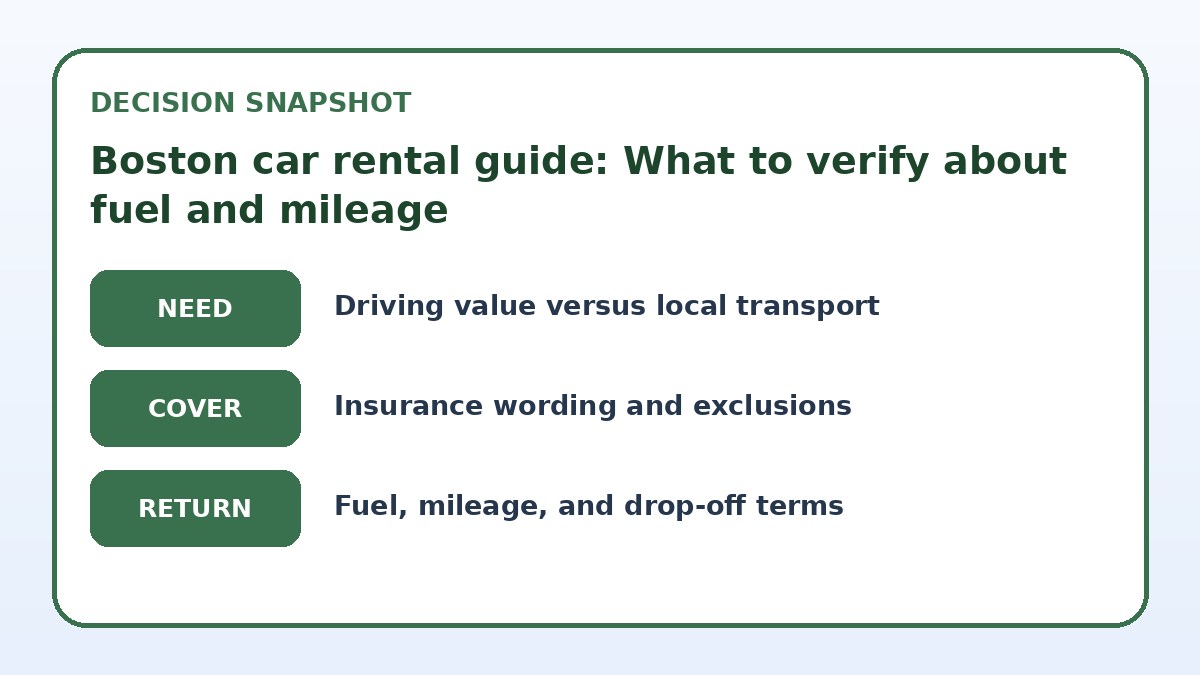
Decide if driving truly improves your Boston business trip
Start by mapping where your meetings are and when they happen. Boston’s core business districts—Financial District, Back Bay, Seaport—are compact, well served by the T, commuter rail, and short ride-hail trips, so a rental often adds parking hassles and time searching for spots. If your day’s appointments are spread across suburbs such as Cambridge, Waltham, or Quincy with limited transit between them, driving can reduce transfer times and let you carry materials without extra coordination.
Weigh schedule rigidity and passenger needs: early starts, late finishes, or multiple client sites that aren’t near transit nodes tilt the decision toward renting. Also consider group travel: a single car for two or three colleagues can be cheaper and more predictable than multiple ride-hail trips. Finally, remember ride-hail surge pricing, event-day congestion, and limited evening transit may influence the convenience calculus—estimate those costs alongside rental fees before committing.
Decide whether driving earns its place
| Mobility strategy | Best for | Cost or friction to check |
|---|---|---|
| Rent a car with unlimited mileage | Multi-suburb client rounds and flexible itineraries with many miles | Higher base rate but predictable per-mile cost and freedom to stop on your schedule |
| Short-term rental for downtown only (daily pick-up/drop-off) | Single-day urban errands where parking and congestion are manageable | Saves ride-hail costs but adds parking, meter, and potential short-trip fuel penalties |
| Ride-hail plus local transit | Dense downtown schedules and when you prefer not to manage parking or fuel | Flexible and low-friction for short hops but unpredictable cost during peak times |
| Rail or shuttle-focused non-driving plan | Commuter-line suburbs and fixed-schedule meetings aligned with train or shuttle times | Cost-effective and reliable on schedule, but less flexible for last-minute detours |
Check live rental choices only after the route test
Use the exact driver, dates, pickup point, and return plan to compare current conditions.
What to verify on fuel and mileage policies before booking
Fuel policy language determines whether you must return full, prepay fuel, or accept a fuel service charge. On the provider’s final booking page, find the exact phrasing: 'return full' versus 'fuel purchase option' or 'fuel service fee.' If a prepay option exists, note whether unused prepaid fuel is refunded; many vendors do not refund unused amounts. Also confirm how the company calculates fuel service charges—per gallon equivalent or flat fee—and whether state fuel taxes are included.
Mileage rules are equally important. Check for explicit 'unlimited mileage' wording or a clear daily/total mileage cap with the per-mile overage rate. For business travelers planning long suburban runs, a modest daily cap can quickly generate expensive overage charges. If your route includes highway travel or a long one-way drop-off, also verify whether the contract permits one-way rentals without punitive fees or restricted zones.
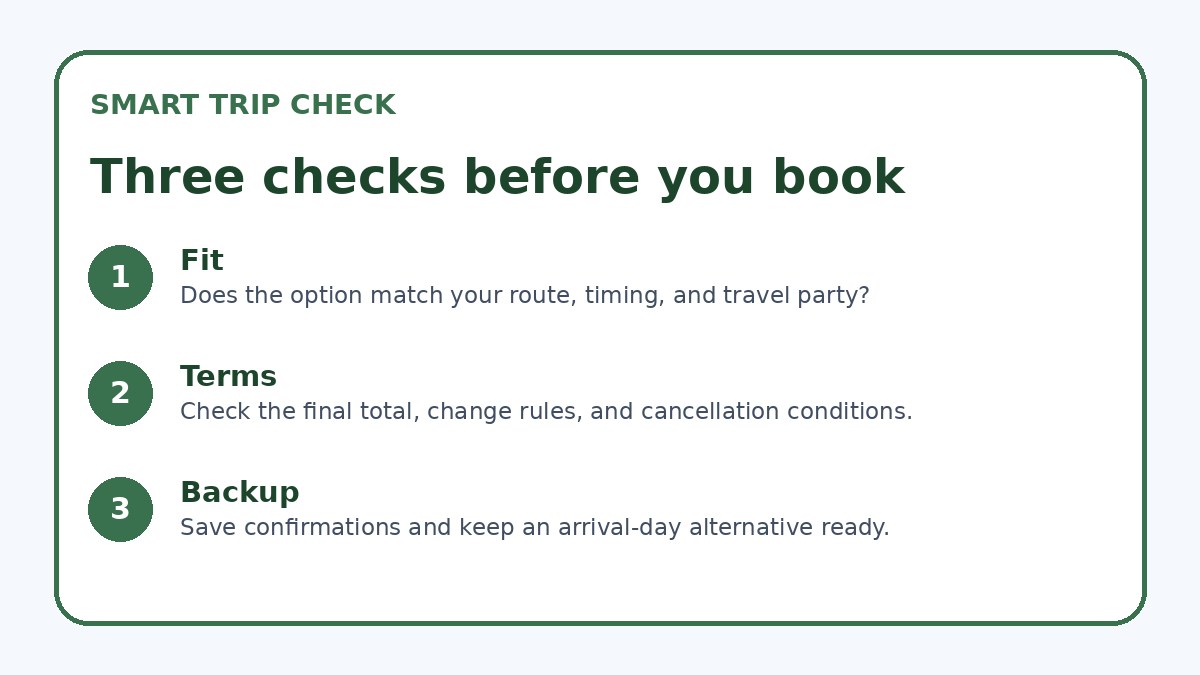
Compare the full rental conditions
Confirm insurance wording, exclusions, deposit, fuel, mileage, and return terms on the final page.
Insurance and liability wording: what business travelers must check
Insurance sections can be dense but read them closely on the final booking page. Confirm whether collision damage waiver (CDW), loss damage waiver (LDW), and liability coverage are included or offered as optional add-ons, and—critically—what they exclude. Look for exclusions like damage to tires, windows, undercarriage, or off-road use, and whether you must buy optional coverage to avoid a large deductible. If you plan to use a company card or corporate policy, verify if it covers rental vehicles in the U.S. and what documentation the rental counter requires.
Also check wording about authorized drivers and corporate billing. Some contracts restrict who can drive the car without voiding coverage; others allow additional drivers for a fee. If a colleague or contract driver will use the rental, ensure they are listed at pickup. Finally, verify towing and roadside assistance terms—especially important for overnight trips or winter travel—so you’re not surprised by out-of-pocket emergency costs.
Car rental terms to verify
- On the rental provider’s final booking page, confirm the exact fuel policy wording (return full, prepaid, or fuel service fee) and refund rules for unused prepaid fuel.
- Verify mileage allowance: look for 'unlimited mileage' or note daily/total caps and the per-mile overage rate so you can estimate potential extra charges.
- Read the insurance/exclusions section and confirm whether CDW/LDW, liability, and roadside assistance are included or require optional purchase.
- Check authorized-driver rules and list any colleague drivers at pickup; get written confirmation that adding drivers won’t void coverage.
- Confirm pickup and return location details, after-hours return procedure, and the grace period for late returns to avoid surprise fees.
- Prepare a non-driving fallback by estimating ride-hail costs between your meeting clusters, checking commuter rail schedules, and saving transit app credentials.
Pickup, return friction, and a reliable non-driving fallback
Pickup and return logistics add real time costs. Off-airport desks can mean shuttles, added wait time, and extra fees; city-center locations may have limited hours that complicate late returns. On the booking page, check exact pickup location details, shuttle requirements, after-hours return instructions, and whether out-of-hours returns incur charges. Also confirm the grace period for late returns and the billing increments used to calculate late fees—hourly or daily—so you can plan drop-off timing precisely between meetings or flights.
A strong non-driving fallback minimizes risk if your plan changes. For downtown-focused itineraries, identify a primary ride-hail provider and estimate round-trip costs for each meeting cluster. For longer transfers, check commuter rail schedules, shuttle services from major hotels, and express bus connections to suburban office parks. Keep one contingency card in your wallet—booking apps, a local transit map PDF, and a small prepaid transit card or digital pay option can make the non-driving alternative fast and reliable.
Car Rental & Road Trip questions travelers ask
Should I accept a prepaid fuel option when renting in Boston?
Prepaid fuel can be convenient if you know you’ll use most of the tank, but many providers do not refund unused amounts. If your day is mainly urban and you expect low mileage, it’s usually cheaper to return the car full and avoid prepay unless the vendor explicitly promises a refund for unused fuel. On the booking page, verify the exact refund policy, how the charge is calculated, and whether a ‘fuel service fee’ applies instead of a per-gallon charge.
How do I verify whether my corporate card or personal insurance covers rental damage?
Don’t rely on assumptions—check your corporate travel policy and your card issuer’s rental coverage terms before pickup. On the provider’s final booking page, note required documentation and whether specific coverages are excluded. If the corporate policy covers rentals, confirm any deductible amounts and whether coverage applies within the U.S. If uncovered items remain, decide whether to buy the rental company’s optional waivers to eliminate potential large deductibles.
What are the practical signs that I should skip renting and use ride-hail or transit instead?
Skip renting if most meetings are within a compact Boston neighborhood, where parking is limited or expensive, or if you’ll be moving between locations well served by the T or commuter rails. Also avoid renting when you face late-night or early-morning pickups that complicate after-hours returns, or when short one-way trips would trigger high drop-off fees. Compare estimated ride-hail fares and transit timetables for your exact meeting times before deciding.
Final decision note
For business travelers in Boston, the practical question is not whether a rental exists but whether it reduces friction for your precise schedule. Confirm fuel policies, mileage caps, and insurance wording on the rental provider’s final booking page, and check pickup/return logistics before you commit. If most activity is downtown, a transit-plus-ride-hail strategy often wins on time and cost; if you need suburban reach or multiple early-morning stops, a car with unlimited mileage and clear insurance terms will likely be better. Keep a non-driving fallback and a concise checklist at hand so you can pivot without wasted time or surprise expenses.
Continue planning
Check current options and final conditions
Use the provider page to confirm live availability, the final total, cancellation terms, and every condition that matters to your trip.
This evergreen planning guide was created with AI-assisted drafting and a structured quality review. It does not display live prices, schedules, availability, visa guidance, or provider rankings. Verify current details before booking. Some links are affiliate links; we may earn a commission at no additional cost to you.