
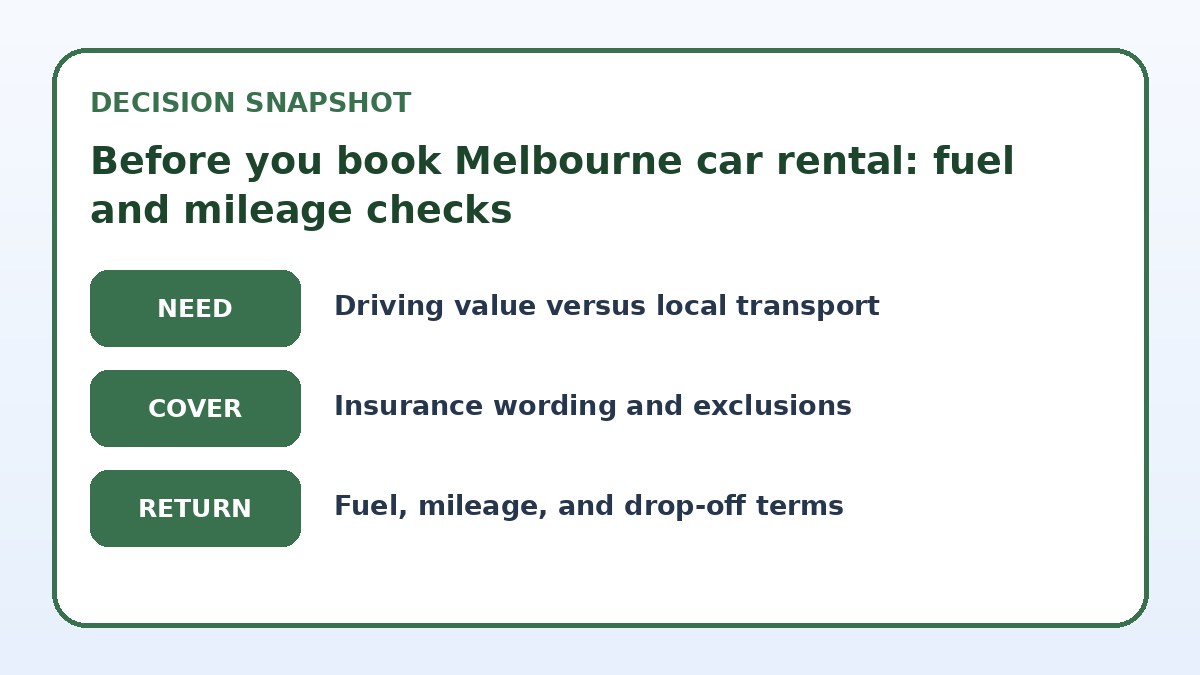
For business travelers renting in Melbourne, the quickest way to avoid surprise charges is to check the car rental provider's fuel and mileage rules before you book. Confirm the fuel policy (full-to-full, pre-purchase, or refuel service), the odometer allowance or per-kilometre charges, and whether urban congestion or airport surcharges affect claims. These three items affect both your out-of-pocket costs and how your finance team will reconcile expenses. Also verify how the company documents fuel purchases and mileage for invoicing or receipts; some providers produce detailed rental summaries while others expect you to keep receipts and note odometer readings. If you plan longer day trips to Geelong, the Mornington Peninsula, or regional Victoria, mileage limits and excess-kilometre rates become important to avoid steep fees. Use the supplier’s final booking page to confirm the exact wording of fuel and mileage terms and any mandatory refuelling fees.
See current options before you compare the details
Availability and final conditions change. Open Trip.com now or keep reading for the practical comparison.
Understand Melbourne fuel policies and their tradeoffs
Rental companies generally offer a few common fuel options; the one you choose changes convenience and cost. Full-to-full means you pick up with a full tank and return it full; this is often the simplest and cheapest option for business travelers who can refuel locally before return. Pre-purchase (‘buy fuel upfront’) can look convenient but may leave you paying for unused litres at the supplier’s rate. A refuel service charges for filling the tank after drop-off, typically at a higher per-litre rate plus an administration fee, so weigh that against the time saved if you’re tight for schedule when returning the car.
Deciding which to use depends on itinerary and time pressures. For a multi-day road schedule with planned petrol stops, full-to-full reduces surprises but requires remembering to refuel before return. Pre-purchase can work if your trip is short and you expect to use most of the tank, and you value avoiding a last-minute fuel stop. If you know you'll arrive late or have limited time on return, paying for a refuel service may be worth the premium — but only if company policy or reimbursements cover the added cost. Always check the contract language on fuel rates and fees before confirming.
Mileage allowances: what business travelers must check
Some Melbourne rentals include unlimited kilometres, while others set a daily or total allowance with excess-kilometre charges. For business travelers this matters if your schedule includes trips outside metropolitan Melbourne to places like Ballarat or the Mornington Peninsula. Calculate your planned distance, compare it to the supplier’s allowance, and multiply any excess kilometres by the published per-kilometre fee to estimate potential overage. Note that different vehicle categories may have different allowances—compact cars might come with a lower allowance than SUVs or vans—so match the vehicle type to your travel needs.
Beyond stated allowances, check how the provider measures distance and records odometer readings at collection and return. Ask whether toll roads and GPS-tracked miles are treated differently, and if the rental company rounds readings or uses a final invoice that lists per-day mile totals. For expense approval, your finance team will prefer clear documentation of start and end odometer figures and any intermediary charges. If in doubt, photograph the odometer at pickup and drop-off to support expense claims and dispute potential discrepancies.
| Approach | Best for | Tradeoff to check |
|---|---|---|
| Full-to-full fuel policy | Travelers with time to refuel before return and who want minimal extra fees | Requires remembering to refuel; last-minute refuels may be inconvenient if returning late. |
| Pre-purchase fuel | Short trips where you’ll likely use most of the tank or value not stopping at return | You may pay for unused fuel; less cost-effective if you return with fuel remaining. |
| Refuel service by provider | Travelers with tight schedules who need a quick after-hours return | Higher per-litre rate plus admin fees; may not be reimbursable by corporate policy. |
| Unlimited mileage booking | Business trips that include regional day trips or uncertain driving distances | Often more expensive in base rate; check if truly unlimited or subject to fair-use limits. |
Ready to check the option that fits your plan?
Use your exact dates and traveler details so the provider page can show the current total and conditions.
Corporate billing, receipts, and expense reconciliation
Business travelers need to know exactly what documentation the rental firm provides at checkout and on return. Some companies produce a comprehensive rental summary that lists start/end odometer readings, fuel charges, refuelling fees, and any location surcharges; others provide only a basic receipt and expect you to retain fuel till receipts and manually note kilometres. Confirm whether the firm can email an itemised invoice to the corporate account or to your email immediately after return. If your company requires VAT-style or GST-compliant invoices, check that the provider’s paperwork meets those accounting needs.
Also verify whether extra services—like refuelling service fees, out-of-hours return fees, or airport collection surcharges—appear automatically on the invoice and how they are described. Ask in advance whether the rental firm supports corporate billing codes, central invoicing, or direct charging to a corporate card, and whether adjustments after the rental (for tolls or damage) will produce revised documentation. Knowing the provider’s invoicing timelines helps you plan expense submissions and avoid delays in reimbursement.
Before you book
- Read the fuel policy wording on the provider’s final booking page and note whether the policy is full-to-full, pre-purchase, or refuel service.
- Calculate expected trip kilometres and compare to the stated allowance; estimate any excess-kilometre cost before choosing a vehicle category.
- Photograph the odometer and fuel gauge at pickup and again at return and save pump receipts for corporate expense claims.
- Confirm what invoice documentation the rental company issues and whether itemised, emailed invoices meet your company’s accounting needs.
- Ask the booking agent about location-specific fuel or airport surcharges and whether those will appear on the final invoice.
- If returning after hours, follow the provider’s documented drop-off and key return procedures and obtain a confirmatory email or receipt.
Practical steps at pickup and return to avoid disputes
At pickup, inspect the vehicle and record the odometer reading, fuel level, and any existing damage. Take photos or a short video that clearly shows the dash, petrol gauge, and exterior condition; these are invaluable if you later contest fuel or mileage charges. Ask the agent to confirm the fuel policy in writing for your contract—don’t rely solely on a verbal statement. If you’re on a corporate account, present your business card and confirm the account details so billing aligns with your employer’s expectations.
On return, refuel according to the agreed policy and keep the pump receipt; if returning after hours, follow the supplier’s documented procedure for sign-off and where to leave the keys. Photograph the odometer and fuel gauge again, and request an itemised receipt or rental summary before you leave the depot when possible. If any charges are unexpected on the invoice, contact the provider promptly and provide photos and receipts; most disputes are resolved faster when you can show contemporaneous evidence of fuel level and kilometres at pickup and drop-off.
Frequently asked questions
How do I prove mileage for my company expense report?
To prove mileage, record the odometer reading at pickup and at return and keep a clear photo of each. Save all fuel pump receipts with date, litres, and price. If your employer requires a specific form, fill it out and attach the odometer photos and fuel receipts. Ask the rental company for an itemised invoice that lists start and end odometer readings; many companies can email this automatically. If an invoice lacks odometer details, your photos combined with pump receipts and the rental agreement will support the claim in most corporate processes.
Can I refuel after hours without being overcharged?
If you return outside opening hours, confirm the supplier’s after-hours return procedure and whether they accept a fuel receipt submitted later. Some providers require you to use their refuel service for after-hours returns and will charge a premium; others permit you to leave the keys and upload receipts within a set timeframe. Check the final booking page or ask the agent to document the after-hours policy. Keep your pump receipt and timestamped photos of the fuel gauge to dispute any unreasonable refuelling fees.
Should I book unlimited kilometres for a multi-site day of meetings?
Booking unlimited kilometres removes the worry of excess-kilometre charges during busy multi-site days, and it simplifies expense calculations. However, unlimited options can raise the base rental rate; weigh that against your realistic daily distance. If you can reliably estimate total kilometres and the excess-kilometre fee is modest, a standard allowance plus calculated overage may be cheaper. For unpredictable itineraries or regional site visits, unlimited or a high daily allowance offers predictable budgeting and fewer administrative headaches when submitting expenses.
Final planning note
When renting in Melbourne for business, checking fuel and mileage rules upfront saves time and prevents billing surprises. Focus first on the fuel policy—full-to-full tends to be clearest for corporate expense reconciliation—then confirm mileage allowances against your planned itinerary. Document odometer readings and fuel levels with photos and retain pump receipts to support any later disputes. Verify invoicing options and ask the provider to email an itemised summary if your company requires specific documentation. Finally, use the supplier’s final booking page to confirm the exact fuel wording, per-kilometre fees, and any location surcharges before you complete the reservation.
Continue planning
Check current options and final conditions
Use the provider page to confirm live availability, the final total, cancellation terms, and every condition that matters to your trip.
This evergreen planning guide was created with AI-assisted drafting and a structured quality review. It does not display live prices, schedules, availability, visa guidance, or provider rankings. Verify current details before booking. Some links are affiliate links; we may earn a commission at no additional cost to you.