For business travelers wrapping up a trip in Auckland, the return to the airport can be the most schedule-sensitive part of your journey. Plan the transfer deliberately: pick a transport mode that matches your meeting end time, luggage, and risk tolerance, then build in buffers for traffic, check-in, and security. Decide whether fixed-schedule shuttle, private car, rideshare, or rental-car drop-off best fits your timeline before you commit. In the paragraphs that follow I explain practical tradeoffs—reliability vs cost, control vs convenience—and the specific checks to make on provider pages so you don’t face surprises at checkout or on the day of travel.
See current options before you compare the details
Availability and final conditions change. Open Trip.com now or keep reading for the practical comparison.
Choose the transfer style that matches your schedule
Start by mapping your timeline: note the flight check-in and security baseline recommended by your airline, then subtract the time you need to arrive at the airport. Business travelers often prioritize reliability and predictability over saving a few dollars, so consider pre-booked private transfers or hotel-arranged airport cars when meetings run late or you must arrive at a fixed time. Those options let you lock in a pickup window and provide a single point of contact if plans change.
If meetings are more fluid and you value flexibility, rideshare services or taxis can be faster to summon at short notice. They work well when you have slack in your schedule and can tolerate some wait time for a vehicle or brief variability from traffic. For group travel, a shared airport shuttle may be cost-effective but check whether the shuttle’s fixed schedule meshes with your planned departure time and whether it stops at multiple hotels en route, which adds travel time.
Account for Auckland traffic patterns and check-in windows
Auckland’s traffic peaks and the distance from central neighborhoods to the airport vary by time of day; morning and late-afternoon peaks can add significant journey time. For any option you choose, build in a conservative buffer beyond the usual drive time, especially if you’re relying on a taxi or rideshare where route choice and pickup time are less predictable. Business travelers should also respect recommended airline check-in and international security timelines and aim to arrive earlier if returning a rental car or transporting heavy luggage.
When calculating departure time, consider meetings that overrun and the time you’ll need to reach the pickup point from the meeting venue, especially if you’re in a building with limited loading access. If you must be at the airport by a specific time, favor options that let you confirm the pickup in advance and provide contact details for last-minute adjustments. Verify provider cancellation and change policies on their booking pages so you know the flexibility if your schedule slips.
| Approach | Best for | Tradeoff to check |
|---|---|---|
| Pre-booked private transfer | Fixed schedules, heavy luggage, executive comfort | Higher cost and need to book in advance; verify waiting and late arrival terms |
| Hotel-arranged car | Convenience and minimal planning on departure day | May use third-party providers; confirm pickup instructions and direct contact details |
| Rideshare or taxi | Flexible departures and last-minute changes | Variable wait times and pricing; requires app access and contingency for peak demand |
| Rental-car return | Control of departure time and flexibility during the trip | Extra time for vehicle handover and shuttle; confirm drop-off process and location |
Ready to check the option that fits your plan?
Use your exact dates and traveler details so the provider page can show the current total and conditions.
Compare control, cost, and convenience before booking
Private pre-booked transfers give the greatest control: fixed pickup, driver waiting options, and often meet-and-greet service at hotels. These are ideal for executives carrying equipment or preferring a quiet, direct ride. The tradeoff is generally a higher base fare and the need to book in advance. Make sure to verify whether waiting time is included, how drivers identify you at pickup, and what happens if your meeting runs late—these are details providers may change and will be listed on their booking page.
Rideshares and taxis give convenience without advance commitment and can be cheaper for solo travelers on a tight budget. However, they expose you to price fluctuations, variable wait times, and potential surge pricing during peak demand. For rental cars, confirm airport drop-off procedures, keys handover, and whether you’ll need a shuttle from the rental lot. Always check the provider’s final booking terms—pickup location, contact process, inclusions, and change fees—before you confirm.
Before you book
- Work backward from your flight’s required airport arrival time and add at least 30–60 minutes buffer for traffic and unexpected delays.
- Decide whether you need a pre-booked pickup or can rely on on-demand options, then reserve or install necessary apps accordingly.
- If using a hotel transfer, get the driver or provider’s direct phone number and written pickup instructions before checkout.
- Confirm rental-car return procedures with the agency: drop-off location, key handover, and whether an airport shuttle is needed.
- Record local taxi dispatch numbers and ensure at least one rideshare app is active with a valid payment method as backup.
- Check provider terms on the final booking page: wait-time rules, late arrival policy, cancellation and change fees, and luggage limits.
Practical checks and backup plans to finalize your choice
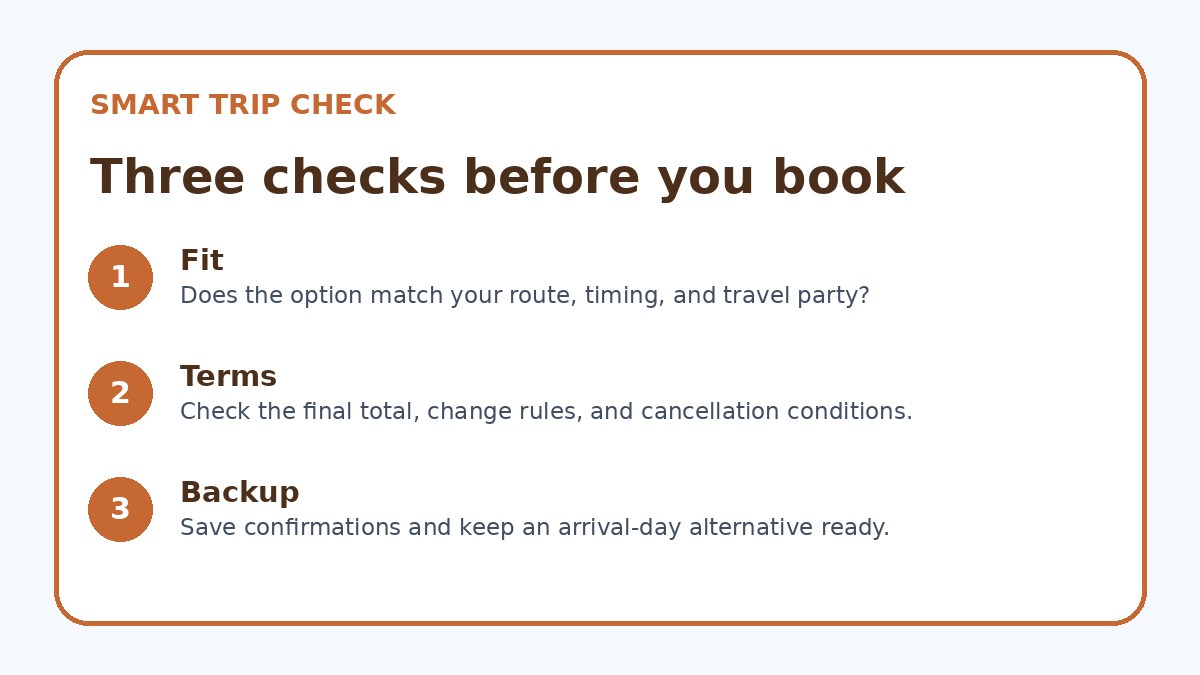
Before you book, verify a few essentials on the supplier’s page: exact pickup location and meeting instructions, contact number, wait-time and late-arrival policy, cancellation and change terms, and any luggage or vehicle-size restrictions. If you rely on your hotel to arrange transport, confirm whether they use a third-party provider and obtain direct contact details. Business travelers should also ask about invoicing or corporate account options if expense reporting is needed.
Always prepare a backup: note the local taxi dispatch number, install at least one rideshare app and top up payment methods, and confirm where the rental-car return shuttle departs. If your schedule is critical, book the primary option and secure a secondary plan you can execute quickly. Trip.com can be used as a place to compare current availability and conditions, but verify all operational details on the chosen provider’s official booking page before confirming.
Frequently asked questions
How far in advance should I book an airport transfer in Auckland for a business flight?
For business flights with fixed departure times, book a pre-arranged transfer as soon as your travel times are confirmed—this secures the pickup window and reduces day-of stress. If you prefer flexibility, keep a rideshare app installed and confirm taxi or hotel-arranged options the night before. When booking, check the provider’s stated pickup and waiting policies so you understand what happens if your meeting runs late and whether there’s a grace period or extra charge.
What factors should I consider when deciding between rideshare and pre-booked private car?
Consider schedule certainty, luggage, comfort, and expense reporting needs. Pre-booked cars offer predictable pickups and professional meet-and-greet—helpful for tight schedules or when carrying equipment. Rideshares are convenient for variable plans and can be summoned quickly but may fluctuate in price and availability during peak times. Also check invoicing and corporate payment options if you need receipts for expense claims, and verify any pickup-location restrictions on the provider’s booking page.
If I return a rental car at the airport, how much extra time should I allow?
Allow additional time beyond the driving distance to complete vehicle inspection, paperwork, and return the keys; if the rental lot isn’t adjacent to the terminal, factor in shuttle transfer time to the terminal as well. The exact extra time depends on the company and lot layout, so confirm drop-off procedures and estimated transfer time on the rental agreement or provider page. Plan conservatively so you’re not rushing through security or check-in after the handover.
Final planning note
Business travel to Auckland goes more smoothly when you plan the return transfer with the same care you give meetings and flights. Choose the transfer style that matches your tolerance for uncertainty, luggage needs, and corporate requirements, then verify pickup details, waiting policies, and change fees on the provider’s booking page. Always build conservative time buffers for traffic, vehicle handovers, and security. Keep a backup option ready—hotel-arranged transport, a local taxi number, or a rideshare app—and you’ll leave Auckland with less stress and more control over your schedule.
Continue planning
Check current options and final conditions
Use the provider page to confirm live availability, the final total, cancellation terms, and every condition that matters to your trip.
This evergreen planning guide was created with AI-assisted drafting and a structured quality review. It does not display live prices, schedules, availability, visa guidance, or provider rankings. Verify current details before booking. Some links are affiliate links; we may earn a commission at no additional cost to you.