If you need to travel from Bangkok to Ayutthaya for a meeting or site visit, pick the option that minimizes total door-to-door time, transfer hassle, and the risk of being late. For most business travelers who value predictability and low transfer friction, a point-to-point road transfer (taxi or private car) wins when meetings start early or end late, or when you must carry sensitive luggage. Rail becomes the smart choice when your schedule aligns with a reliable service and you can manage the short last-mile transfer at either end. Coaches and shared minivans can be cost-efficient and comfortable, but watch for fixed departure times and extra stops that add variability. Read on to compare terminal fit, luggage handling, timing flexibility and disruption backups so you can choose the most practical intercity option for your next business trip.
Terminal fit: where each mode drops you and why it matters
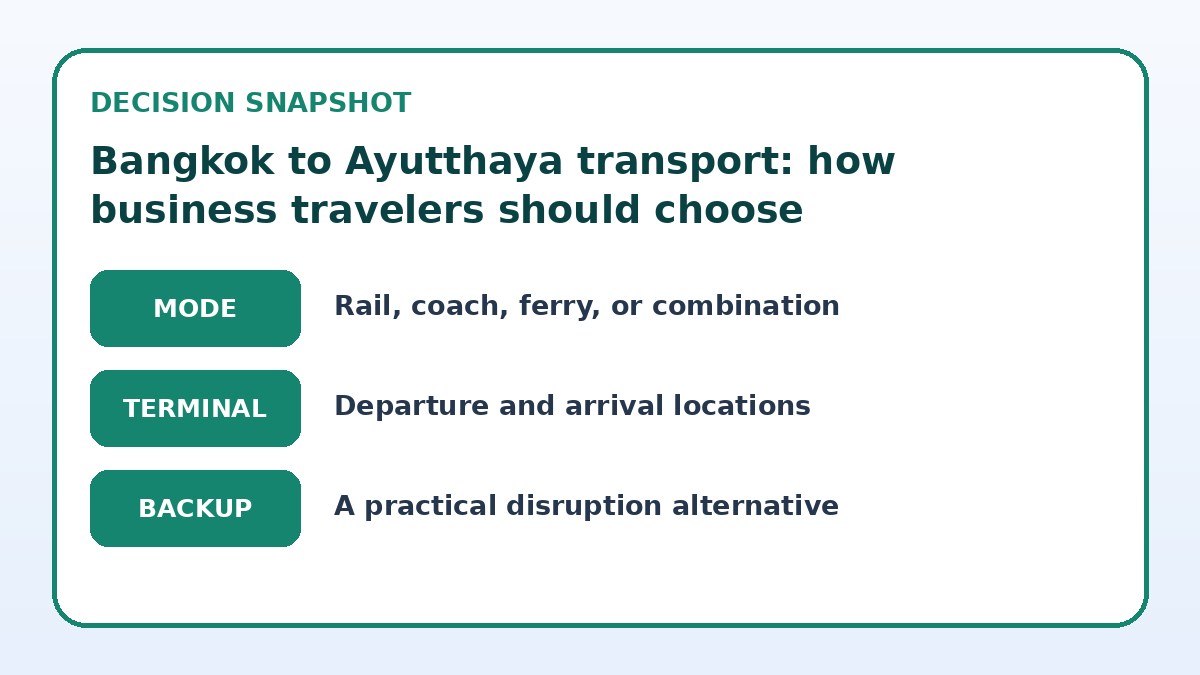
Terminal fit is about how close the arrival and departure points are to your actual meeting address. Road transfers (metered taxi, booked private car) offer the clearest terminal fit because they deliver you door-to-door; there’s no last-mile parking walk unless a building restricts vehicle access. For corporate travel, this reduces walking with luggage, simplifies arrival at office receptions, and avoids the time spent coordinating onward local transfers. If your meeting is at a riverside site or a suburban address outside Ayutthaya’s historic center, a direct car keeps the schedule tight and predictable.
Trains arrive at Ayutthaya station which sits within the town but usually requires a short taxi or tuk-tuk ride to many hotels and business addresses. That extra leg is short but adds an unknown if local taxis are busy at arrival times. Coaches and minivans often stop at centralized bus terminals or roadside drop-offs; select services that list their exact drop point before booking so you can gauge the final transfer. Always map the final walking distance and likely waiting time for local transfers when you compare options.
Choose the end-to-end journey plan
| Journey approach | Best for | Friction to check |
|---|---|---|
| Private car/taxi | Maximizing door-to-door predictability and minimizing transfers | Higher cost and potential traffic variability on the road leg |
| Train (station + short taxi) | Stable onboard time and work-friendly environment during the journey | Requires a last-mile transfer and alignment with train schedules |
| Coach/minivan service | Balanced cost and comfort for mid-day trips with fixed departures | Less flexibility and potential extra stops that extend total travel time |
| Hybrid (scheduled main leg + pre-booked taxi) | Combines lower-cost scheduled travel with guaranteed last-mile timing | Requires coordinating two bookings and monitoring both providers |
Check live intercity options
Look beyond the ride itself and compare terminals, transfers, luggage, and arrival fit.
Luggage and transfer friction: what to expect with bags and devices
If you travel with a wheeled suitcase, briefcase and electronics, transfer friction becomes a real productivity cost. Road transfers let you stow bags in the trunk and keep devices on your person, avoiding platform stairs or tight bus aisles. Private cars also let you keep meeting materials within reach for last-minute prep. For travelers with oversize items or locked equipment, confirm the vehicle type when you book. If you use a ride-hailing app, check whether the ‘large luggage’ or equivalent option is available in Bangkok and Ayutthaya service areas.
On trains and coaches, luggage storage varies: trains may have racks, under-seat space, or guarded luggage areas depending on class; coaches usually have external luggage holds but require attendants to load and unload. That adds handling steps and a small risk of delay if staff are busy. If you have fragile equipment, bring a soft wheeled bag you can keep on your lap where allowed, and plan buffer time for platform-to-meeting transfers. Also confirm whether the station or terminal has elevators or ramps if mobility or heavy cases are a concern.
Timing flexibility: aligning departures with business schedules
Assess whether you need a fixed departure time or a flexible, on-demand option. Road transfers provide maximum flexibility: you can leave when your schedule allows, take the fastest route available, and adapt to meeting overruns. This suits one-off midday hops or last-minute changes. If you anticipate variable meeting lengths or need to return the same day, a private car can reduce the anxiety of missed fixed-departure options. For routine commutes between cities for recurring meetings, negotiate standing bookings or preferred pickup windows with a trusted transfer provider.
Trains and coaches run to published timetables, which can be a strength if those times match your appointments — they offer predictable windows and can be easier to budget. However, fixed departures also mean you must plan to arrive at the terminal early and allow time for local transfer variances. If choosing scheduled services, select departures that create comfortable buffers before meetings and after expected finish times. When schedules don’t match, consider a hybrid approach: use a train for the main leg and pre-book a short taxi at the destination for guaranteed last-mile timing.
Compare the practical alternatives
Use the final page to confirm what is actually offered on your dates and save a workable fallback.
Intercity travel checklist
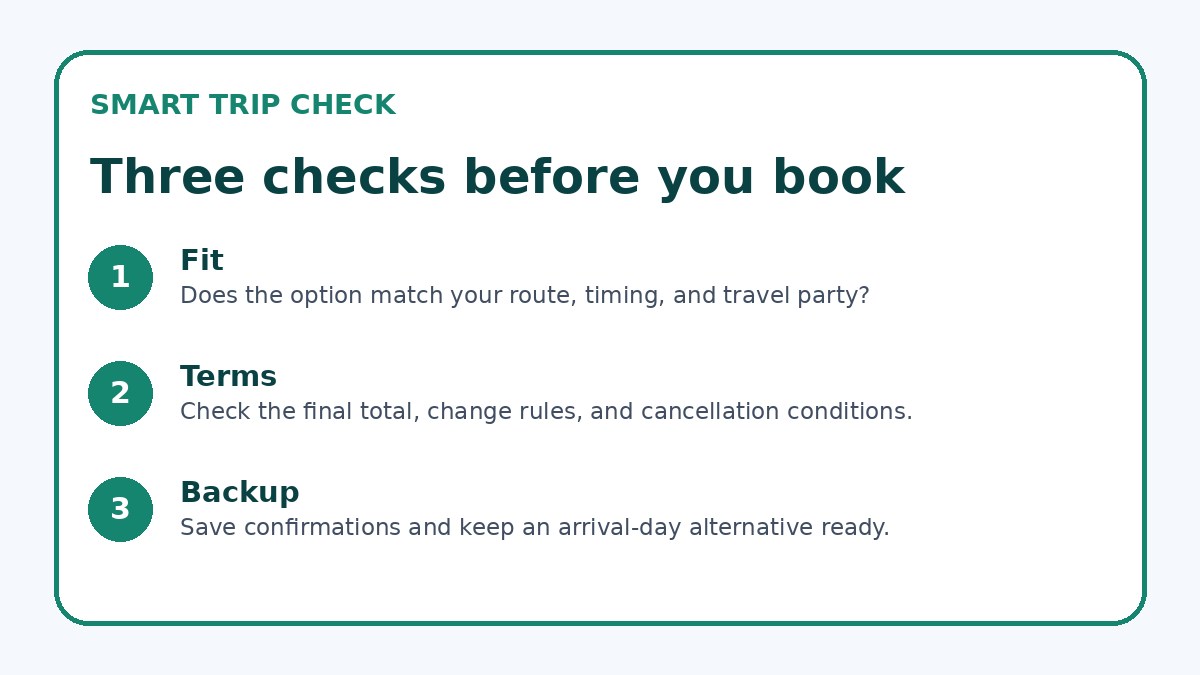
- Map door-to-door time: estimate hotel pickup to meeting address including likely traffic at your planned travel hour.
- Confirm exact drop-off and pickup points: verify station or terminal names and the distance to your meeting venue.
- Pre-book a backup transfer: arrange a second taxi or ride-hailing option and save contact details to your phone.
- Prepare luggage for transfers: use a compact wheeled case or carry-on that fits trunks and train racks easily.
- Allow schedule buffers: choose departures that leave at least 30–60 minutes of spare time before important meetings.
- Verify provider terms: check cancellation, change fees, and baggage rules on the final booking page before payment.
Disruption backup: minimize the risk of missed meetings
Always build a straightforward backup into your plan. For road transfers, a backup can be a second taxi app, contact details for a local chauffeur service, or a hotel concierge able to arrange an emergency car. For scheduled services, pick earlier departures or add a half-hour buffer to account for local traffic, platform changes, or baggage handling. Carry digital contact details and screenshots of confirmations because mobile reception can vary along some road stretches. Make sure your meeting host has a realistic arrival ETA and a contingency for joining remotely if a delay occurs.
If you choose rail or coach, know the frequency and nearest alternative departures in case you miss your booked time. Verify the station’s taxi rank location and typical wait times, and keep an airline-style backup of essential documents and a power bank to avoid tech failures. Before you finalize any booking, check the provider’s cancellation and change policies on the booking page; when in doubt, have a paid, refundable option that can be altered without long calls during a day of meetings. Trip.com is a valid place to compare current availability and conditions but verify the final terms on the provider’s page.
Rail & Intercity Transport questions travelers ask
Is taking the train between Bangkok and Ayutthaya practical for a same-day business round trip?
A same-day round trip by train can be practical if train departure and return times align with your meeting window and you accept the minor last-mile transfer at each end. Trains offer a comfortable onboard environment where you can work uninterrupted, but schedule rigidity means you should book departures that include a buffer for delays. If your meeting time is tight or unpredictable, pairing a scheduled train with a pre-booked taxi at the arrival station reduces risk. Always confirm train timings and the station’s taxi options on the operator’s booking page before committing.
How should I decide between booking a private car and using a ride-hailing app for this route?
Decide based on predictability, luggage needs, and cost transparency. A pre-booked private car or corporate transfer gives you guaranteed vehicle type, driver contact details and often fixed pickup times—useful for important meetings. A ride-hailing app can be convenient and flexible but may vary in vehicle size and wait times during peak hours. If you must arrive at an exact time, reserve a private car through a reputable provider or arrange a concierge to book a confirmed vehicle rather than relying on on-demand availability.
What should I do if my scheduled service is canceled or delayed on the travel day?
Activate your predefined disruption backup immediately: contact your pre-booked taxi or chauffeur, or request a ride-hailing vehicle to the station. Inform the meeting host with an updated ETA and, if needed, switch to a remote meeting option. If you booked through an agent or platform, use their customer service contact for rebooking assistance. Keep digital copies of confirmations, and know nearby alternative departure times so you can pivot quickly. Planning an earlier departure or booking the next available private transfer reduces the stress of last-minute cancellations.
Final decision note
For business travelers choosing Bangkok to Ayutthaya transport, the most practical option depends on whether you prioritize absolute predictability or lower friction and cost. Private cars and taxis deliver the tightest door-to-door control and are best when meeting times are fixed or luggage is bulky. Trains and coaches work well when their schedules fit your appointment windows and you can accept a short last-mile transfer. A hybrid approach often provides the best balance: use a scheduled service for the main leg and pre-book a local car for the final mile. Whatever you pick, verify terminal locations, luggage rules and provider change policies on the booking page, prepare a disruption backup, and build reasonable time buffers before any important meeting.
Continue planning
Check current options and final conditions
Use the provider page to confirm live availability, the final total, cancellation terms, and every condition that matters to your trip.
This evergreen planning guide was created with AI-assisted drafting and a structured quality review. It does not display live prices, schedules, availability, visa guidance, or provider rankings. Verify current details before booking. Some links are affiliate links; we may earn a commission at no additional cost to you.