Practical answer up front: if you and your partner value time together and simplicity, prioritize direct flights between Amsterdam and Rome when available; if you need lower fares, specific departure times, or want to add a stopover, consider connecting options but budget extra time and attention to baggage and connection risk. For couples the tradeoff often comes down to convenience versus flexibility: direct flights minimize stress and lost time, while connections can open cheaper or better-timed itineraries and potential mini stopovers. Before you search live fares, decide how much extra transfer time and complication you’re willing to accept, whether you need holdable seats together, and whether checked baggage or strict carry-on-only fares are acceptable. These choices shape which flight strategy makes sense for your specific travel dates and priorities.

See live routes for your exact travel day
Compare direct and connecting choices with the same baggage and traveler details.
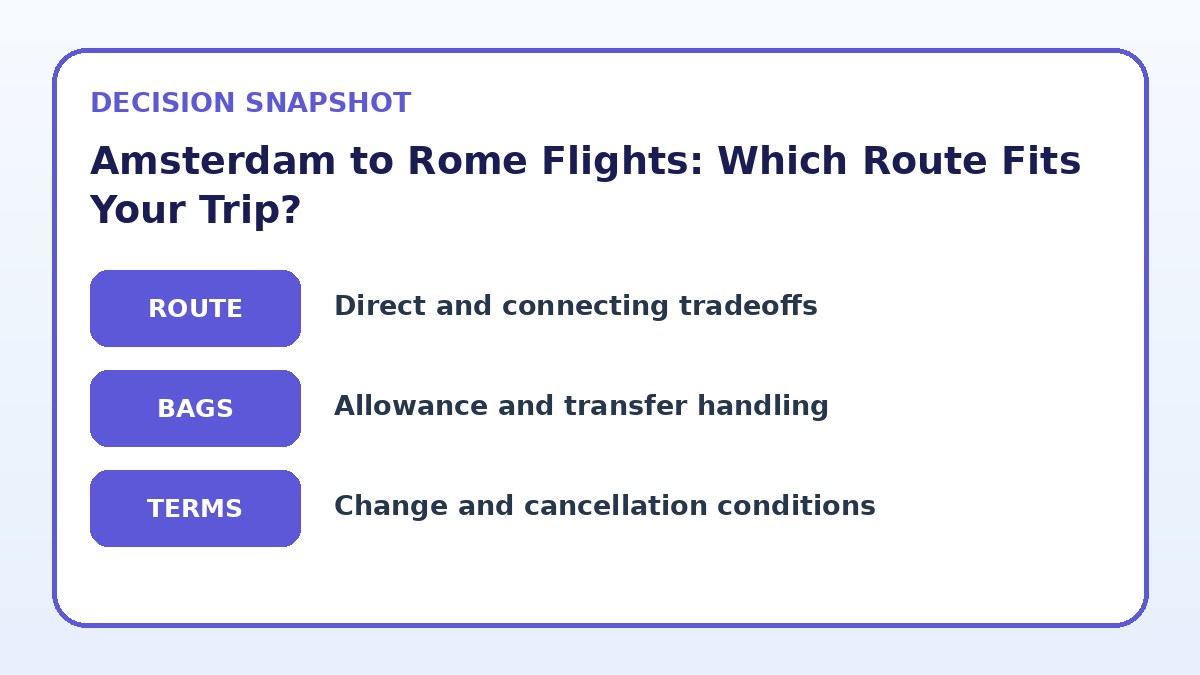
Routing and itinerary choices
On the Amsterdam to Rome corridor you’ll typically compare direct nonstop services with one-stop itineraries that route through other European hubs. For couples, the routing question often begins with your trip length: a short city break favors direct flights to maximize time in Rome, while longer stays might justify an overnight or two-hour connection if it saves money or lets you align with preferred departure times. When searching, enter your exact travel dates and passenger details so search results show true availability for seat pairs and any fare bundles that include baggage or seat selection.
If you consider a connecting itinerary, look closely at the transfer airport and whether the connection is within one carrier or split between separate airlines. Single-carrier connections generally make baggage transfers and rebooking simpler; interline or self-transfer itineraries require checking minimum connection times and whether you must recheck luggage or clear security and immigration. For couples traveling together, prioritize connections with reasonable layovers (not the absolute minimum) to reduce stress and keep some buffer for minor delays.
Baggage and connection risk
Baggage rules can change the economics and convenience of a route. Some low-cost fares classify checked bags as optional extras and may not include transfer protection; if a connection is missed due to delay, getting your luggage to the final airport can be more complicated on separate tickets. Couples who plan to check luggage should compare the total cost of including checked bags on both direct and connecting options and verify whether through-checked baggage is offered on connecting itineraries. Always check the final booking page for exact baggage allowances, fees, and whether a transfer will be handled automatically.
Connection risk is not only about delays — it’s about the time and logistics required to move between terminals or even airports at some hubs. When you evaluate a connecting option, inspect the scheduled connection time, the airport layout of the transfer point, and whether transfers require immigration or customs clearance. For couples, a longer but stress-free transfer may be worth it to avoid missed connections; consider adding travel insurance that covers missed connections and independently verify the airline or booking agent’s rebooking policies on the provider’s final booking page.
Compare flight-selection strategies
| Flight strategy | Best for | Risk to check |
|---|---|---|
| Nonstop flight at a higher fare | Couples prioritizing simplicity, minimal travel time, and stress-free logistics. | Usually a higher headline fare and fewer departure time choices. |
| One-stop connecting flight on a single ticket | Couples wanting lower fares without taking on self-transfer complexity. | Longer travel time and some added connection risk, but baggage and rebooking are usually simpler. |
| Cheaper split-ticket connections with different carriers | Flexible couples seeking the lowest possible fare and willing to manage transfers. | Higher chance of baggage and missed-connection headaches and limited rebooking protection. |
| Long layover or intentional stopover | Couples who want to add a short visit to another city en route without extra airfare. | Adds total trip time and requires careful planning for visas, bags, and transit logistics. |
Recheck the complete itinerary
Confirm airports, connection handling, baggage, and change conditions before deciding.

Schedule fit and personal priorities
Decide what matters more for your trip: arriving earlier in the day to start sightseeing, or leaving late to maximize sleeping in? Direct flights tend to offer predictable departure and arrival windows that make planning daily activities easier, which is helpful for romantic itineraries with timed tours or restaurant reservations. If you value maximizing awake hours in Rome, pick the flight that gives you the most usable time on arrival and the least transit time overall — factoring in travel to and from airports, check-in, and security. Couples should discuss whether they need specific arrival times for hotel check-in or planned activities and use those constraints to filter options.
If one of you prefers a lower cost or a particular departure airport, connecting flights expand your choices, including early or late departures not served nonstop. However, balancing flight times against the physical toll of connections is important: a tight schedule with multiple connections can leave you tired on arrival, whereas a slightly longer but simpler itinerary may improve the mood and enjoyment of the trip. Use calendar syncing or a shared checklist to confirm both travelers’ priorities before booking so you avoid last-minute regrets about timing or convenience.
Flight details to verify
- Confirm exact travel dates, full passenger names, birthdates, and passport details before searching live fares.
- Decide whether checked baggage is essential and compare total fare-plus-baggage costs for direct and connecting options.
- Check seat availability together and verify on the final booking page whether you can reserve adjacent seats.
- Inspect connection times and airport transfer requirements, including whether you must change terminals or re-clear security.
- Read the fare conditions on the airline’s final booking screen for change, cancellation, and missed-connection policies.
- If booking on a third-party site, double-check identical flight details and fare rules on the airline’s official page before payment.
Fare conditions and what to verify before booking
Fare rules differ widely: refundable versus nonrefundable, change fees, seat selection, and bundled versus à la carte baggage. Couples should verify on the final booking page whether seats can be selected together, whether holds or name changes are allowed, and what penalties apply if plans shift. Don’t rely on a search summary for these details — open the fare conditions and read the change, cancellation, and baggage clauses on the operator’s official booking screen. This prevents surprises when a low headline fare excludes essentials you want as a couple, such as guaranteed adjacent seats or checked luggage.
Also confirm whether connecting itineraries protect you under the carrier’s rebooking policy if an initial flight is delayed and you miss your onward segment. When flights are on the same ticket and same alliance, protection is common; when you book separate tickets, that protection may not exist. Check whether the fare includes advance seat assignment and whether any mandatory fees apply at the airport. If you use a third-party platform to compare options, verify these same conditions on the airline’s own booking page before finalizing the purchase.
Flight Guide questions travelers ask
How much connection time should we allow between flights as a couple?
Aim for at least 90–120 minutes for intra-Europe connections when flights are on the same ticket and don’t require immigration; choose longer if you must change terminals, clear passport control, or recheck luggage. If the connection involves different airlines on separate tickets, add more buffer (at least three hours) to allow time for delays and baggage recheck. Consider the mobility, comfort needs, and stress tolerance of both partners — a longer connection reduces anxiety but increases total travel time. Verify minimum recommended connection times on the carrier’s site and account for airport layout and peak-hour congestion.
Can we keep our checked bags on connecting itineraries between Amsterdam and Rome?
Whether checked bags transfer through to the final destination depends on the ticketing arrangement and the carriers involved. For single-ticket itineraries with cooperating carriers, bags are typically checked through, but for separate tickets you may need to collect and recheck them. Always verify on the airline’s final booking page or ask the airline directly what will happen with checked baggage for your chosen itinerary. For peace of mind on a tight schedule, consider traveling with carry-on only or choosing a single-ticket connection that includes through-checked baggage.
What should couples prioritize when choosing between a cheaper connecting flight and a pricier nonstop?
Weigh the value of time, convenience, and the overall travel experience: if your trip is short or you dislike airport stress, a nonstop may be worth the extra spend. If you have flexibility in schedule, prefer savings, or want a potential stopover, a connecting flight can be sensible — but factor in the total door-to-door time, baggage handling, and the emotional cost of possible delays. Discuss with your partner how much extra travel complexity you each can tolerate, then confirm fare rules, baggage, and seat options on the final booking page before committing.
Final decision note
For couples traveling Amsterdam to Rome the right choice hinges on priorities: choose direct flights for simplicity, time savings, and fewer logistics to manage; opt for carefully selected connections if you need specific times, lower fares, or want a stopover. Before you hit purchase, gather exact travel dates, full passenger details, and baggage preferences so search results match your real needs. Compare total trip time, fare inclusions, and the protection a single-ticket connection provides versus the risks of split tickets. Verify all fare conditions, seat assignment rules, and baggage handling on the airline’s booking page and consider travel protection for missed connections if your itinerary includes tight layovers.
Continue planning
Check current options and final conditions
Use the provider page to confirm live availability, the final total, cancellation terms, and every condition that matters to your trip.
This evergreen planning guide was created with AI-assisted drafting and a structured quality review. It does not display live prices, schedules, availability, visa guidance, or provider rankings. Verify current details before booking. Some links are affiliate links; we may earn a commission at no additional cost to you.