Practical answer first: if you value minimizing stress on travel day, prioritize convenience—direct flights or single-carrier itineraries with short ground transfers and predictable baggage handling. If you prioritize lower fares or a wider time window, prioritize schedule flexibility—open booking windows, multi-airline options, and longer layovers that reduce missed-connection anxiety. For a solo traveler between Amsterdam and Rome the right balance depends on your tolerance for time on the ground, how fixed your dates are, and whether you carry checked bags. Before you search, lock your exact travel dates, preferred departure windows, and baggage needs. With those details ready you can compare direct versus connecting options, check fare-change and cancellation conditions, and estimate the real cost of “convenience” when connections, transit to airports, and baggage rules are included.
See live routes for your exact travel day
Compare direct and connecting choices with the same baggage and traveler details.
Routing: direct vs connecting and how it affects convenience
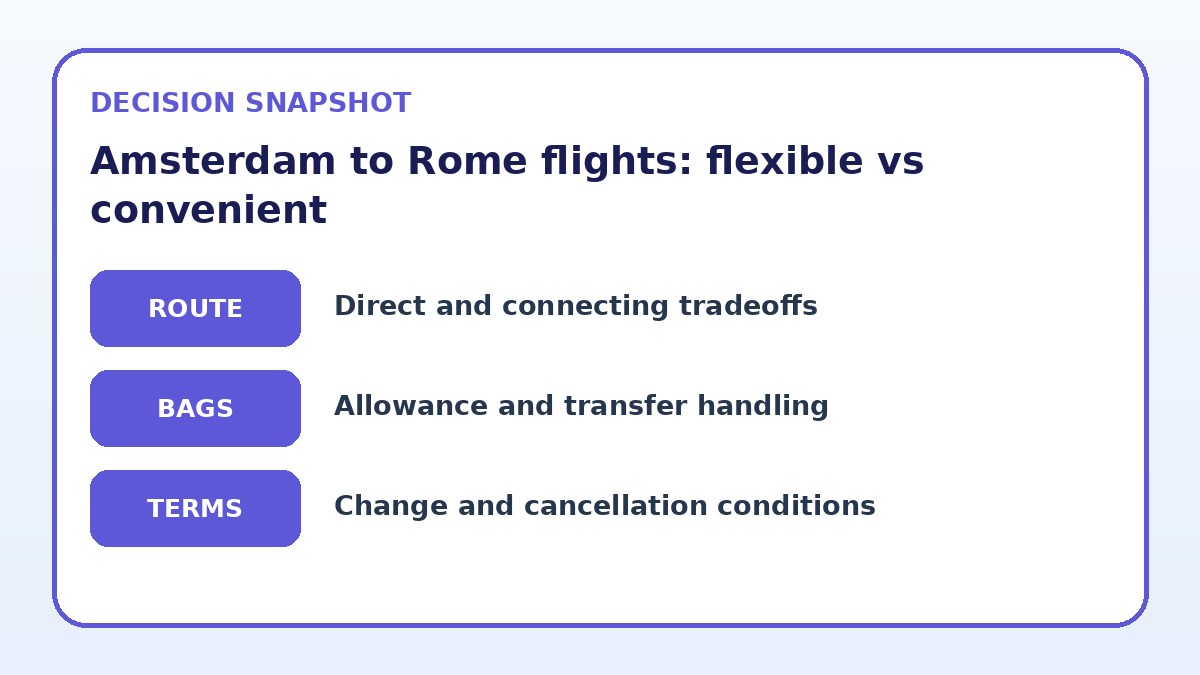
Direct flights are the simplest convenience tradeoff for many solo travelers because they remove the risk and time cost of an intermediate change. If a direct option exists on your selected date, it usually means fewer unknowns: one boarding process, one disembarkation, and the potential to avoid re-clearing security or changing terminals. That matters most when you have tight schedules on either end, limited experience navigating unfamiliar airports, or valuables and equipment that are inconvenient to move through multiple checkpoints. A direct option is a clear convenience win for single-day transfers or short city breaks.
Connecting itineraries expand your schedule flexibility by offering more departure times and sometimes lower base fares, but they add complexity. Connections with generous layover windows give you cover for delays and reduce stress, while tight connections increase the chance of missed flights and baggage transfer problems. For solo travelers comfortable with airports and willing to accept some extra time, a one-stop itinerary can be a practical compromise: you get more flight choices and often better alignment with your preferred times, at the cost of extra planning to ensure smooth transfers.
Baggage and connection risk: what to check before you commit
Baggage rules are a decisive factor in convenience. Low-fare tickets may exclude checked bags or charge fees that change the total cost picture quickly; they may also limit carry-on size or priority boarding. When comparing options, write down your exact baggage needs—carry-on only, one checked bag, or special items—and verify how each fare handles those items. If a connection involves different carriers, check whether baggage is interlined (transferred automatically) or requires a re-check; re-checking adds time, potential queueing, and the risk of missing the next flight.
Connection risk is about both schedule padding and the realities of the transit airport. For short layovers, ask whether transfers require changing terminals or re-clearing security and whether connections are all on the same ticket. Single-ticket itineraries generally offer more protection and are easier to resolve if a delay causes a missed connection, while separate tickets leave you responsible for missed legs. As a solo traveler, factor in time of day, typical airport congestion, and whether you prefer the security of longer layovers versus the time savings of tighter schedules.
Compare flight-selection strategies
| Flight strategy | Best for | Risk to check |
|---|---|---|
| Direct flights only | Solo travelers who prioritize simplicity and minimal transfer hassle. | Fewer departure times and sometimes higher base fares compared with connecting options. |
| Single-carrier connections | Those who want protection under one ticket with more schedule options. | May cost more than multi-carrier bargains but reduces interline baggage and rebooking headaches. |
| Multi-carrier/cheapest-fare routing | Budget-focused solo travelers with flexible dates and comfort handling separate tickets. | Higher risk of missed connections and baggage issues; you shoulder rebooking responsibility. |
| Flexible/refundable fare | Travelers who need date certainty or may change plans at short notice. | Higher upfront cost but less worry and fees if plans shift; not always necessary for fixed itineraries. |
Recheck the complete itinerary
Confirm airports, connection handling, baggage, and change conditions before deciding.
Schedule fit: aligning departure windows with your on-the-ground plans
Schedule fit begins with your door-to-door timetable. Think about the time you need to get to Amsterdam's departure airport and from Rome's arrival airport into the city center. Early-morning departures can be convenient for full first days in Rome but require very early transfers from your accommodation; late arrivals may save daytime but cost you a taxi or late-night transit. Plot the likely transfer times and pick a flight window that minimizes stress while preserving your preferred time in the destination. For solo travelers, convenience often comes from avoiding awkward arrival hours that leave you navigating new neighborhoods at night.
Also consider recovery time. If your Rome plans include immediate meetings or tours, prioritize earlier arrival over a cheaper flight that arrives late. If your schedule is flexible, you can exploit lower-demand departure times for savings and more flight options. When comparing flights, use the total travel-chain approach: include airport transfer durations, security queue variability, and practical arrival time into Rome so you can choose the itinerary that best matches your first-day needs without unpleasant surprises.
Flight details to verify
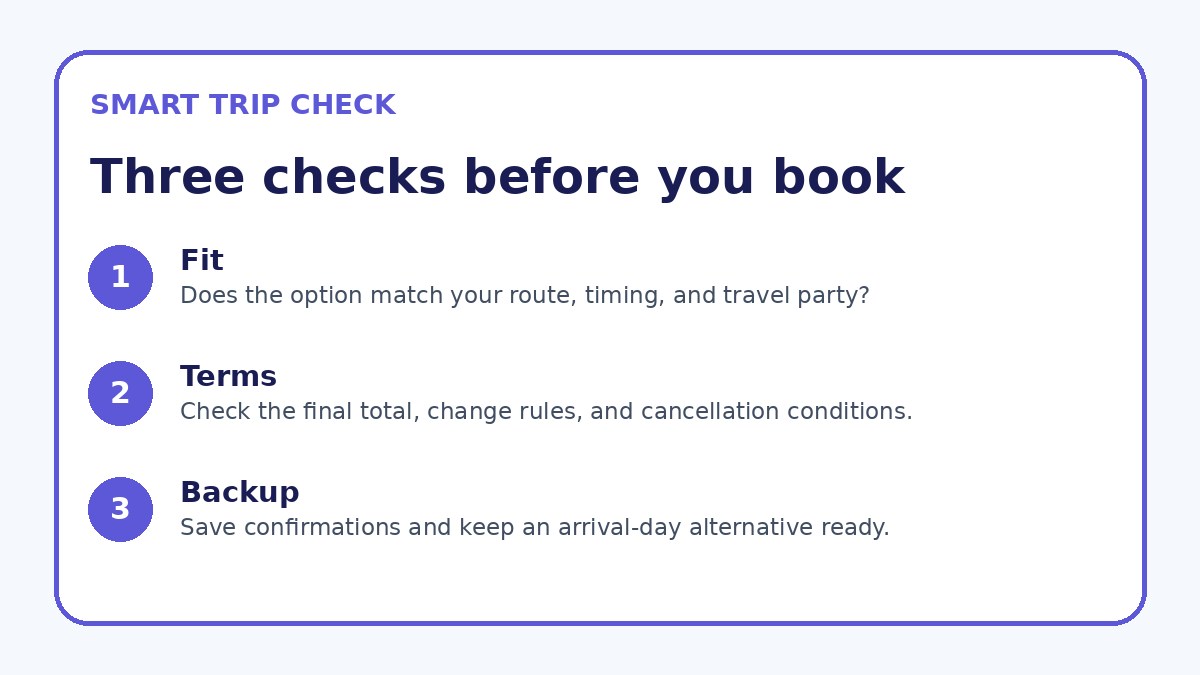
- Confirm your exact travel dates, preferred departure window, and arrival time requirement before searching fares.
- Decide and note your baggage needs (carry-on only, checked bag count, special items) and compare how each fare handles those items.
- Check whether potential itineraries are single-ticket or separate tickets and verify interline baggage transfer on the booking page.
- Read the full fare conditions on the airline or booking site: change fees, cancellation policy, refund process, and seat/baggage inclusions.
- Estimate door-to-door time by adding airport transfer, recommended arrival buffer, flight time, and post-arrival transfer into Rome.
- If unsure, compare prices and protections on at least two sources (airline site and Trip.com or another OTA) and verify final terms there.
Fare conditions: flexible tickets, change policies, and what to verify
Fare conditions make or break the flexibility side of the equation. Flexible fares allow date changes with minimal fees or provide travel credit, which is helpful if dates can shift. Check the exact change and cancellation fees, how refunds are processed, and whether name changes or same-day standby are permitted. Look for whether the fare includes seat selection, priority boarding, and baggage so you can compare the true cost of convenience. Always read the final terms on the airline or booking agent page—don’t rely on summary boxes alone—because the difference between a refundable and a non-refundable ticket is often in the fine print.
When mixing carriers, confirm whether each leg’s fare rules interact. Some low-cost carriers treat connecting delays differently and may not assume responsibility if the missed connection is due to another carrier’s delay. If you buy through an online travel agency or aggregator, verify whether they offer consolidated change or rebooking help and what fees apply. As a solo traveler, you may prefer a slightly higher, single-carrier fare that bundles protections over a complex, cheaper itinerary that shifts all risk onto you in case of disruptions.
Flight Guide questions travelers ask
Should I book a direct Amsterdam to Rome flight or accept a cheaper connection?
It depends on your priorities. Book direct if you want the simplest, lowest-stress travel day—valuable when you have tight onward plans or limited airport experience. Accepting a cheaper connection makes sense if you have flexible dates, are comfortable with transfers, and want to lower out-of-pocket costs. Before booking, compare the total journey time, transfer complexity, and baggage rules. If the connection is on a single ticket with generous layover time, it can be a good middle ground. If separate tickets are involved, account for extra time and possible rebooking costs in case of delays.
How much layover time should I allow for a connecting flight between Amsterdam and Rome?
Allow more time than the minimum connection suggests, especially if you must change terminals or re-clear security. For single-ticket connections on the same carrier, a moderate buffer often suffices; for separate tickets or different carriers, plan significantly longer layovers to cover delays and baggage re-checks. Consider time of day and airport size—busy periods and large terminals require extra padding. If you’re risk-averse or traveling with checked luggage, choose longer layovers to reduce stress; if you prefer speed and are experienced with quick transfers, shorter but realistic buffers may work.
What should I verify on the airline or booking page before finalizing my Amsterdam to Rome reservation?
On the final booking page, verify fare rules (change and cancellation fees), baggage allowances and costs, whether the itinerary is on one ticket, and which airport terminals apply. Confirm exact departure and arrival airports (Amsterdam and Rome have multiple airports or terminals options in many metropolitan areas) and any transit requirements. Check whether baggage is checked through to final destination on connecting itineraries and whether seat selection, priority boarding, or other conveniences are included. Finally, ensure passenger name, passport data format, and contact information are correct before purchase.
Final decision note
Balancing schedule flexibility and convenience on Amsterdam to Rome flights is a personal choice shaped by your dates, baggage needs, and tolerance for airport time. Solo travelers who value simplicity and predictability should lean toward direct flights or single-carrier itineraries that reduce transfer risk and streamline baggage handling. Those prioritizing lower cost or wider departure options can choose connections, but should plan longer layovers, verify baggage interlining, and read fare rules carefully. Prepare exact travel dates, passenger details, and baggage lists before searching; compare total door-to-door time and the true cost of convenience, and confirm final terms on the airline or OTA booking page (Trip.com is an optional comparison source). With those checks, you can pick an itinerary that fits both your schedule and peace of mind.
Continue planning
Check current options and final conditions
Use the provider page to confirm live availability, the final total, cancellation terms, and every condition that matters to your trip.
This evergreen planning guide was created with AI-assisted drafting and a structured quality review. It does not display live prices, schedules, availability, visa guidance, or provider rankings. Verify current details before booking. Some links are affiliate links; we may earn a commission at no additional cost to you.