If you and your partner are weighing whether to rent a car in Amsterdam, the short practical answer is this: in most central Amsterdam itineraries, driving rarely improves the core city experience, but a car can be useful for day trips outside the region—only if you understand insurance wording and how it affects liability for both drivers. Couples often assume that a second listed driver is automatically covered in the same way as the primary renter; that assumption can be costly. Before you book, decide whether the route value of owning a car outweighs parking, low-emission zones, and the friction of pickup and return. If you lean toward renting, make the insurance wording your decision hinge: verify who is authorised, what constitutes damage, excess amounts, theft coverage, roadside assistance, and whether your existing credit card or travel policy complements or conflicts with the rental terms.
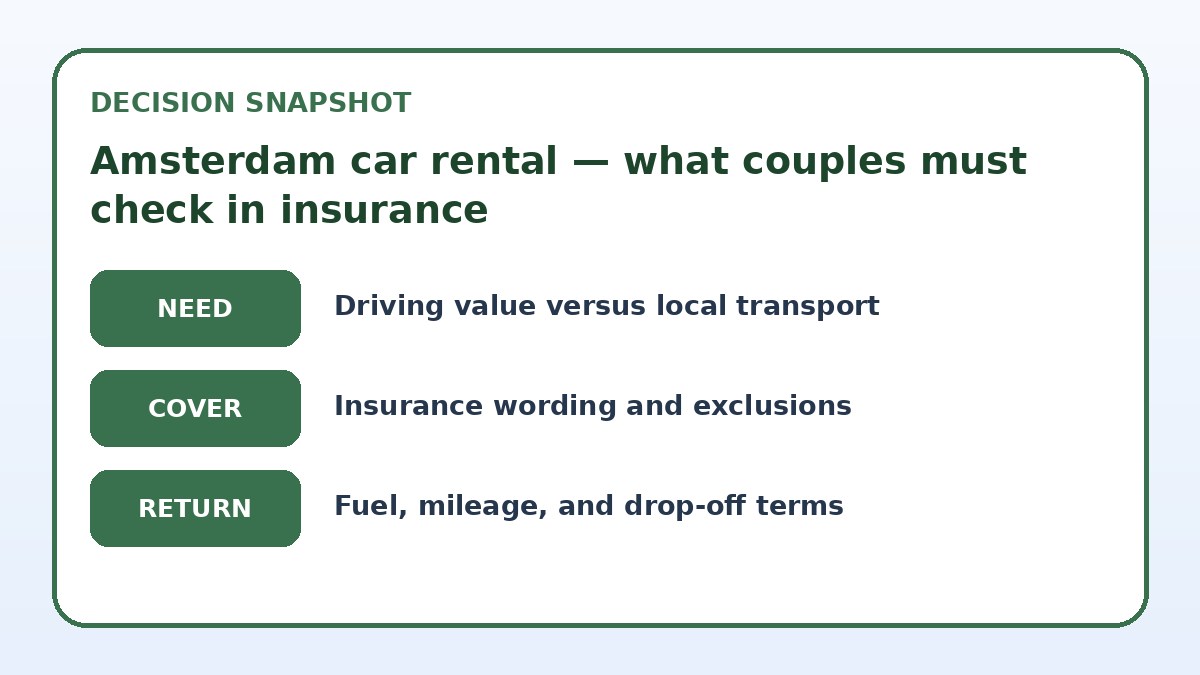
Does driving actually improve your Amsterdam itinerary?
Start by mapping what you want to do together. If your schedule stays inside Amsterdam’s ring—museums, neighbourhood strolls, canal cruises, and intimate restaurants—driving will mostly add cost and stress because parking is scarce and regulated, and many central destinations are easiest reached by tram, metro, bike, or on foot. A car shines when your couple’s plan includes flexible day trips to the North Holland coast, the tulip fields in season, the Veluwe, or small towns with limited rail service. Those routes offer scenic value and time savings compared with public transport, but only if you’re comfortable with narrow Dutch roads and paying attention to low-emission zones and parking rules.
For a mixed itinerary—couple time in the city plus two or three outer-day trips—consider whether you could combine a single rental day or a one-way hire with efficient rail for the city portion. Compare the friction of renting (pickup lines, extra driver fees, insurance reviews at the desk) with the convenience of leaving Amsterdam for a clear, planned excursion. Couples benefit from picking a single decision criterion—comfort, flexibility, or budget—and using insurance clarity as a tie-breaker. If the insurance wording increases your potential exposure or adds complexity for the second driver, you may prefer non-driving options even when a car seems tempting.
Decide whether driving earns its place
| Mobility strategy | Best for | Cost or friction to check |
|---|---|---|
| Full-day rental with primary driver only | Couples wanting a single flexible day trip while minimizing paperwork. | Lower administrative hassle but second driver may not be covered unless added at the counter. |
| Multi-day rental with both drivers registered | Couples planning several day trips or split driving shifts. | Convenient shared driving but adds declared additional-driver fees and potential age-related restrictions. |
| No car: trains, trams, bikes | Couples prioritizing relaxed city exploration and low logistics. | Less flexibility for remote sights; requires planning for timed day trips and luggage handling. |
| One-way hire for an outbound excursion | Couples who want point-to-point freedom without returning to Amsterdam by car. | Avoids inner-city parking on return but can incur drop-off fees and complex cross-location insurance rules. |
Check live rental choices only after the route test
Use the exact driver, dates, pickup point, and return plan to compare current conditions.
Decoding insurance wording for couples
Insurance sections usually name covered drivers, list the excess (you pay this before insurer reimbursement), and specify excluded damage types. For couples, the crucial lines state whether additional drivers must be declared and paid for, whether partner drivers under a certain age are excluded, and whether cross-border travel is allowed. Look for phrases such as “additional driver permitted if registered at pickup” or “only drivers listed on the voucher are covered.” If the contract permits adding a driver only at the counter, photographing the signed rental agreement that lists both names is your best protection. Also verify whether partner drivers are subject to a higher excess or surcharge.
Pay attention to what insurers call ‘loss of use’ and administrative fees: even minor damage can trigger charges beyond repair costs if the agency charges for time the car is out of service. Read exclusions carefully: damage from unpaved roads, towing after unauthorised crossings, or incidents while intoxicated are commonly excluded. Couples should also check whether your credit card or a separate travel insurance overlaps or conflicts with the rental policy. If you plan to rely on a credit card’s coverage, confirm whether it requires you to decline the provider’s collision damage waiver—this is a detail you must verify on the final booking or card provider page.
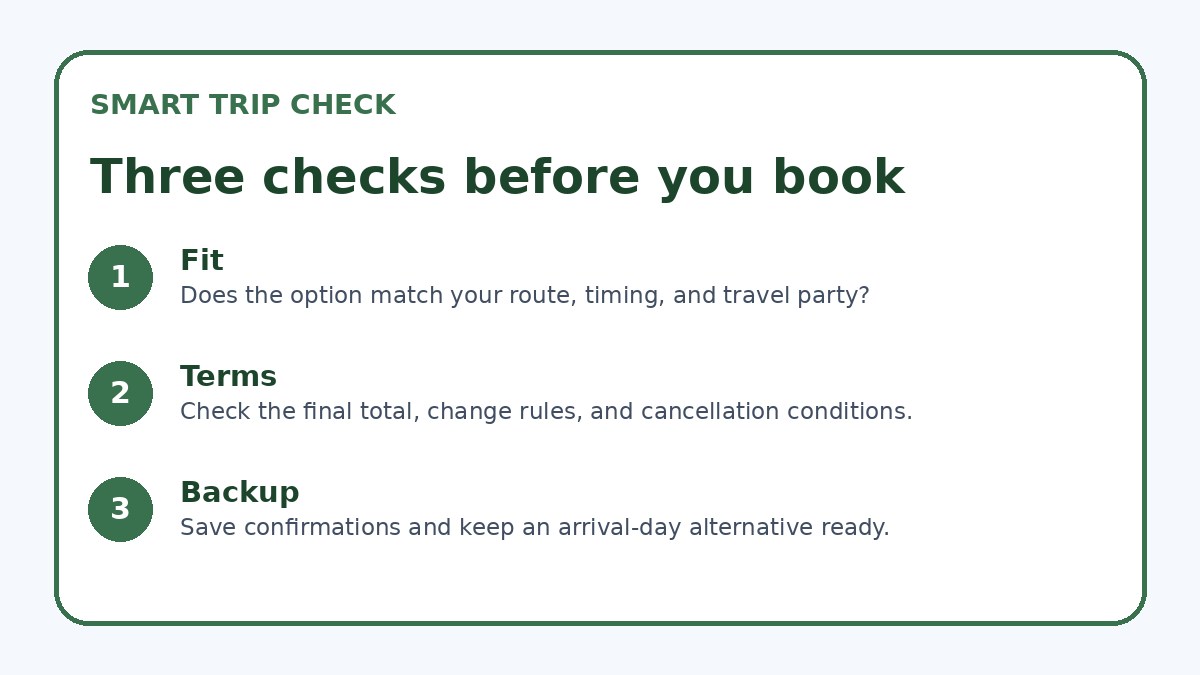
Compare the full rental conditions
Confirm insurance wording, exclusions, deposit, fuel, mileage, and return terms on the final page.
Pickup and return friction: what to verify at the desk
Pickup and return push many subtle fees into play. When you reach the counter, compare the printed booking confirmation with the actual contract. Check the exact spelling of both drivers’ names, the listed coverages, the stated excess amounts, and whether mandatory extras (like local taxes or airport surcharges) are shown as estimates or final charges. Have both drivers present with their licences, ID, and the credit card that will be used for the deposit. Photograph the vehicle from multiple angles before you drive away and have the agent note any existing scratches on the contract—a documented discrepancy can save hundreds in disputes.
On return, allow time for an end-of-rental inspection and request the inspector’s name or a confirmation number for the check-out. Insist on a written report listing any new damage and retain copies of fuel receipts if you were charged by the agency. If you find new damage later on your card statement, contact the rental agency promptly and ask for the inspection report; escalate to your card issuer or travel insurance if the agency’s evidence is inconsistent. For online comparison, Trip.com can be used to check current availability and pick-up policies, but always verify the final terms on the provider’s booking page before relying on them.
Car rental terms to verify
- Compare the rental agreement’s named drivers with the booking confirmation and ensure both partners are listed if they’ll drive.
- Confirm the collision damage waiver (CDW) terms, the excess amount, and whether you can buy it down at the counter.
- Photograph the vehicle’s exterior and interior during pickup and ask the agent to note existing damage on the contract.
- Verify whether your credit card or personal travel insurance provides overlapping coverage and whether the rental requires you to decline vendor CDW.
- Check whether the policy permits cross-border travel and whether additional permissions or fees apply for neighbouring countries.
- Request a written return inspection report and keep receipts for fuel and tolls to contest any later charges efficiently.
Non-driving fallback: how couples get around Amsterdam without a car
If the drive decision leans negative, plan an efficient non-driving fallback. Amsterdam’s public transport network—trams, buses, metro—covers the city and many suburbs. For regional trips, the Dutch rail network is frequent and comfortable for couples: trains reach Haarlem, Zaandam, and Utrecht in short hops, while coordinated buses and ferries extend reach. Consider combining a couple of single-day guided excursions or regional train passes with bicycle rentals when you want countryside access without driving. Bikes give you the intimacy of local travel and are easy to rent by the hour or day across the city.
For door-to-door convenience, taxis and app-based ride-hailing reduce walking time between evening activities but can be costly for long day trips. If you want complete flexibility for a single day outside the city, book a one-way rental that you return near your destination or at a suburban station—just verify cross-location drop fees and insurance wording about one-way returns. Ultimately, a non-driving plan can match or exceed the couple experience if you prioritize relaxed movement, fewer logistics at pickup and return, and clear insurance simplicity.
Car Rental & Road Trip questions travelers ask
If both partners are named drivers, will they share the same excess and liability?
Naming both partners usually means both are authorised to drive, but it does not automatically change excess or liability rules. Many contracts list a single excess amount that applies regardless of which authorised driver caused damage, while others apply additional fees for younger drivers or impose higher excess for certain categories of damage. Read the excess section carefully: it should state who bears the initial outlay if damage occurs and whether any reductions apply for purchased waivers. To be safe, ask the rental agent to point to the exact clause and obtain written confirmation at pickup.
Can a couple rely on a credit card’s insurance rather than the rental company’s cover?
Some credit cards offer secondary or primary rental insurance, but cardholder benefits vary widely. If you plan to use card coverage, check whether the card requires you to decline the rental company’s collision damage waiver and whether it covers third-party liability, theft, or loss-of-use charges. Important: verify the card’s geographic scope and any age restrictions or vehicle-type exclusions. Always confirm the card provider’s terms on their official page and bring written proof to the rental desk; otherwise, the agency may insist on their own insurances as a condition of the hire.
What wording should couples watch for that signals unexpected exclusions?
Watch for terms like ‘unauthorised use,’ ‘off-road,’ ‘racing,’ ‘driver under influence,’ and ‘unlisted drivers’—these are common exclusion triggers. Also note conditions tied to tyres, windscreen, and undercarriage damage, which some insurers exclude from basic cover. Phrases such as ‘loss of use’ or ‘administrative handling fee’ can indicate additional post-accident charges. If the policy mentions geographic limits, read whether bridges, tunnels, or ferry crossings are restricted. When in doubt, ask the agent to highlight exclusions and to add clarifying language to the rental contract at pickup.
Final decision note
For most couples staying primarily in Amsterdam, the city’s transport network and bike culture make driving unnecessary. A rental becomes appealing when your shared plan includes multiple regional day trips requiring flexibility or remote access. Make insurance wording the deciding factor: confirm who is authorised to drive, what the excess is, what exclusions apply, and how credit-card or travel insurance interacts with the vendor’s policies. During pickup, compare written terms to the online booking, document the car’s condition, and secure a signed inspection at return. If any insurance clause leaves ambiguity, opt for the simpler non-driving alternative or clarify and document the coverage before you leave the desk.
Continue planning
Check current options and final conditions
Use the provider page to confirm live availability, the final total, cancellation terms, and every condition that matters to your trip.
This evergreen planning guide was created with AI-assisted drafting and a structured quality review. It does not display live prices, schedules, availability, visa guidance, or provider rankings. Verify current details before booking. Some links are affiliate links; we may earn a commission at no additional cost to you.