Practical answer first: for most travelers carrying a lot of luggage, driving in and around Kyoto can help if your itinerary includes outer suburbs, day trips to places like Uji, Amanohashidate, or rural temples—provided you verify fuel policy, daily mileage allowances, and whether the vehicle’s trunk actually fits your bags. If your plans stay within central Kyoto and rely on frequent station stops, public transport plus occasional taxis or luggage forwarding is often easier and cheaper. This article walks you through the decision criteria that matter when extra luggage is involved: how to assess route value, read insurance and fuel wording, gauge pickup and return friction, and test a non-driving fallback. Read these checks before you book and have a fall-back plan so you aren’t caught at the counter with unexpected fees or a car that won’t take your bags.
Decide whether driving adds real route value
Start by listing the places you will definitely visit and note whether public transport serves them directly. Driving pays when your planned stops are widely spaced, late-night, or not well connected by trains and buses; it also helps when you must move bulky gear between accommodations. Compare door-to-door travel time rather than just point-to-point: a 40–60 minute rural drive might beat a 90-minute transfer requiring taxis and multiple trains when you have heavy bags.
Weigh the comfort trade-off: more legroom, climate control, and private storage versus the stress of parking, narrow streets, and potentially high city parking fees. If most attractions are concentrated in central Kyoto—temples, Gion, Nishiki Market—public transport keeps you mobile without repeated trunk access. Use this route-value check first; if driving doesn’t cut travel time or simplifies luggage handling substantially, choose the non-driving alternative.
Decide whether driving earns its place
| Mobility strategy | Best for | Cost or friction to check |
|---|---|---|
| Drive with a roomy rental car | Itineraries with dispersed stops and frequent trunk access | Higher parking hassle, fuel/mileage checks, and potential insurance limits for heavy loads |
| Public transport plus luggage forwarding | City-focused plans where trains/buses access most sites | Forwarding adds cost and timing constraints, but removes parking and fuel concerns |
| Station-to-station travel with taxis for transfers | Short hops between stations when you need occasional door-to-door service | Taxis can be expensive for multiple long legs and may have vehicle size limits for bulky items |
| Hybrid: rent car only for specific day trips | Mostly public-transport plans needing one or two long rural excursions | Requires precise scheduling and may incur one-day rental premiums or airport pickup friction |
Check live rental choices only after the route test
Use the exact driver, dates, pickup point, and return plan to compare current conditions.
What to read in fuel and mileage clauses
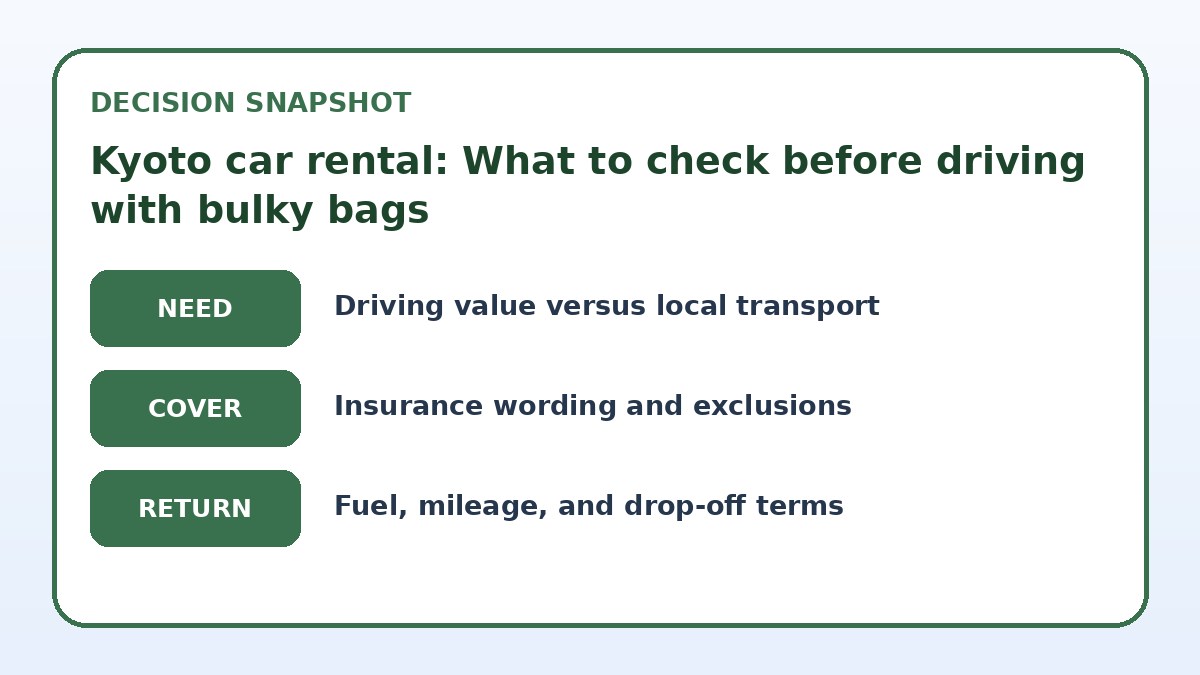
Fuel policy wording determines whether you must return the car full or pay a pre-charged rate. Full-to-full is cleaner: you pick up with full tank and refill just before return, avoiding pre-paid surcharges if you drive less. Pre-purchase or fuel-to-empty options can be convenient when you don’t want to hunt for a station, but they may charge for unused fuel or add a refueling fee. Verify where fuel stations are near your return location because running out without a nearby station can be a costly mistake.
Mileage terms are equally important when luggage prompts longer or non-linear routes. Look for daily or total mileage caps and the per-kilometer penalty for overages. Consider how often you expect to detour or make several day trips; an otherwise cheap rental can become expensive once over-mileage fees are added. Before booking, make the provider calculate a realistic mileage estimate for your intended driving days and ask whether unlimited mileage is available as an upgrade.
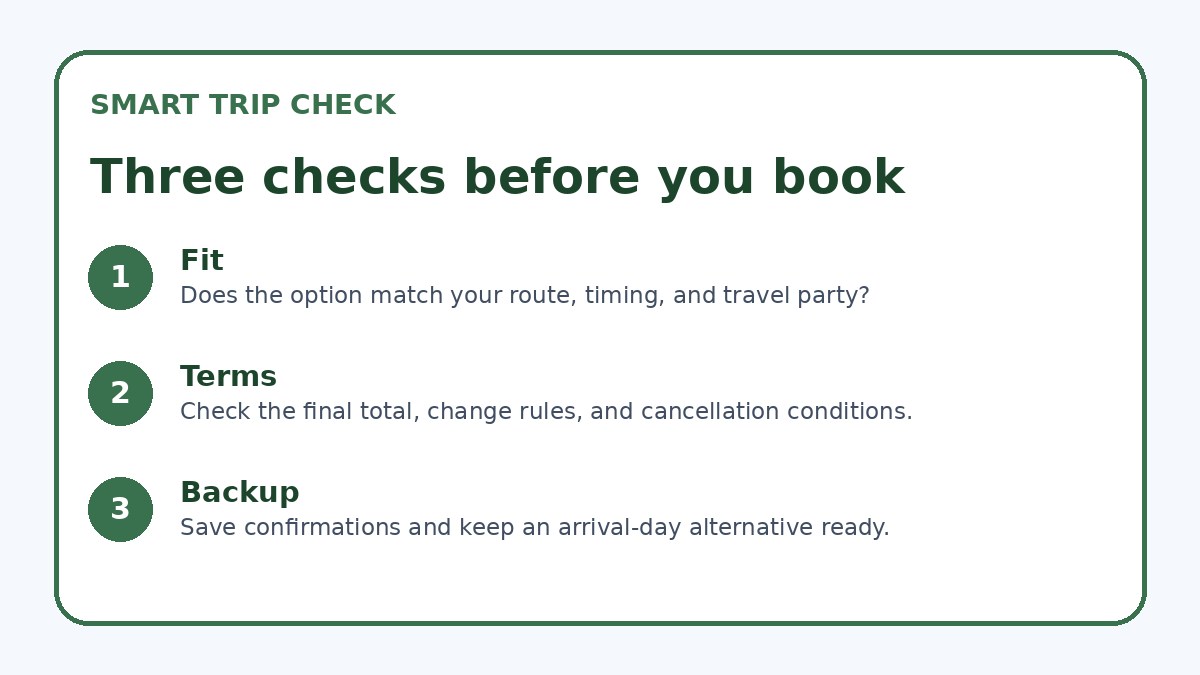
Compare the full rental conditions
Confirm insurance wording, exclusions, deposit, fuel, mileage, and return terms on the final page.
Insurance wording and pickup/return friction to verify
Insurance pages often list exclusions and excesses in small-print language; read the section about interior damage, roof-rack use, and overloaded vehicles. Some policies reduce cover or raise excess if the vehicle is used to carry unusually heavy or bulky loads not meant for the cabin or trunk. Confirm whether third-party liability, collision damage waiver, and theft protection are included and what the excess amounts are. When in doubt, get a written statement from the provider confirming that carrying the volume and weight of your luggage will not void cover.
Pickup and return logistics can eat time when you have a lot of baggage. Check whether the rental desk is at the airport, a station, or an off-site lot requiring a shuttle; shuttles with luggage may have space limits. Ask about after-hours returns, the need for a deposit hold on your card, and whether staff will help load or measure bags at pickup. Simple friction — like long walks from the desk to a car park or limited elevator access where you must haul bags — can turn a convenient drive into a hassle.
Car rental terms to verify
- Measure your largest suitcase and check the rental listing or ask for trunk dimensions and a photo with a similar-size bag.
- Confirm fuel policy (full-to-full vs pre-purchase) and locate nearby gas stations around your return point before you accept the car.
- Ask for the rental agreement’s mileage allowance and calculate expected kilometers to see if unlimited mileage is necessary.
- Request written clarification of insurance exclusions for interior or roof-load damage and the excess amount for each coverage type.
- Confirm pickup and return logistics: desk location, shuttle requirements, after-hours drop box, and staff assistance with loading.
- Check luggage-forwarding options and delivery windows with your hotels as a non-driving contingency for heavy bags.
Non-driving fallback and practical packing tactics
If you decide not to drive, plan for luggage-handling solutions: luggage forwarding (takkyubin), larger-capacity taxis for airport transfers, and choosing a hotel near a major station with porter or luggage-hold services. Luggage forwarding is common in Japan and keeps train travel simple; compare costs and delivery windows and ensure your hotel accepts incoming deliveries. For last-mile trips, apps and taxi stands can accommodate large items but check vehicle size and extra charges for oversized loads.
Packing tactics can reduce friction whether driving or not. Use soft-sided bags that compress in trunks, distribute weight across two suitcases rather than one large item, or bring a small collapsible bag for day trips. Photograph trunk space or ask the rental agent to demonstrate fit at pickup. Having a compact luggage scale and a simple tape measure helps you predict fit and avoid awkward surprises when loading the car or handing a bag to a courier.
Car Rental & Road Trip questions travelers ask
Will carrying extra luggage void the rental insurance in Kyoto?
Insurance terms vary by company. Many standard policies don’t automatically void for extra luggage, but some exclude damage caused by overloading or unsecured items. Always read the insurer’s damage and exclusion clauses and ask the provider to confirm in writing that the policy covers interior and trunk damage with your expected load. If the wording is unclear, consider purchasing supplemental coverage that specifically mentions luggage-related damage, or reduce load by using luggage forwarding.
How do fuel policies affect returns when my schedule changes?
If your booking is full-to-full, you’ll refill the tank before return and avoid pre-paid fuel penalties, but schedule changes can make timely refueling harder if stations are closed or distant. Pre-paid fuel saves the step but may charge for unused liters. Verify what the provider does if you return with less fuel than expected: some charge a refueling service fee on top of fuel, while others use a per-liter rate. Before booking, ask the supplier how they calculate refueling charges and whether nearby stations operate when you’ll return.
Can I fit two large suitcases plus carry-ons in a compact rental car?
Trunk dimensions and interior layout differ widely by model. Compact cars sometimes accommodate two large suitcases only if seats fold or bags are soft-sided and compressible. Don’t assume based on category name alone—request a trunk photo with comparable bags or a specific model’s boot volume in liters, and ask whether the rear seats fold flat and how they affect passenger space. If exact fit matters, upgrade to a larger class or bring a soft duffel you can compress into available gaps.
Final decision note
Driving in Kyoto with extra luggage can be a sensible choice when your stops are spread out or when moving between dispersed accommodations—provided you do the homework. Check trunk fit, fuel policy, mileage limits, and insurance exclusions before you book; confirm pickup and return logistics so the physical act of handling bags won’t become your trip’s weakest link. If driving doesn’t truly save time or simplify transfers, use luggage-forwarding, taxis, or train-based travel with occasional car hires. Keep a short checklist at booking and an alternate plan in your phone so luggage becomes a solved problem, not a travel stressor. Trip.com can be one place to compare current availability and terms, but always verify the final contract language with the provider.
Continue planning
Check current options and final conditions
Use the provider page to confirm live availability, the final total, cancellation terms, and every condition that matters to your trip.
This evergreen planning guide was created with AI-assisted drafting and a structured quality review. It does not display live prices, schedules, availability, visa guidance, or provider rankings. Verify current details before booking. Some links are affiliate links; we may earn a commission at no additional cost to you.