Practical tradeoff first: for families flying New York City to Los Angeles, you’ll decide whether a slightly cheaper connecting itinerary or a pricier nonstop saves you time, stress, and unexpected fees. That route-versus-fare tradeoff drives every other decision here. Before searching, gather exact travel dates, ages of every traveler, preferred airports in NYC and L.A., and any mobility or seating needs. Use those details when comparing results so you evaluate like-for-like. This article gives a targeted pre-booking checklist and explains how to weigh routing, baggage and connection risk, schedule fit, and fare conditions. Follow it and you’ll have the concrete facts to pick the itinerary that balances cost, convenience, and peace of mind for your family.

See live routes for your exact travel day
Compare direct and connecting choices with the same baggage and traveler details.
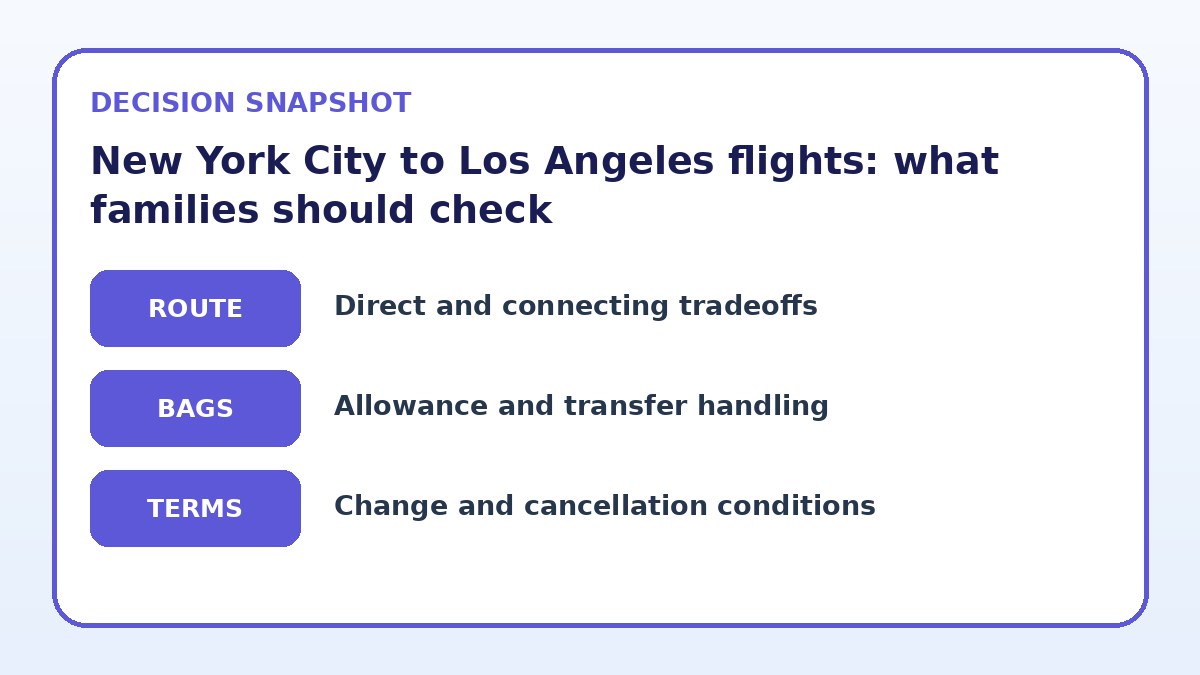
Routing: nonstop versus connecting
Routing is the clearest manifestation of the route-versus-fare tradeoff. Nonstop flights between New York City and Los Angeles cut travel time and reduce the number of points where something can go wrong—missed connections, lost bags, or a suddenly cranky child. Connecting itineraries may offer lower base fares or better departure times, but they add complexity: you’ll need to change aircraft, possibly change terminals, and manage carry-on items and children through additional boarding and security checks. When you compare options, list total door-to-door time, number and length of connections, and whether the connection requires an airport change.
For families, also think about the timing of connections. Short connections increase the chance of stress; long overnight connections add accommodation costs and fatigue. If saving on fare requires a connection with tight minimum connection time, factor in a buffer for delays and the logistics of moving between gates or terminals. When searching fares, filter for nonstop options first, then compare their time savings against the additional cost. If a connecting option is attractive, verify layover length, terminal transfer complexity, and whether the same carrier handles both segments to simplify rechecking baggage.
Baggage and connection risk
Baggage rules and connection risk go hand in hand for families who travel with strollers, car seats, or extra luggage. Before booking, collect the airline’s baggage allowance for adults and children, fees for additional checked pieces, and whether your stroller or car seat counts as an extra item or as part of your free allowance. Some low-cost or basic-fare options restrict carry-on size or charge for the first checked bag; these fees easily offset a fare “savings.” If your itinerary includes a connection, verify whether checked bags transfer automatically or must be reclaimed and rechecked—this varies by carrier and ticket type and dramatically changes the hassle of a connection.
Connection risk also includes the possibility of missing a tight layover due to a delayed inbound flight. For family travel, choose connections that leave comfortable buffers: at least 60–90 minutes for domestic same-terminal connections and longer if you must change terminals or re-clear security. If traveling with infants or elderly relatives, aim for even more time. If a connecting itinerary looks significantly cheaper, factor in the expected cost and time of extra checked bags, potential gate changes, and the stress of handling children through additional movements in the airport.
Compare flight-selection strategies
| Flight strategy | Best for | Risk to check |
|---|---|---|
| Prioritize nonstop flights | Families wanting shortest travel time and fewer logistics | Usually higher fares but lower chance of missed connections and less stress with children |
| Choose cheapest available itinerary | Families on tight budgets who can tolerate extra travel complexity | May include tight connections, extra baggage fees, and more handling during travel |
| Pick flexible, changeable fares | Families who value change protection and plan uncertainty | Higher upfront cost that can save money if plans change or someone becomes ill |
| Optimize for schedule fit (timing over price) | Families prioritizing sleep, nap schedules, or convenient arrival times | Might pay more for ideal departure/arrival times or accept a connection to get preferred times |
Recheck the complete itinerary
Confirm airports, connection handling, baggage, and change conditions before deciding.
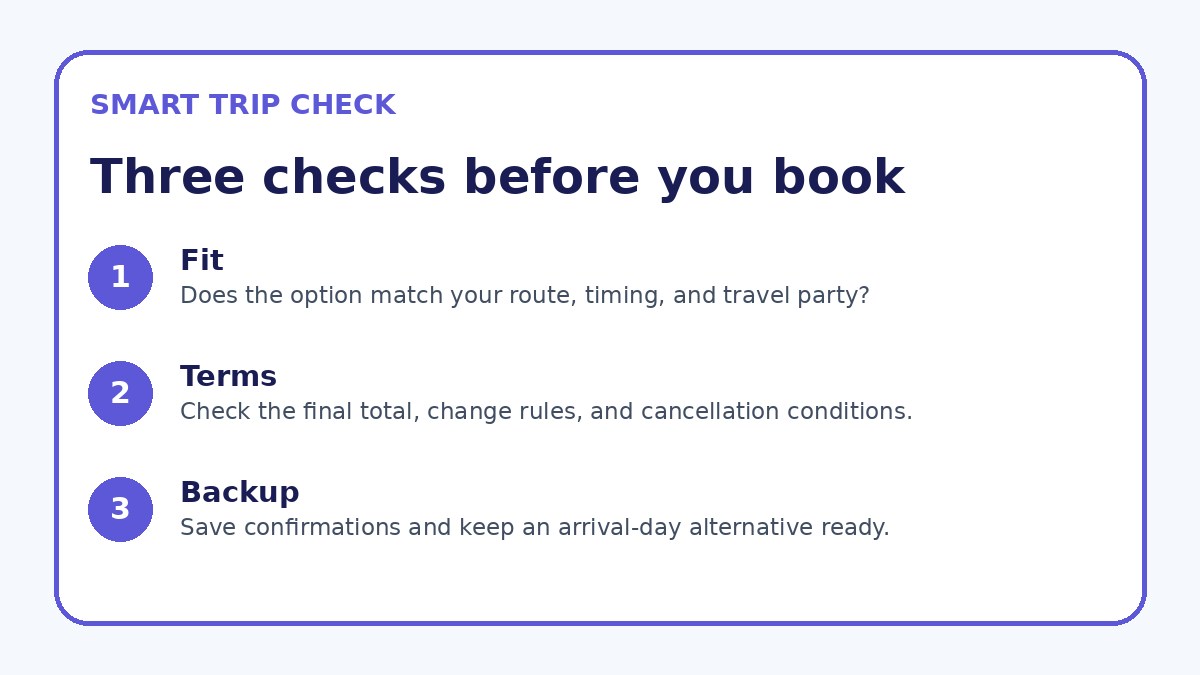
Schedule fit and daily rhythms
Schedule fit is about matching departure and arrival times to your family’s daily rhythms, including nap schedules, mealtimes, and ground transport at both ends. Early morning nonstop departures can be efficient and avoid rush-hour traffic at the origin, while late-evening arrivals in Los Angeles might be convenient if your family sleeps on the plane—but consider whether ground transport options are available and whether late arrivals will disrupt the first day. Connecting itineraries may offer better departure times but add the unpredictability of layovers that break naps or meals.
When deciding, consider local logistics beyond flight times: airport-to-home or airport-to-hotel transfer times, car seat requirements in taxis or rideshares, and daylight vs. night arrival for unfamiliar routes. Put arrival windows into your calendar and check typical travel times from each airport to your destination neighborhood. Also think about acclimatization: your children’s adaptability to time changes, and whether an earlier arrival reduces jet lag by allowing a full day in Los Angeles versus a nighttime arrival that leaves you exhausted the next morning.
Flight details to verify
- Assemble exact traveler details: full names as on ID, dates of birth, passport or Real ID needs, and any frequent flyer numbers before checking fares.
- Choose your preferred NYC and L.A. airports and note typical transfer times; compare options by door-to-door travel time, not just flight duration.
- Decide whether nonstop flights are worth the price premium for your family and filter search results to compare nonstop and one-stop itineraries side-by-side.
- Confirm baggage allowances and fees for every passenger, plus rules for strollers and car seats; add expected checked bags to the fare comparison.
- Check minimum connection times, terminal changes, and whether baggage is through-checked; rule out connections that leave less than your family’s comfortable buffer.
- Read the airline’s fare conditions on the carrier’s final booking page: change/cancellation fees, seat assignment rules, refundability, and any required name-correction fees.
Fare conditions and what to verify before booking
Fare rules determine whether your booking is truly family-friendly. Before you book, check change and cancellation policies, whether the fare includes seat assignments for children, how refunds are handled for involuntary schedule changes, and any fees for name corrections. Especially for families, flexibility matters: a change fee plus fare difference can be costly if plans shift. If you’re comparing fares from multiple sources, verify the same fare code and rules on the airline’s final booking page; third-party listings can omit fees or display incorrect restrictions.
Also verify what is included in the fare: baggage allowance, carry-on rules, seat selection, and whether meals are included on longer flights. If you need contiguous seats, confirm whether the fare or airline policy guarantees them or if you must pay extra. If you find a good-looking fare on a travel aggregator, click through to the airline’s booking page to confirm final terms, luggage fees, and exact total price before you enter passenger details. Trip.com can be used to compare availability, but always confirm final conditions with the airline.
Flight Guide questions travelers ask
Should families always book nonstop New York City to Los Angeles flights?
Not always. Nonstops reduce travel time and connection risk, which benefits families, but they can be pricier. If your family values minimizing airport hassle and a predictable schedule, nonstop is often worth the premium. However, if cost is the dominant constraint and you can accept an extra connection with a comfortable layover and easy terminal layout, a one-stop itinerary can be a reasonable compromise. Always compare total travel time, connection complexity, and baggage transfer rules when making the choice.
How much layover time should I allow when traveling with young children?
Plan for generous buffers. For same-terminal domestic connections, allow at least 60–90 minutes to move between gates and manage children and carry-ons. If the connection requires changing terminals, reclaiming bags, or re-clearing security, add 60–120 minutes depending on airport size and your family’s needs. Also account for time to feed, change, and calm children between flights. Choosing slightly longer layovers reduces stress and the risk of missing a connection, which can be more valuable than a small fare saving.
What fare rules should I prioritize for family travel?
Prioritize flexibility and clear baggage inclusions. Choose fares that allow fee-free or low-cost changes and that include enough baggage allowance for children’s gear, or explicitly list stroller and car seat policies. Confirm seat assignment rules so you can secure seats together without surprise charges. Also verify refundability and whether the airline offers exceptions for illness or travel disruptions. Always click through to the airline’s own booking page to confirm these conditions before entering payment information.
Final decision note
Booking New York City to Los Angeles flights for a family requires focused preparation: gather exact traveler details, pick airports deliberately, and compare nonstop versus connecting options by total door-to-door time, baggage cost, and connection complexity. Use the checklist items to make your search apples-to-apples, and verify fare conditions on the airline’s final booking page before paying. If flexibility is important, accept a higher fare for change protection; if budget is tight, ensure any connection you choose includes comfortable layovers and clear baggage transfer rules. With these steps you’ll reduce surprises and choose an itinerary that balances cost, convenience, and your family’s comfort.
Continue planning
Check current options and final conditions
Use the provider page to confirm live availability, the final total, cancellation terms, and every condition that matters to your trip.
This evergreen planning guide was created with AI-assisted drafting and a structured quality review. It does not display live prices, schedules, availability, visa guidance, or provider rankings. Verify current details before booking. Some links are affiliate links; we may earn a commission at no additional cost to you.