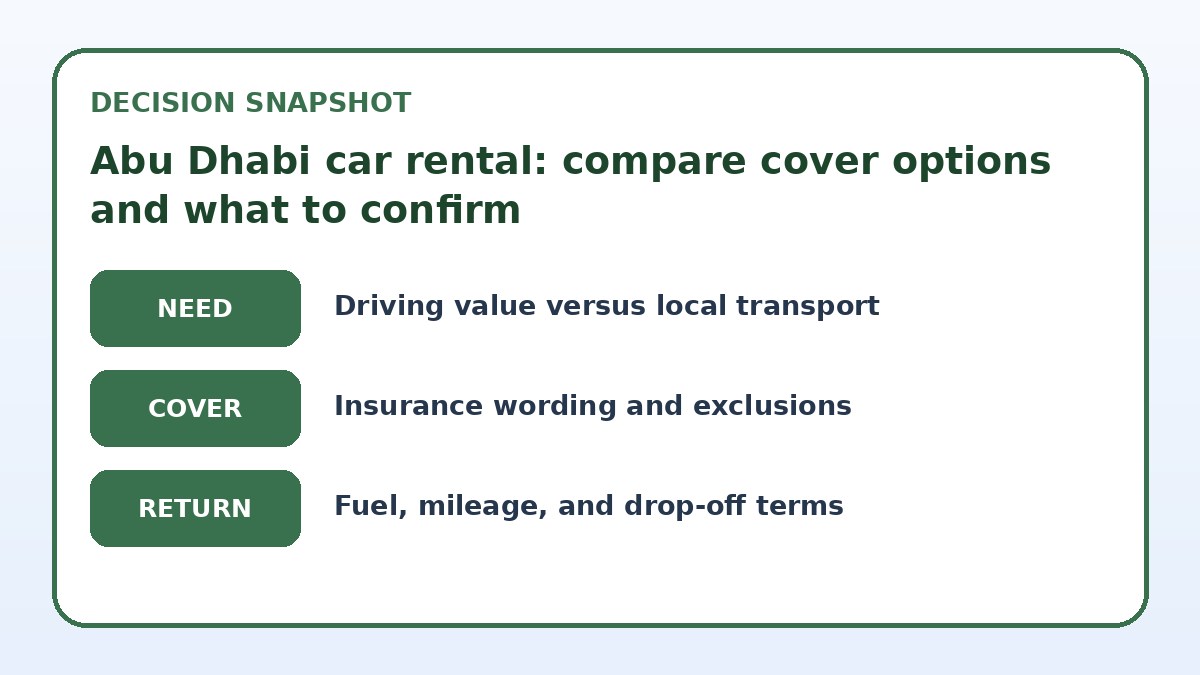
If you’re planning to rent a car in Abu Dhabi with children, the practical first step is to understand the insurance wording on the rental contract and optional add-ons. Focus on five things: what the basic liability cover includes, the deductible/excess and how to reduce it, who counts as an authorised driver, whether third-party or collision damage is excluded for certain uses, and how claims are handled. Read policy names as shorthand, not guarantees — terms like 'collision damage waiver' or 'loss damage waiver' (CDW/LDW) can mean different things depending on the provider. For families, the key decisions balance financial risk against convenience: a lower excess costs more at booking but avoids stress if a minor fender-bender happens near a busy beach or on an unfamiliar road. Later sections explain how to compare wording, what to verify on booking pages, and how family-specific needs (car seats, extra drivers, cross-border plans) interact with insurance wording.
Decoding the common insurance terms on your rental contract
Rental contracts use shorthand that looks simple but hides important boundaries. Collision Damage Waiver (CDW) or Loss Damage Waiver (LDW) often limit what you pay for damage to the rental vehicle, but they rarely remove all liability. Liability cover or Third Party Liability protects other people and property damaged in an accident — this is distinct from CDW. Super Collision or Zero Excess options reduce or eliminate your excess but can come with conditions, like excluding windscreen or tyre damage unless you buy separate protection. Read the sentence describing what 'loss' and 'damage' include; sometimes interior damage, undercarriage, or roof dents are excluded.
Also watch for naming differences: 'Supplemental Liability Insurance' may sound like extra third-party cover but could be a marketing name for only a narrow extension. Wording that limits cover to 'normal road use' can be decisive for families planning trips to beaches, desert parking areas, or off-road sightseeing. Words such as 'unauthorised driver', 'willful misconduct', or 'intoxication' are exclusion triggers; if a family member might drive while managing tired children, you want clarity on how drivers are authorised and what constitutes exclusion. When in doubt, ask the rental company to highlight exclusions in writing before you accept the keys.
Excess, deposit holds and how those numbers affect family budgets
The excess (or deductible) is the amount you would pay in an incident before insurance pays the rest. For families, a lower excess is attractive because small collisions or parking scrapes with prams, car seats, or shopping trolleys happen easily. Reducing excess often requires purchasing an upgrade at booking or the counter. That upgrade may be sold as 'super cover' or 'excess reduction' and usually lowers your financial exposure, but the exact protection may still exclude items like tyres, windscreens, and roof damage unless specifically stated.
Deposit holds on the credit card are separate but related: companies typically place a hold for the excess amount plus any extras. If your card has limited available credit, that hold can be inconvenient when travelling with kids and other prepaid costs. Verify the deposit amount and the accepted card types on the final booking page and consider whether your bank or credit card provider offers rental insurance that covers excess — that can change the value proposition of buying excess reduction from the rental firm. Always ask how long the hold will be released after return so you can plan finances during your trip.
| Approach | Best for | Tradeoff to check |
|---|---|---|
| Self-insure with high excess | Families with strong emergency savings and low-risk driving plans | Lower upfront cost but larger potential out-of-pocket expense after an incident |
| Buy rental company excess reduction | Families wanting predictable costs and minimal paperwork after damage | Higher daily cost; may still exclude wheels, glass, or undercarriage |
| Use credit-card or third-party excess cover | Families with credit cards that include rental insurance benefits | May require filing claims and waiting for reimbursement; careful clause comparison needed |
| Full-premium cover including roadside assistance | Families prioritising convenience and immediate help during a breakdown | Most expensive option; some benefits duplicate services you already have via other providers |
Family-specific cover: drivers, car seats, and roadside support
Family travel often means multiple carers who might swap driving duties and extra equipment such as child seats. Read whether additional drivers are included or charged, and whether every named driver must present a licence at collection. Some policies exclude drivers under a certain age or require an additional fee for drivers over a specific age. If you rely on several adults to rotate driving, ensure each is listed and the policy doesn’t invalidate cover if an 'unauthorised' person takes the wheel for a short leg while loading children.
Child seats and accessories are typically not insured as part of the vehicle; you may be liable if a seat is damaged or lost. If roadside assistance is essential for your family (flat tyre with children in the car, battery issues, or lockout), check what exactly the assistance covers and whether there are response-time guarantees. If assistance is sold by a third-party supplier, note their contact and claim process. When booking, confirm any baby or booster seat hire terms and ask whether damage to those accessories is covered or refundable.
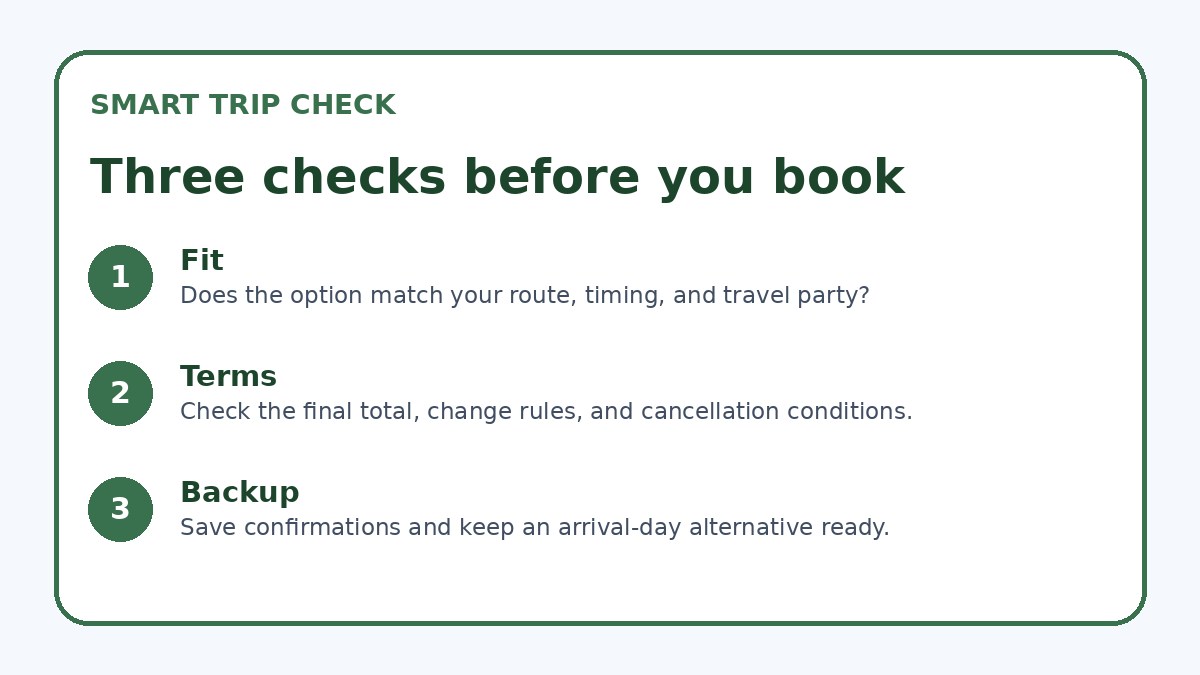
Before you book
- Download and save a PDF of the rental company’s full insurance terms before arriving to collect the vehicle.
- Confirm the exact excess amount and ask whether a separate excess-reduction product removes tyre, windscreen, and roof exclusions.
- List all potential drivers on the booking and have each driver’s valid licence and ID ready at collection.
- Check the credit card hold amount and ensure your card has sufficient available credit for the deposit.
- Ask for roadside assistance contact details, response expectations, and whether assistance is included in your chosen policy.
- Photograph the car at collection (full exterior and interior) and email images to the rental company to avoid disputes on return.
How to compare options and what to verify on the supplier page
Comparing cover is about matching wording, not price tags. Look for the full contract or insurance policy link on the supplier's booking page and read the exclusions list as carefully as you would a medical consent form. Verify the excess amount, which specific damage types are excluded (tyres, windscreens, undercarriage, roof), whether multiple drivers are allowed without penalty, and whether cross-emirate or neighbouring-country travel is permitted. If anything is ambiguous, contact the company and ask them to email the exact clause you’re querying.
On the booking page confirm which card types are accepted for the deposit and whether prepaid rates change the cover. If a 'premium' reduced-excess option is offered, compare its wording to third-party cover from your credit card issuer or separate insurance provider. Trip.com can be useful to compare availability and the supplier's listed terms, but always click through to the rental company’s final booking page to verify the definitive contract wording, permitted uses, and the cancellation or amendment process.
Frequently asked questions
Is the 'collision damage waiver' the same as full insurance for my family?
No. A collision damage waiver (CDW) limits or waives your financial responsibility for damage to the rental car, but it usually doesn’t cover liability to third parties, tyres, windscreens, interior damage, or misuse exclusions. For families, CDW reduces the worry about vehicle damage after an accident, but you should check what the waiver explicitly excludes. If you need broad protection, compare CDW wording with third-party liability coverage and any additional options for glass or tyre protection. Confirm the definitive coverage clauses on the rental company’s final booking page before accepting.
Can my partner or grandparent drive the rental car without extra charge?
Possibly, but don’t assume. Some bookings include one driver and charge extra for additional named drivers; others allow multiple authorised drivers if they’re listed. Beyond fees, insurance wording often requires every person who will drive to be registered or risk making a claim invalid if an 'unauthorised' driver is involved. For family trips where adults will swap driving duties, add each driver to the contract and have each present the required licence at pick-up to ensure cover remains valid.
Does my home-country credit card insurance cover excess in Abu Dhabi?
Maybe, but it depends entirely on your card’s terms and exclusions. Some credit cards provide secondary or primary rental car insurance that can cover the excess; others exclude rentals in certain countries or for certain vehicle categories. To rely on card cover, read the cardholder insurance policy carefully for geographic limits, permitted vehicle types, driver age limits, and whether you must decline the rental company’s CDW at collection. If unclear, contact the card issuer for written confirmation and keep that evidence with you when collecting the car.
Final planning note
For families renting a car in Abu Dhabi, the most practical approach is to read the insurance wording as carefully as you would a medical consent form for your children. Focus on the excess, named drivers, specific exclusions, and the nature of roadside assistance. Balance up-front cost against the stress and potential out-of-pocket expense after an incident: a modest extra daily cost can buy predictability and simpler claims handling, while relying on credit-card cover can reduce expense if the card terms match your trip. Before you drive away, confirm deposit holds, photograph the car, and secure written clarification of any ambiguous clause on the rental company’s final page—doing so prevents surprises and keeps your family’s trip running smoothly.
Continue planning
Check current options and final conditions
Use the provider page to confirm live availability, the final total, cancellation terms, and every condition that matters to your trip.
This evergreen planning guide was created with AI-assisted drafting and a structured quality review. It does not display live prices, schedules, availability, visa guidance, or provider rankings. Verify current details before booking. Some links are affiliate links; we may earn a commission at no additional cost to you.