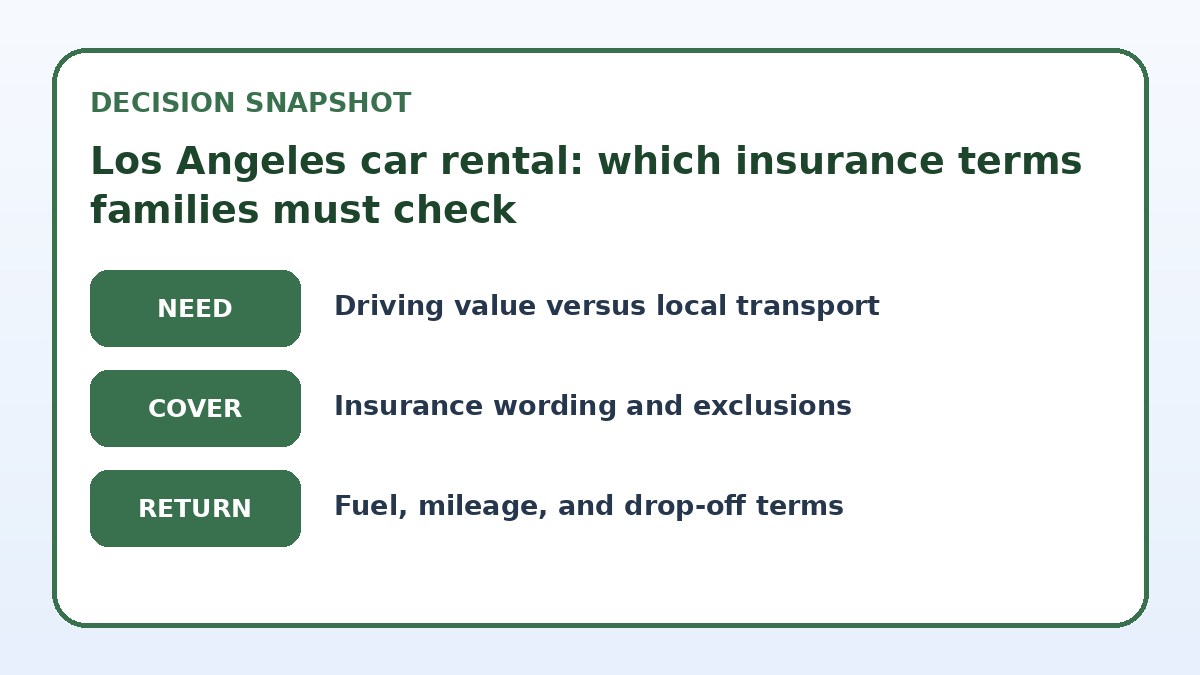
If you’re renting a car in Los Angeles with children, the practical step is to read and ask about three phrases before you book or drive away: collision damage waiver (CDW) or loss damage waiver (LDW), liability coverage limits, and who is considered an authorized driver. These three determine whether a minor crash, damage from street parking, or a third-party claim will hit your personal insurance or the rental company. Bring the car seat and driver’s license information you plan to use and get the insurer’s exact wording in writing—either on the reservation confirmation or a photographed page at the counter. Knowing these key terms ahead of time helps you avoid surprise denials, unexpected deductibles, or paying for duplicate coverage that your personal policy or credit card might already handle.
Decode the core terms: CDW/LDW, SLI, and supplemental coverage
CDW (collision damage waiver) and LDW (loss damage waiver) are commonly used phrases in Los Angeles rental contracts. They often sound like full insurance but are waivers that shift responsibility for damage from the rental company to the renter unless purchased. Read the contract wording carefully: some waivers cover only damage to the rental vehicle and still leave the renter liable for loss of use charges, administrative fees, or certain parts like tires and windshields. For families, that matters because small parking lot dings or curb scrapes are common and might be excluded unless specifically spelled out.
Supplemental liability insurance (SLI) and personal liability coverage address third-party claims for injury or property damage. California requires minimum liability coverage for vehicles but rental companies may offer higher limits. When traveling with children in Los Angeles—where multi-vehicle accidents and pedestrian incidents are not rare—higher liability limits can protect your family’s assets if you’re found at fault. Ask how the policy coordinates with your auto insurer or homeowners liability, and whether SLI fills gaps your personal coverage leaves open when driving a rental.
How personal auto and credit card policies commonly interact
Before skipping rental coverage, check your personal auto insurance policy’s rental-car wording. Many primary auto policies extend coverage to rental vehicles, often mirroring your existing deductibles and liability limits. However, policies vary on exclusions—luxury SUVs, certain commercial uses, off-road damage, or additional drivers may be treated differently. Call your insurer and get a concise statement about what is covered when renting in California; note any age-related exclusions if you have a teenage driver in the family.
Credit cards often offer secondary collision coverage when you pay for the rental with the card, covering what your personal policy doesn’t. The key details to verify on your cardholder agreement are whether coverage is primary or secondary, whether it excludes certain vehicle categories, and whether it requires you to decline the rental company’s CDW/LDW to be valid. If you rely on a card’s coverage, request written confirmation from the issuer and bring that info to the rental counter; agents commonly ask for the card used to pay and may record its number.
| Approach | Best for | Tradeoff to check |
|---|---|---|
| Buy the rental company’s CDW/LDW | Families wanting simplest, counter-closed peace of mind with minimal claims management | Usually higher immediate cost and potential overlap with your personal or card coverage |
| Rely on personal auto insurance (primary) | Families with comprehensive personal policies and reasonable deductibles | You’ll face your personal deductible and a potential premium increase after a claim |
| Use credit card secondary coverage | Families who want reduced out-of-pocket for minor damage and already meet card terms | Coverage is typically secondary and may exclude certain vehicles or drivers |
| Purchase third-party rental insurance before travel | Families seeking a potentially cheaper alternative with known terms and higher limits | You must verify claims process and whether it coordinates easily with rentals in California |
Authorized drivers, extras, and common exclusions to watch
Who is listed as an authorized driver directly affects insurance validity. Many family trips involve multiple adults sharing driving duties; add everyone who may drive to the rental agreement when you book or at pickup. Some companies permit spouses at no extra charge but require additional drivers to be paid or added in advance. If a child uses the car for loading or short movements, that is different from actually driving; ensure anyone who might take a turn behind the wheel is properly authorized to avoid denial of coverage after an incident.
Pay attention to extras that look like insurance but are service waivers—roadside assistance or tire-and-wheel protection may be optional but have specific conditions. Common exclusions in Los Angeles include damage from off-road use, theft with left-keys-in-the-car situations, and vandalism in certain neighborhoods unless proven to be unavoidable. Ask the rental counter to point out exclusions in plain language and, if necessary, request a copy of the exact clauses to photograph for your records.
Before you book
- Photograph the rental car inside and out before driving away and ensure every pre-existing blemish is written on the contract.
- Call your personal auto insurer and confirm exactly what rental situations, vehicle types, and drivers are covered in Los Angeles.
- Check your credit card’s benefit guide for rental coverage details: primary vs secondary status, exclusions, and required documentation.
- Ask the rental desk to explain CDW/LDW, SLI, and any service waivers in plain language, and request those clauses on your reservation confirmation.
- Add every intended driver to the rental agreement at pickup, including spouse or older teens you expect to drive.
- If damage occurs, document the scene, collect police and tow reports, notify the rental company, and keep all repair and correspondence records.
Practical pick-up and post-accident steps for families
At pickup, insist on a clear walk-through of the vehicle and a written record of existing damage. Photograph every panel, the roof, tires, interior, and the odometer, time-stamped if possible, and make sure any pre-existing damage is noted on the rental agreement before you leave. Confirm the mileage policy and fuel terms in case you need to drive across the region with stops for attractions. For families, stash emergency numbers and the name of the rental coverage agent in your phone and in a printed copy inside the car seat bag or glovebox.
If an incident occurs, prioritize safety and then follow the rental insurer’s claims procedure: document the scene, exchange information with other parties, and call the rental company as instructed in your contract. Notify your personal insurer and credit card issuer if you intend to rely on their coverage—waiting can complicate reimbursement. Keep all receipts, tow or repair estimates, police reports, and correspondence. Having these items organized will make dealing with deductibles, loss-of-use charges, and administrative fees far less stressful for a family already coping with a holiday hiccup.
Frequently asked questions
Does California law require rental companies to include liability insurance in the price?
California requires that motor vehicles have minimum liability coverage, but rental companies typically present optional supplemental liability insurance (SLI) to increase limits beyond the legal minimum. The rental rate may not include SLI; instead the company often offers higher limits as an add-on. When planning your family trip, verify the liability limit included in the base rental and compare it with your personal auto policy limits. If your personal policy already provides strong excess liability, you may not need SLI—but confirm the interaction with your insurer before declining any desk offers.
If my credit card covers collision damage, do I still need to buy the rental company’s CDW?
Many credit cards offer collision damage coverage, but terms differ: some provide primary coverage, many are secondary, and several exclude certain vehicle types or drivers. To rely on card coverage, you typically must use the card to pay for the rental and decline the rental agency’s CDW/LDW. Call your card issuer to get a written summary of coverage and exclusions, and bring that with you. If the card’s coverage is secondary, you’ll still be responsible for your personal deductible and possibly administrative fees handled by the rental company.
Are there special considerations for adding a teen driver to a Los Angeles rental?
Teen drivers are often subject to age-based restrictions, added fees, or flat exclusions depending on the rental company and the vehicle class. Even if permitted to drive, adding a teen without properly listing them as an authorized driver can void coverage. Check both the rental company’s age policies and your insurer’s rules for young drivers. If your family plans to include a teen driver, arrange the addition when you book or at pickup and confirm in writing that the vehicle remains fully insured with the teen listed.
Final planning note
For families renting a car in Los Angeles, the right choice depends on balancing convenience, risk tolerance, and what your personal insurance or credit card already covers. Start by getting clear, written definitions of CDW/LDW, liability limits, and who counts as an authorized driver. Photograph the car at pickup, add every driver, and carry proof of any external coverage you plan to use. If you prefer simplicity and faster resolution after damage, paying for the rental company’s waiver at the counter reduces administrative steps; if you want to avoid duplicate costs, confirm your personal and card coverage and bring written proof. Always verify the exact policy wording on the provider’s final booking page or your insurer’s statement so you’re not surprised when you hand the keys back.
Continue planning
Check current options and final conditions
Use the provider page to confirm live availability, the final total, cancellation terms, and every condition that matters to your trip.
This evergreen planning guide was created with AI-assisted drafting and a structured quality review. It does not display live prices, schedules, availability, visa guidance, or provider rankings. Verify current details before booking. Some links are affiliate links; we may earn a commission at no additional cost to you.