Practical answer up front: for most first-time visitors to Munich, a car is unnecessary and often a hassle; the city’s public transport, walkable neighborhoods, and frequent regional trains cover the main sights efficiently. Rent a car if you plan significant day trips into Bavaria’s countryside, need flexibility for remote destinations, carry lots of luggage, or travel on nonstandard schedules. Consider a hybrid approach: use public transit inside Munich and rent a car only for specific day trips (pick up outside the central city to avoid delivery fees and limited parking). This article helps you weigh the tradeoffs—time saved versus parking stress and environmental zones—so you can decide whether a Munich car rental fits your itinerary and comfort level.
Who should rent a car in Munich — the short version
A Munich car rental suits travelers whose itinerary extends beyond the city’s well-connected core. If you want to visit multiple small towns, remote alpine valleys, or scenic routes where trains either don’t run or require long transfers, a car can save time and add flexibility. Families with young children or travelers with large amounts of luggage may also find door-to-door convenience worth the extra coordination. Think in terms of where you will sleep and how often you will leave the city: if most nights are in Munich and you plan only one or two distant day trips, renting for those specific days usually makes more sense than keeping a car the whole stay.
On the other hand, if your schedule focuses on Munich’s museums, beer gardens, the English Garden, shopping districts, and day trips well-served by regional trains—like Salzburg or Nuremberg—public transit plus a single longer-distance train or bus is typically faster and easier. Factor in parking availability and costs, which can quickly outweigh the rental rate, plus the effort of navigating traffic, low-emission zones, and one-way restrictions. For short urban stays, the convenience of leaving the car behind often outweighs the perceived freedom of driving.
When a car adds real value for first-time visitors
Choose a Munich car rental when your route includes rural Bavaria: the Bavarian Alps, Königssee, Neuschwanstein, or smaller alpine towns where trains require transfers, timetables are limited, or last-mile connections are rare. A car lets you set your own pace, visit multiple villages in a single day, and access scenic viewpoints and parking areas outside public-transport hubs. For active travelers planning hiking, cycling with gear, or early/late travel to mountain trailheads, driving can reduce transit friction and improve safety when reaching remote trail starts at unconventional hours.
Cars also help itineraries that mix several dispersed stops—vineyards, thermal spas, and family-run attractions—where waiting for regional buses would fragment your day. If you’re traveling with mobility needs, small children, or a lot of luggage, the step-free, private space of a rental is a practical choice. In these cases, pick a compact car for narrow roads and easier parking; verify roof rack or bike-rack options if you need them, and confirm cross-border permissions if you plan to drive into Austria or Switzerland.
| Approach | Best for | Tradeoff to check |
|---|---|---|
| Rent a car for the whole trip | Travelers prioritizing full flexibility and many rural stops | Higher parking hassle, possible delivery fees, and navigating city restrictions |
| Use public transit only | Visitors focused on Munich’s central sights and limited, well-served day trips | Less flexibility for remote destinations and early/late departures |
| Rent a car just for selected days | Visitors combining city time with a couple of distant day trips | Requires coordinating pick-up/drop-off and possibly paying short-term rental rates |
| Mix transit with guided or private day tours | Those who want convenience without driving and prefer expert routes | Less personal flexibility and dependence on tour schedules |

When to skip renting and rely on Munich’s transit
Skip a Munich car rental for an urban-focused stay. The city’s U-Bahn, S-Bahn, trams and buses are frequent, reliable, and cover major museums, neighborhoods, and the airport connection. Central neighborhoods like Altstadt-Lehel, Maxvorstadt, Schwabing and Glockenbachviertel are compact and walkable; many hotels sit within easy access to transit stops so daily driving isn’t necessary. Guided day tours and regional trains provide simple alternatives for common excursions such as Salzburg or Dachau, avoiding parking hassles at popular tourist sites.
Also consider the environmental and regulatory landscape: Munich enforces low-emission zones and has limited parking in central districts. If your itinerary involves mostly cultural sites, restaurants, and beer gardens within the city, you’ll likely spend more time finding lawful parking, paying for it, and dealing with city traffic than you would saved driving. For short trips where convenience and reduced stress matter more than driving freedom, public transit is the smarter choice.
Before you book
- Map every planned stop and mark whether it’s reachable by public transit, how many transfers are required, and approximate door-to-door travel time.
- If renting, confirm pick-up/drop-off addresses and hours, and whether there are extra fees for airport or city-center locations.
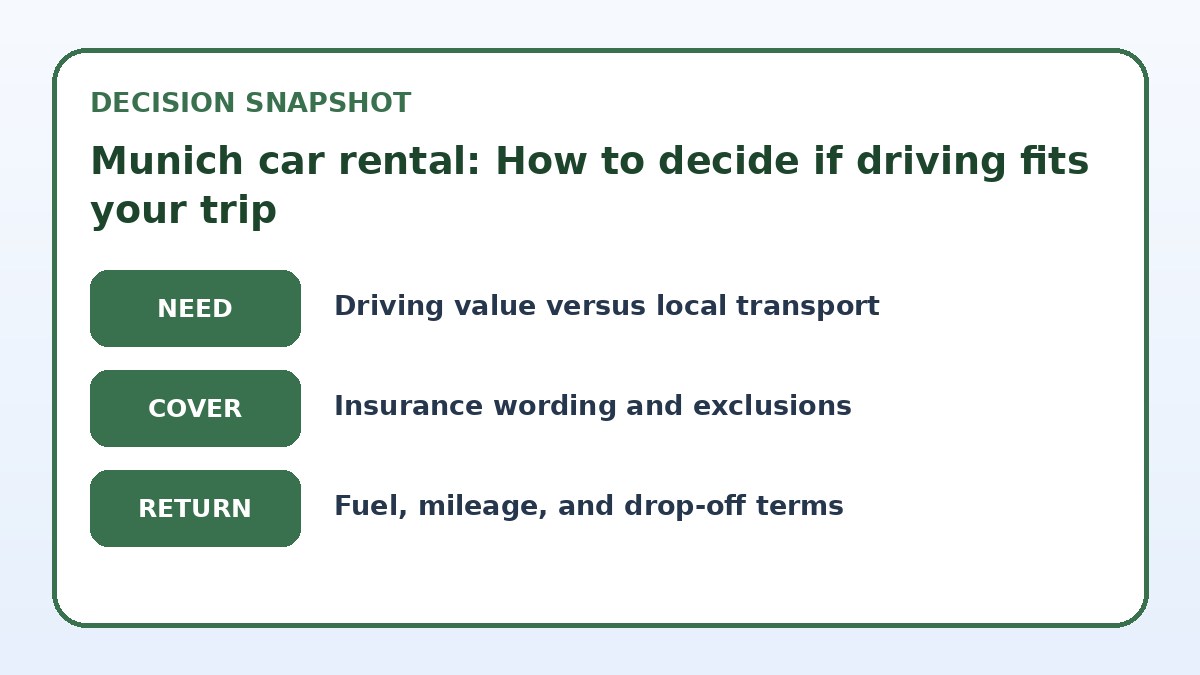
- Verify insurance coverage and excess amounts on the rental provider’s booking page and decide whether to buy additional protection.
- Check which vehicles qualify for Munich’s low-emission zones and whether your rental includes any environmental stickers or permits.
- Estimate parking needs and check typical parking rules near your accommodations and main sights to budget time and cost.
- If crossing borders, confirm cross-border permissions and any supplemental fees directly with the rental company before reserving.
How to decide and what to check before booking
Make a simple decision matrix: list each planned stop and mark whether it’s easy by public transit, requires long transfers, or is effectively car-only. Count the number of days a car would be actively used versus days parked. If a rental is only needed one or two days, compare the logistics and cost of short rental windows versus a continuous booking. Also evaluate group size, luggage, and mobility needs—those factors often tip the balance toward renting even for partial itineraries.
Before you book a Munich car rental, verify key details on the provider’s final booking page: exact pick-up and drop-off locations and hours, fuel and mileage policies, insurance coverage and excess amounts, cross-border travel rules, and any fees for young drivers or additional drivers. Confirm whether the car is permitted in low-emission zones and whether parking or congestion charges apply on planned routes. You can compare live availability and terms on booking platforms including Trip.com, but always read the rental contract fully before payment.
Frequently asked questions
Can I drive a rental car from Munich into nearby countries like Austria or Switzerland?
Many rental contracts allow cross-border travel into neighboring countries, but rules vary by provider and car category. Before you book, check the rental company’s terms on the final booking page for permitted countries, any required documentation, and possible additional fees or insurance requirements. Also verify road rules, vignette tolls, and low-emission zone requirements for the countries you intend to visit. If crossing a border changes your insurance or roadside assistance coverage, the rental provider’s policy will specify how to proceed.
Is parking in central Munich difficult and expensive with a rental car?
Central Munich has limited on-street parking, many resident-only zones, and paid garages; availability varies by neighborhood and time of day. Expect to pay for parking in central districts and at popular attractions, and allow extra time to find legal spots. Some hotels include or offer paid parking—confirm directly with your accommodation. For long stays, look for public garages or park-and-ride options near S-Bahn stations and use transit into the center to avoid repeated parking searches.
What size of car should I choose for driving around Bavaria from Munich?
For Bavarian roads, a compact or small family car is usually the most practical choice: easier parking in towns, better fuel efficiency, and simpler handling on narrow country lanes. If you travel with a lot of luggage, need child seats, or plan mountainous routes with steep passes, consider a slightly larger vehicle or one with higher ground clearance. Always check trunk capacity and roof-rack options if you need extra storage. Confirm specific vehicle features and restrictions on the rental page before completing your reservation.
Final planning note
Deciding on a Munich car rental comes down to the balance between convenience and friction. For most first-time visitors staying mainly in the city and using museums, beer gardens, and easy regional train trips, public transit and selective guided tours are the lower-stress, efficient choice. A rental makes sense when your itinerary includes multiple remote stops, early starts to alpine hikes, or a need for heavy luggage transport. Use the decision matrix described here, run the checklist before booking, and verify all rental terms—pick-up and drop-off, insurance, low-emission permissions, and cross-border rules—on the provider’s final booking page so your travel plans match the realities on the road.
Continue planning
Check current options and final conditions
Use the provider page to confirm live availability, the final total, cancellation terms, and every condition that matters to your trip.
This evergreen planning guide was created with AI-assisted drafting and a structured quality review. It does not display live prices, schedules, availability, visa guidance, or provider rankings. Verify current details before booking. Some links are affiliate links; we may earn a commission at no additional cost to you.