
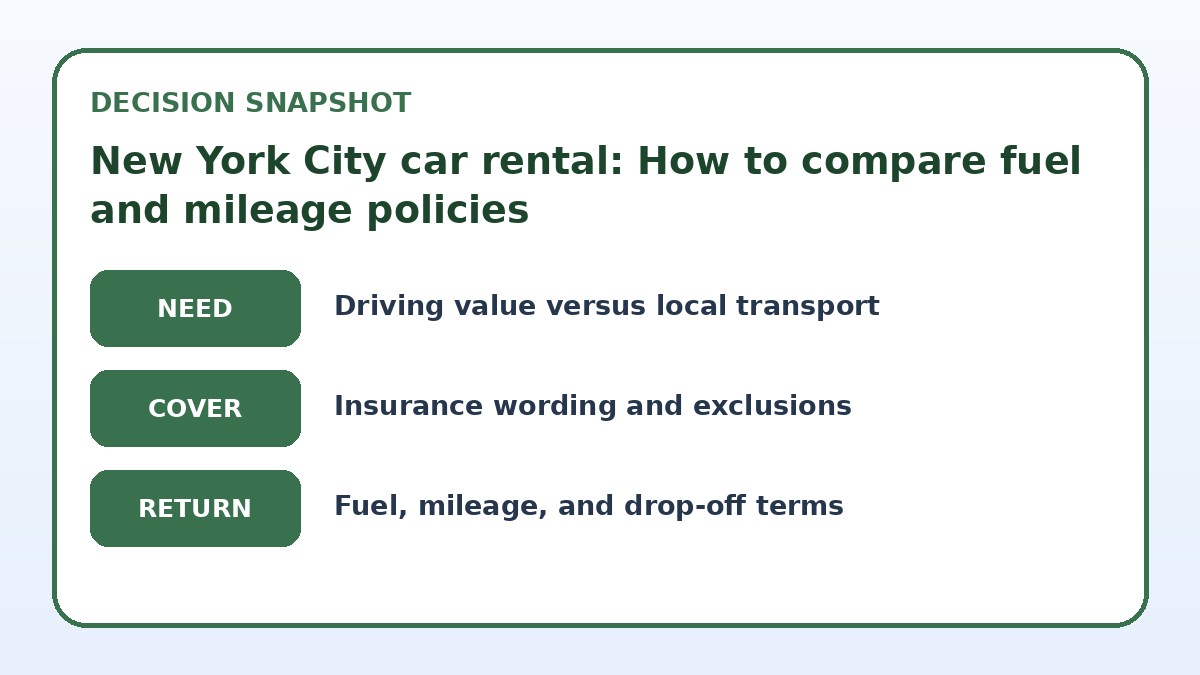
If you’re renting a car in New York City for business, check the rental company’s fuel and mileage rules before you book — those two items affect cost, route choices, and expense reporting more than insurance tiers or GPS add-ons. Practically, verify the fuel policy (return full, prepay, or pay on departure), whether fuel charges use posted or market rates, and whether the quoted mileage is unlimited or capped per day. Also confirm any geographic restrictions, toll handling, and whether company cards cover fuel or incidental surcharges. Knowing these specifics helps you pick the right car class, decide whether to refuel before drop-off, and explain charges to your finance team. Below you’ll find clear checklists, tradeoffs by scenario, how to read contract language, and what to photograph or save for expense claims.
See current options before you compare the details
Availability and final conditions change. Open Trip.com now or keep reading for the practical comparison.
Practical rules to check on the booking page
When comparing New York City car rental offers, start with the contract language displayed on the provider’s final booking page. Look specifically for the fuel policy wording: common options include full-to-full (you refill before return), prepaid fuel (pay for an estimated tank in advance with no refund for unused fuel), or fuel service where the company refuels at a corporate rate. Also check whether the posted rate uses gallons or liters, and whether the company reserves the right to bill fuel at a “market” or administrative rate that could be significantly higher than local pump prices. If the wording is unclear, call the rental branch and ask for the exact wording they will print on the rental agreement.
Next, read the mileage terms here as well. Some contracts state ‘unlimited mileage’ while others set a per-day cap or charge per mile above a threshold — common for specialty vehicles or certain corporate rates. Confirm whether the mileage count resets at midnight or every 24 hours if you plan multi-day travel. Geographic restrictions or one-way mileage conditions (for example, taking the car across state lines or dropping at a different location) can also trigger extra per-mile fees. If your finance or compliance team has policies about cross-state usage or personal use, verify those against the rental terms before confirming.
How fuel policies change your cost and convenience
Full-to-full generally gives you the best control: you pay only for the fuel you use, and you can stop at neighborhood pumps in New York City where prices are often lower than airport station rates. Prepaid fuel offers convenience but usually lacks refunds for unused fuel, which suits short, predictable trips but is wasteful if plans change. Pay-on-return or company-refueled options can include administrative markups; ask how the charge is calculated and whether you’ll receive an itemized receipt. For business travelers, use a corporate fuel card if your company issues one — it simplifies reconciliation and avoids rental-company refuel surcharges.
Consider practicality: in Manhattan, accessing a station with a larger vehicle can be slower because of traffic and parking restrictions, so prepaid fuel might save time despite a small premium. At airports like JFK or LaGuardia, on-site fuel prices and convenience fees can be higher, and some airport locations automatically offer prepaid or post-return refueling. If your itinerary includes frequent short trips or drop-offs, calculate whether time saved by prepaid options offsets additional cost and check whether your employer reimburses for such convenience fees.
| Approach | Best for | Tradeoff to check |
|---|---|---|
| Full-to-full fuel | Business travelers wanting transparent, pay-for-what-you-use charging | Requires time to refuel before drop-off and can be inconvenient in busy urban lots |
| Prepaid fuel | Short trips where convenience and quick returns matter more than precise cost | No refund for unused fuel — can be wasteful if plans change |
| Unlimited mileage rate | Long or multi-stop road trips outside city limits | Higher daily rate may not pay off for strictly intra-city travel |
| Capped-mileage with per-mile fees | City-only itineraries with predictable, short daily travel | Per-mile overage charges can escalate quickly on unexpected detours |
Ready to check the option that fits your plan?
Use your exact dates and traveler details so the provider page can show the current total and conditions.

Mileage limits, route planning, and how they affect choices
If your business travel includes day trips outside the city — into Upstate New York, New Jersey, or Connecticut — mileage caps matter. Unlimited mileage suits road-heavy itineraries and unpredictable client visits; capped rentals are typically fine for urban-only travel. When a rental charges per mile over a limit, multiply the per-mile fee by your expected distance to compare against the cost of a higher-tier rate that includes unlimited miles. Also think about pickups and drop-offs: one-way rentals can have mileage or relocation fees. When calculating, include detours, parking searches, and trips to satellites like airports or suburbs.
Route-planning tools help here. Measure your intended routes and add a buffer for unplanned meetings or reroutes. If you cross toll bridges or highways, include toll costs and the rental’s toll-handling fees in the total. Remember that GPS mileage readings can differ slightly from the rental odometer; always use the rental contract’s odometer reading at pickup and drop-off in your records to avoid billing disputes. For multi-day hire, note how the company rounds mileage — per day, per 24 hours, or by calendar day — since that affects the effective cap.
Before you book
- Read the exact fuel policy on the final booking page and take a screenshot of the paragraph shown at checkout.
- Confirm mileage terms — unlimited or capped — and calculate expected miles including buffers for detours.
- Ask the rental branch how tolls are billed and whether a transponder adds administrative fees.
- Photograph the fuel gauge and odometer at pickup and again at drop-off; attach photos to your expense report.
- Keep all fuel receipts and the rental final invoice with itemized fuel, toll, and mileage charges.
- If you use a corporate card or account, verify which fuel options and fees your company will reimburse.
Documentation, expense handling, and dispute prevention
Before you drive away from the lot, photograph the fuel gauge, the printed mileage on the rental agreement, the vehicle condition, and the outside of the car showing the license and plate. Save the pickup receipt and the final invoice with line-item fuel and mileage charges. If the company uses a transponder for tolls, request the transponder ID and the rental’s toll policy statement. These records speed expense reporting and protect you if a rental company later charges an administrative fuel mark-up or mileage surcharge you didn’t expect.
For expense submission, attach images and the contract excerpt that shows the fuel and mileage policy. When your company reimburses through credit card or corporate account, check whether they require receipts for fuel or accept mileage reimbursement at a standard rate. If a charge appears after return — a refuel, tolls, or admin fee — contact the rental branch promptly and ask for an itemized explanation and supporting evidence, such as a pump receipt or transponder log. If unresolved, escalate with the company’s business travel or corporate customer service and keep all correspondence for records.
Frequently asked questions
Should I always choose unlimited mileage for a New York City business trip?
Not necessarily. Unlimited mileage makes sense if your itinerary involves long day trips outside the city or several client sites far apart. For meetings confined to Manhattan, Brooklyn, or close suburbs, a capped-mileage option often costs less. To decide, estimate total miles for the trip and multiply any per-mile excess fee by that estimate, then compare it with the price difference to an unlimited option. Also consider parking and congestion: high city parking fees and slow speeds can make public transit plus local car hire a smarter choice for strictly urban plans.
How can I avoid high refueling or administrative fuel charges?
Choose full-to-full and refuel yourself at a nearby station before returning the car to avoid administrative markups. If you’re short on time, prepaid fuel can be convenient but check for nonrefundable terms to ensure you’re not overpaying. At airport locations, ask whether the on-site option is optional or automatic and request the exact per-gallon/liter rate the company will charge if they refuel for you. Finally, save pump receipts to contest any charge that doesn’t match documented fuel needs; photographic proof of gauge levels and the refill receipt is your best evidence.
What documentation should I collect to prevent disputes over mileage or fuel?
At pickup, photograph the odometer reading, fuel gauge, vehicle condition, and the written rental agreement pages showing fuel and mileage terms. Collect the printed pickup receipt and any transponder or toll device documentation. At drop-off, immediately photograph the odometer and fuel gauge again and keep the final rental invoice; if possible, get a signed return confirmation from the branch. Save all emailed confirmations and billing statements — these form the audit trail your finance team and the rental firm will need if you dispute a post-rental charge.
Final planning note
For business travelers renting in New York City, fuel and mileage policies are practical levers that affect both cost and convenience. Read the exact wording on the provider’s final booking page, photograph the fuel gauge and odometer at pickup and drop-off, and reconcile toll-handling practices with your corporate expense rules. Use the comparison rows above to match options to your itinerary: full-to-full for cost control, prepaid for quick returns, unlimited mileage for long road trips, and capped rates for short urban stints. When in doubt, call the branch to get contract language you can save; Trip.com can be a place to compare current availability, but always verify the fuel and mileage terms on the rental company’s final booking page before confirming.
Continue planning
Check current options and final conditions
Use the provider page to confirm live availability, the final total, cancellation terms, and every condition that matters to your trip.
This evergreen planning guide was created with AI-assisted drafting and a structured quality review. It does not display live prices, schedules, availability, visa guidance, or provider rankings. Verify current details before booking. Some links are affiliate links; we may earn a commission at no additional cost to you.