
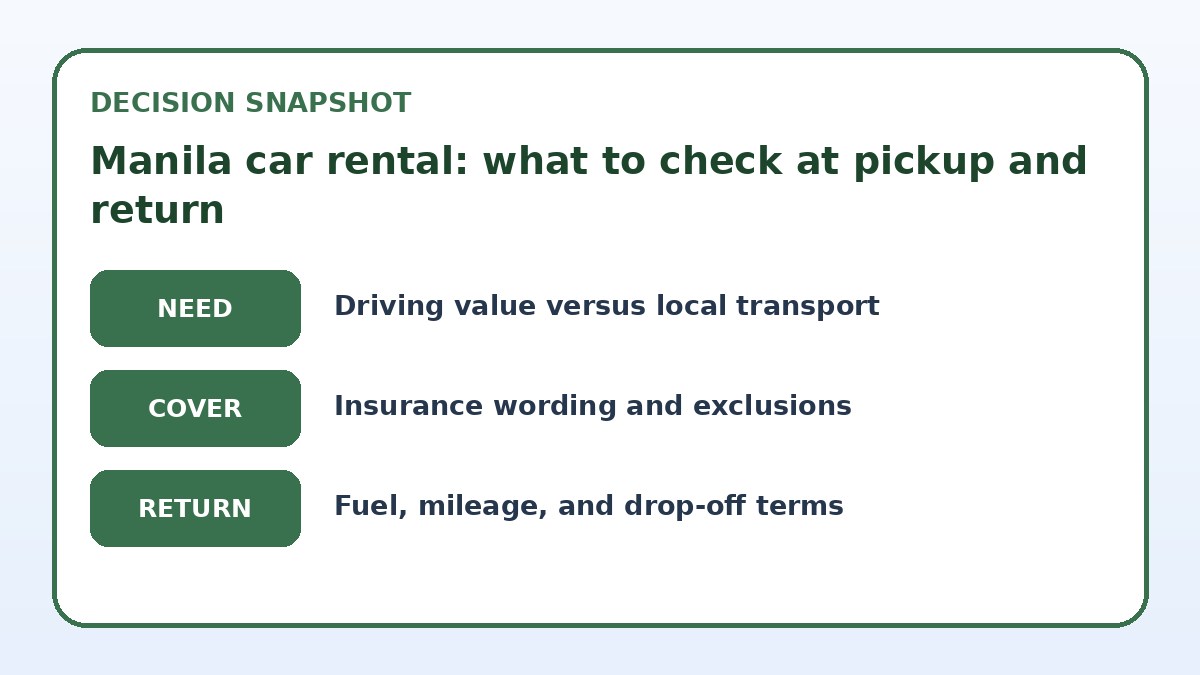
If you’re a solo traveler planning to rent a car in Manila, the practical priority is simple: confirm exactly what you’ll be handed at pickup and what the company expects at return. That short checklist—vehicle condition, fuel policy, mileage limits, insurance coverage, and the steps for after-hours drop-off—determines whether a relaxed day trip becomes a stressful claims dispute. Read this guide to learn which contract clauses change your risk, what to inspect before you drive away, and the questions to ask before you sign. I’ll also explain trade-offs (cheaper rates vs. higher liability, office convenience vs. flexible returns) and show how to compare options so you can make a confident booking decision. Where provider-specific facts matter, I’ll tell you exactly what to verify on the final booking page.
See current options before you compare the details
Availability and final conditions change. Open Trip.com now or keep reading for the practical comparison.
Pickup: inspect, ask, and document
At pickup, your goal is to leave the lot with no uncertainties. Walk around the vehicle with a company staff member, point out any scratches, dents, or interior stains, and insist that these be noted on the rental agreement. Take time-stamped photos of all sides, the odometer, fuel level, and the interior. If the provider uses a digital check-in app, keep copies or screenshots. Ask for a clear explanation of the fuel policy, permitted drivers, and whether airport pickups include extra fees—then confirm which fees appear on the initial invoice versus what may be billed after return.
Also confirm operational details you’ll need while driving: what to do if the car breaks down, the procedure for roadside assistance, and whether towing is covered. Ask about the company’s process for traffic infractions and toll charges—will the company handle notices and bill you later, or must you settle on the spot? If you rely on navigation apps, confirm mobile signal and recommended offline maps for planned routes. Before you sign any contract, verify the total amount due at pickup, including deposit, estimated taxes, and authorizations on your card.
Insurance, excess, and third-party responsibility
Understanding insurance terms is essential for minimizing financial exposure. The base rate often includes minimal third-party liability; collision damage waivers (CDW) and theft protection may be optional and vary by provider. If a CDW is offered, read whether it reduces your financial responsibility to zero or leaves a deductible (excess) you must cover. Ask explicitly how the company treats ‘‘loss of use’’ charges and administrative fees after accidents—these are common extra items charged while repairs happen or claims process.
If you have personal travel insurance or a credit card with rental coverage, check the policy wording before declining provider insurance. Many personal policies exclude certain vehicle classes, drivers under a specified age, or rentals in particular countries. If you rely on third-party coverage, get written confirmation of accepted deductibles and whether the rental company requires a hold on your card. On the provider’s booking page, verify exact insurance inclusions, the excess amount, and how collision claims are handled.
| Approach | Best for | Tradeoff to check |
|---|---|---|
| Budget rate with minimal inclusions | Solo travelers prioritizing lowest base cost and willing to manage more risk | Lower upfront price but higher liability and many optional fees for coverage and extras |
| Higher-rate package with low deductible | Travelers willing to pay more for predictable liability and simpler claims handling | Higher daily cost but reduces stress and out-of-pocket risk after incidents |
| Airport pickup and return | Those valuing convenience and immediate access to transport on arrival or departure days | Often includes surcharges and can involve longer queues at busy terminals |
| Off-airport agency with flexible hours | Solo travelers wanting lower surcharges and personalized service | May require an extra taxi to the office and stricter hours for returns |
Ready to check the option that fits your plan?
Use your exact dates and traveler details so the provider page can show the current total and conditions.
Return strategies: fuel, hours, and after-hours drop-off
Plan your return to avoid surprises. Full-to-full fuel policies are most straightforward: you receive and return the car full, and you’re charged only for fuel you used. Pre-purchase fuel options can look convenient but often result in paying for a full tank regardless of consumption. Confirm the provider’s hours and whether after-hours returns are allowed without penalty. If you expect to return outside office hours, ask for a formal procedure—where to leave keys, how the company documents the return condition, and how they acknowledge receipt. A written after-hours policy reduces the risk of later damage claims.
During return inspection, be present and request a final condition report. Repeat the photo documentation from pickup: photograph the same angles, the odometer, and the fuel gauge. If you disagree with the company’s damage assessment, insist on a written record and contact details for the claims department. Keep all receipts for tolls, parking, or repairs accepted by the company. Finally, verify the timing for release of any security hold on your card and exactly where the release timeframe is stated on the provider’s terms.
Before you book
- Photograph the vehicle (all sides, interior, odometer, fuel level) with timestamps before leaving the lot.
- Confirm fuel policy in writing and choose full-to-full if you want the simplest return process.
- Get explicit written details of insurance inclusions, the excess amount, and how collision claims are processed.
- Ask for the exact after-hours return procedure and a contact number for the claims or returns desk.
- Verify whether tolls, parking fines, and traffic tickets will be charged to your card and how notices are delivered.
- Keep all rental paperwork, receipts, and final return confirmation until your security hold is fully released.
Solo-traveler trade-offs and decision criteria
As a solo traveler, prioritize simplicity and low friction over marginal savings. A slightly higher rate that includes a low deductible and roadside assistance can be worth it if it prevents claim disputes far from your accommodation. Consider vehicle size carefully: a compact car is easier to park in Manila and costs less to fuel, but if you plan long drives outside the city on uneven roads, a sturdier vehicle may improve safety and comfort. Evaluate mileage terms—unlimited mileage matters if your itinerary covers long day trips, while capped mileage keeps costs predictable for city-only plans.
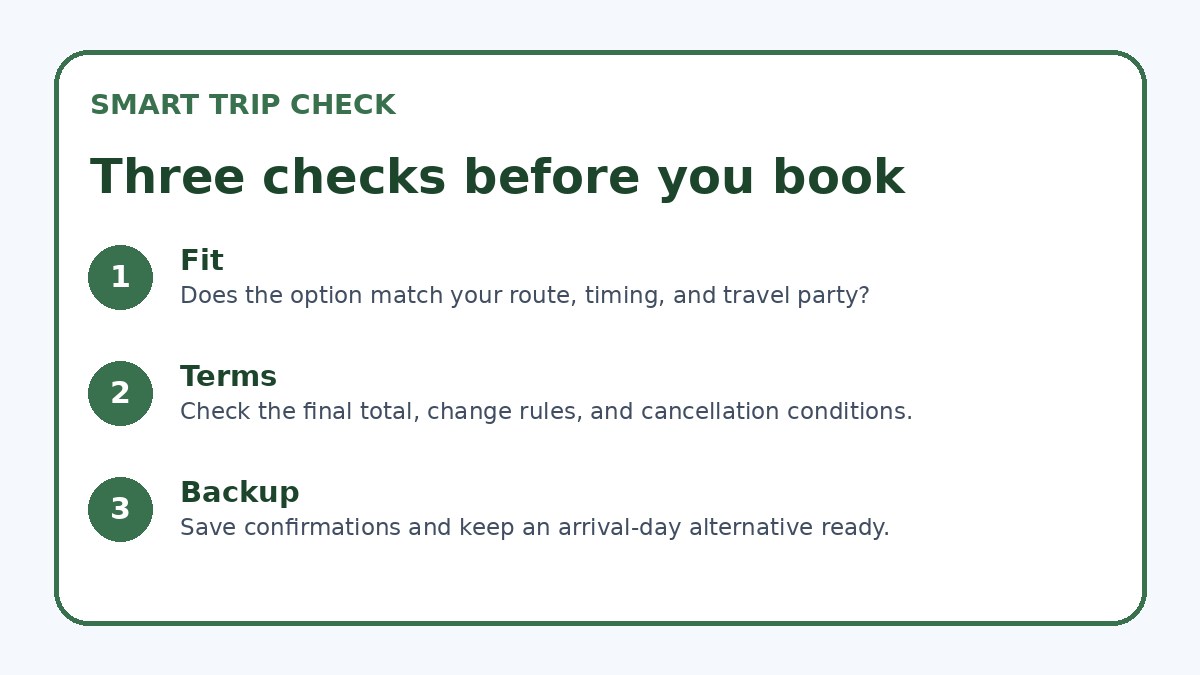
Other decision criteria: pickup location (airport desks are convenient but can add surcharges), cancellation rules, payment and deposit methods, and whether the provider mandates additional documentation for solo drivers—some companies require proof of local address, round-trip tickets, or minimum age. Before booking, compare total estimated charges (including deposits and potential extras) across several providers and confirm the exact pickup and return procedures on the final booking page. You can check availability and current terms on comparison sites like Trip.com, but always verify contract specifics with the rental company directly.
Frequently asked questions
What should I do if the rental agent notes damage I didn’t cause?
Remain calm and ask for the damage to be documented on the rental agreement with photos or an attached condition report. If the agent insists an item is new damage, request the name and employee ID of the person who completed the inspection. Take your own photos showing the disputed area and the surrounding context; if possible, have the agent sign or initial the disagreement on the paperwork. If the company won’t provide a satisfactory record, ask to speak to a manager and consider taking a short video that timestamps your effort to resolve the issue.
Can I rely on my credit card or travel insurance for collision coverage in the Philippines?
Possibly, but you must verify specifics before declining rental company coverage. Contact your credit card provider and insurer to confirm whether rental cars in the Philippines are covered, which vehicle types are included, and whether there are age or license restrictions. Ask about required documentation for claims, whether a police report is mandatory after an incident, and whether the card issuer will reimburse the rental company’s deductible or only certain loss items. If you proceed on third-party coverage, carry written confirmation and note any coverage limits on the provider’s booking page.
How do after-hours returns normally work, and how can I avoid disputes?
Providers vary, so get the exact after-hours procedure in writing before you book. Common practices include leaving the keys in a secure drop box and parking in a specified lot; the company then inspects the car the next business day and may email a confirmation. To avoid disputes, follow the provider’s instructions precisely, photograph the car at drop-off showing the keys and the parking spot, obtain a timestamped confirmation if available, and keep proof you followed the documented process. Ask how long it will take for any security hold on your card to be released and where that timeframe is stated.
Final planning note
For solo travelers in Manila, careful attention at pickup and a planned, documented return are the simplest ways to avoid stress and unexpected charges. Prioritize clear, written confirmation of fuel policy, insurance excess, and after-hours return procedures. Balance cost against convenience: a slightly pricier package that reduces liability and includes roadside assistance usually saves time and worry. Before you finalize any booking, verify the exact terms on the provider’s final booking page—payment holds, additional fees, and the claims process are the items most likely to change. With the right checks and a routine of documenting condition and fuel, you can keep your Manila driving experience straightforward and focused on the trip itself.
Continue planning
Check current options and final conditions
Use the provider page to confirm live availability, the final total, cancellation terms, and every condition that matters to your trip.
This evergreen planning guide was created with AI-assisted drafting and a structured quality review. It does not display live prices, schedules, availability, visa guidance, or provider rankings. Verify current details before booking. Some links are affiliate links; we may earn a commission at no additional cost to you.