If you have a business day to make from Seoul to Busan, preparation beats luck. Decide whether speed, workspace reliability, or flexibility matters most, then plan logistics around that priority. Confirm the type of transport you're booking (direct or connecting), the exact departure and arrival stations or terminals, and any access amenities you need—quiet seating, plug points, or Wi‑Fi. Pack a compact, organized carry-on with chargers, portable battery, meeting materials, masks, and a backup outfit or polos in case of delays. Block time on your calendar for the whole travel window plus a buffer for transfers and local transport at both ends. Finally, double-check your final booking page for baggage rules, seat confirmation options, and arrival terminal details before you leave the office.
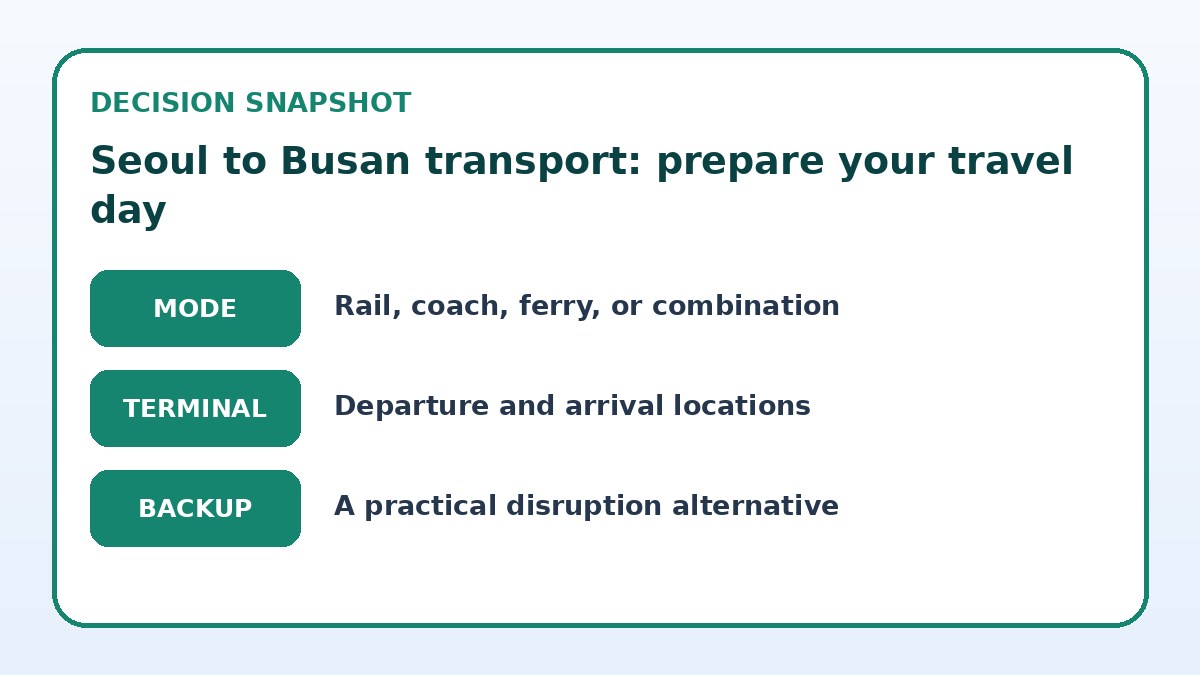
See current options before you compare the details
Availability and final conditions change. Open Trip.com now or keep reading for the practical comparison.
Choose the transport type that fits your meeting priorities
Start your decision by ranking what matters most for the travel day: total door-to-door time, ability to work en route, or schedule flexibility in case meetings shift. High-speed rail often offers predictable travel times and stable onboard work conditions, while flights may shave travel minutes but include extra transit for check-in, security, and transfers. Long-distance buses or slower trains might be cheaper or more frequent, providing extra schedule options if flexibility is the priority. Think through how you’ll use the travel time—will you need continuous internet, quiet for calls, or simply a window for notes? That use case will point you toward the most suitable transport.
Next, compare realistic door-to-door scenarios rather than headline travel times. Include the time to get from your hotel or office to the departure point and from the arrival station or airport to your meeting venue. Also factor in the logistics of moving within stations—some larger terminals have long walks between platforms or remote bus stops. If a transfer is required, check whether the connection requires moving luggage between different terminals or stations. Make these comparisons on the provider’s final booking pages and local transit maps so you can estimate actual travel windows and select reliable alternatives if the primary option becomes inconvenient.
Packing and tech checklist for uninterrupted work
For a business travel day, pack a carry-on configured to keep you productive and presentable. Include a compact laptop or tablet with a reliable keyboard, one or two charging cables, and a high-capacity power bank. Add noise-cancelling earbuds or a small headset for calls, plus a paper notebook and printed brief materials if you expect to rely on hard copies. Keep travel-sized toiletries and a change of shirt or polo to handle unexpected delays. Store essentials in easily accessible pockets so you can pass through security or board quickly without unpacking everything.
Think about redundancy and battery management: carry chargers that match different power outlets or USB standards, and keep your devices at higher charge levels before departure. If you’ll need internet for video calls, plan a backup connection—either hotspot on your phone or a local data SIM—after checking roaming options. Also secure digital access to key documents by saving them offline or in an accessible cloud folder, and lock sensitive files behind passwords or device encryption. These measures reduce stress if your primary connection or device encounters issues while en route.
| Approach | Best for | Tradeoff to check |
|---|---|---|
| Direct high-speed rail | Travelers prioritizing predictable travel time and onboard workspace | May be less flexible on departure times than buses and can require advance seat selection |
| Air travel (with transfers) | Those seeking the shortest possible flight time between the cities | Total door-to-door time can lengthen due to airport transfer, security, and check-in procedures |
| Long-distance bus or slower intercity trains | Travelers needing schedule flexibility or lower-cost options on the travel day | Onboard work conditions may be noisier and travel time generally longer |
| Hybrid plan with flexible booking | Business travelers who want backup options and refundable changes | Typically higher fare or booking complexity; requires active management the day of travel |
Ready to check the option that fits your plan?
Use your exact dates and traveler details so the provider page can show the current total and conditions.
Timing, transfers and handling uncertainty
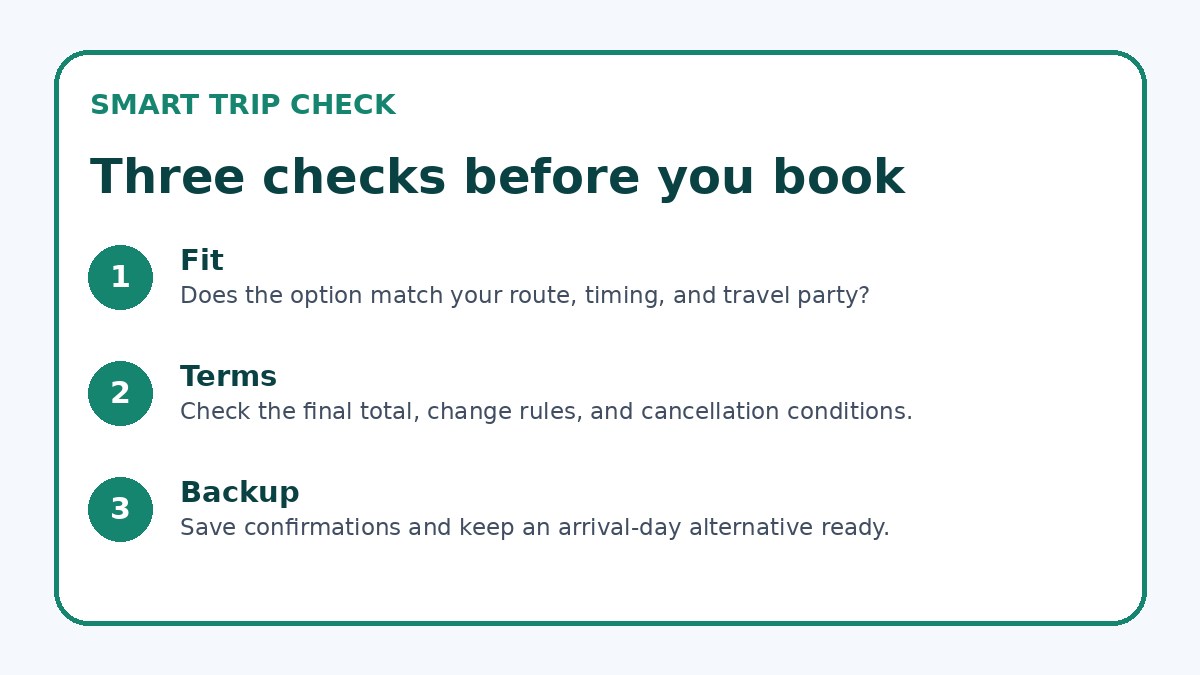
Build realistic buffers into your schedule. For business travelers, a conservative approach is to allow extra time for each phase: reaching the departure point, boarding, any connections, and final transit to your meeting. If your itinerary includes a connection, evaluate the minimum connection time and whether baggage must be rechecked. When comparing options, check whether services are direct or require changes; for connections, choose schedules that leave you more margin than the minimum to reduce risk of arriving late to meetings.
Have contingency plans for common disruptions. Identify the next available departures on alternate routes and save quick-compare tabs or apps so you can rebook efficiently. Keep contact info for your meeting hosts and, if applicable, your corporate travel desk readily available to notify stakeholders of delays. If you must work during a tight transfer, pre-prepare small tasks—email drafts, brief presentations, or meeting notes—you can complete offline. Lastly, know the ground transport alternatives at both ends—taxi apps, local trains, or express shuttles—so you can choose the fastest remaining option if schedules slip.
Before you book
- Confirm exact departure and arrival station/terminal names on the provider’s final booking page and save the confirmation number.
- Pack a carry-on with laptop/tablet, chargers, power bank, earbuds, printed meeting materials, and a fresh shirt or polo.
- Set calendar blocks that include travel, transfer buffers, and a recovery window before your first meeting.
- Save offline copies of key documents and add contact numbers for hosts, your travel desk, and the carrier to your phone.
- Verify luggage allowances and seat assignment options on the carrier’s booking page and select a work-friendly seat if possible.
- Check local ground transport options at both ends and preload any necessary taxi or rideshare apps for faster pickups.
Final booking checks and day-of routines
Before you confirm a booking, verify critical provider details on their final page: exact departure and arrival locations (station name and terminal), luggage allowances, seat selection policies, and check-in or boarding windows. If the provider offers seat assignment or business-class options, confirm those details to secure a work-friendly spot. Double-check cancellation or change policies and how to contact customer service if you need to make last-minute adjustments. If you use an intermediary or company travel portal, cross-reference the confirmation number with the carrier’s site to ensure there are no discrepancies.
On the travel day, adopt a reliable routine: wake earlier than usual to avoid rushed departures, confirm live status for your service, and recheck booking details one last time. Pack your essentials by a checklist to avoid forgotten items, and set calendar alerts to move between travel stages. Dress in layers for comfort in varying temperatures on trains, planes, or at stations. Finally, if you rely on external apps for taxi or rideshare pickup, ping the driver only when you’re ready to leave so arrival aligns with your schedule and you avoid waiting time or missed pickups.
Frequently asked questions
What is the easiest way to decide between train and plane for the Seoul to Busan transport day?
Start by defining what you need on the travel day: continuous work time, quickest travel, or schedule flexibility. Compare realistic door-to-door estimates that include transfers, check-in, and time to and from terminals. If you need reliable onboard workspace and fewer transfer steps, rail often delivers. If the absolute fastest airborne segment matters and you accept extra transfer logistics, flights may suit. Use the carrier’s final booking pages to compare direct versus connecting options, and factor in how easy it is to reach each departure point from your origin and final meeting location.
How much buffer should I build into my schedule for unexpected delays?
For business travel days, a conservative buffer reduces stress: add extra time for getting to the departure point, any required check-in or security, possible connections, and local transit after arrival. If you must be on time for a critical meeting, plan enough buffer to handle common delays like traffic, longer-than-expected transfers, or service disruptions. The exact amount depends on local traffic patterns and the type of transport chosen; confirm typical transfer distances and station layouts on provider pages and increase your buffer when crossing busy times or if making tight connections.
What should I verify on the provider’s final booking page before leaving the office?
Check the precise pickup or departure location (station/terminal and platform if listed), seat assignment and class, baggage rules, and boarding or check-in windows. Confirm the transport is direct or has connections and whether those connections require rechecking luggage. Review change and cancellation conditions in case your schedule shifts. Also capture emergency contact information and the booking reference number. If anything on the final page differs from your expectations, resolve it with the carrier before you travel to avoid surprises at the station or airport.
Final planning note
Preparing for a Seoul to Busan business travel day reduces stress and keeps you productive. Prioritize what matters—speed, workspace, or flexibility—and let that decision guide whether you book rail, air, bus, or a hybrid approach. Pack and power your devices, secure offline copies of critical documents, and build conservative time buffers around every stage of the journey. Verify departure locations, luggage rules, and seat options on the carrier’s final booking page well before departure. With contingency plans, preloaded local transport apps, and a simple day-of routine, you’ll turn a travel day into a controlled, professional extension of your work schedule.
Continue planning
Check current options and final conditions
Use the provider page to confirm live availability, the final total, cancellation terms, and every condition that matters to your trip.
This evergreen planning guide was created with AI-assisted drafting and a structured quality review. It does not display live prices, schedules, availability, visa guidance, or provider rankings. Verify current details before booking. Some links are affiliate links; we may earn a commission at no additional cost to you.