
If you’re traveling to Seoul with extra luggage, the most practical step is to use flexible date searches and compare fare rules before committing to any booking. Shifting departure or return by a few days can change baggage allowances, fare-family restrictions, and luggage-fee triggers more reliably than hoping for a single sale. Start with a date range of plus/minus three to seven days, scan fares and baggage allowance columns, and note which combinations include complimentary checked baggage or offer cheaper paid-bag options. While flexible dates may slightly alter flight times or layovers, the potential savings and reduced hassle of pre-booked allowance usually outweigh the inconvenience. This article explains the decision tradeoffs, what to verify on booking pages, and how to align hotel and ground-transport choices with heavier bags so you travel through Seoul with less stress and more predictability.
See current options before you compare the details
Availability and final conditions change. Open Trip.com now or keep reading for the practical comparison.
How flexible dates affect baggage costs and rules
Airlines and booking sites often display different fare families and baggage inclusions across consecutive days. A ticket sold on one day might include one checked bag while the same route two days earlier requires paying separately. When you widen your search window you increase the chance of finding a fare that bundles checked luggage or offers lower paid-bag rates. The practical step is to record baggage allowance for each candidate fare side by side, not just the base fare, because the total out-the-door cost includes luggage and ancillary fees.
Don’t assume lower headline fares are cheaper once baggage is added. For travelers with extra luggage, a marginally higher fare that includes one or two checked bags or allows discounted add-ons will often be the better choice. Use fare-family tables on carrier pages or the detailed fare rules provided at checkout to confirm how many bags are included, the weight/size limits, and whether bags can be pre-paid online at a lower rate. On the provider’s final booking page, verify bag weight limits, extra-piece fees, and refund/change penalties before paying.
Choosing date windows and scan tactics that save money
Start searches with a flexible calendar tool showing +/- three to seven days around your preferred travel dates. Prioritize days that avoid midweek-to-weekend transitions when baggage-inclusive fares may be scarce. Run two parallel searches: one that sorts by lowest total cost after adding expected baggage fees, and another that sorts by shortest total journey time if transfer hassles matter more than savings. This dual approach helps you see whether a date shift reduces total cost or merely swaps cash savings for longer connections.
When you find a promising date, check nearby flight times and layover patterns for practical issues—overnight connections, early-morning departures, or multiple terminal transfers can increase the burden of heavy luggage. Also compare refundable/changeable fare classes over adjacent days: a slightly higher fare that allows free changes might let you rebook to a cheaper, baggage-friendly flight if fares shift again. On booking pages, verify cancellation and change fees, and whether pre-paid baggage can be modified without loss if you change dates.
| Approach | Best for | Tradeoff to check |
|---|---|---|
| Shift dates to weekdays | Travelers who want lower base fares and more chance of baggage-inclusive fares | May mean inconvenient departure or arrival times and fewer direct service options |
| Book refundable or changeable fares | Those carrying lots of luggage who want the option to rebook without large penalties | Higher upfront cost that may offset some potential baggage savings |
| Adjust hotel dates to suit flight savings | Travelers who can be flexible on accommodations and want smoother luggage logistics | May require extra nights or moving between properties, adding time handling bags |
| Combine cheaper flights with paid airport transfer | Those prioritizing lower fare but willing to pay for door-to-door convenience | Transfer cost can erode flight savings; verify vehicle luggage limits on the provider page |
Ready to check the option that fits your plan?
Use your exact dates and traveler details so the provider page can show the current total and conditions.
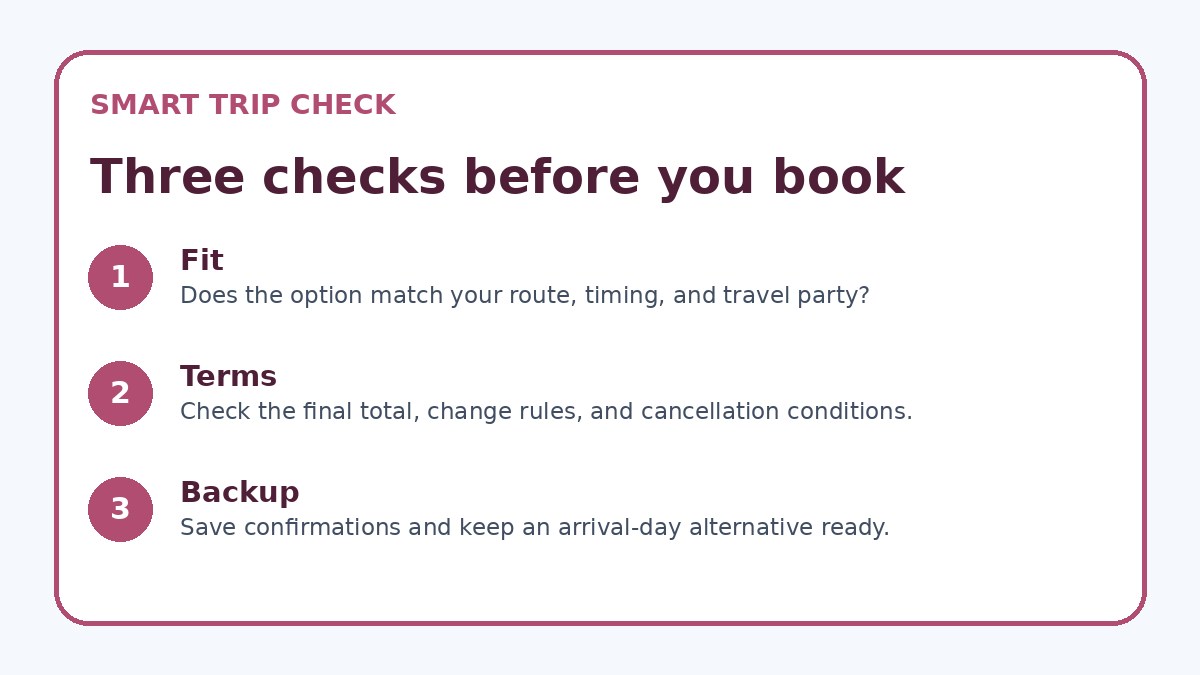
Coordinating hotels, airports, and ground transport for luggage
Pick hotels and arrival/departure logistics that reduce the friction of moving heavy bags. If your flexible-date search lands you on a cheaper flight arriving late or departing early, consider hotels with 24-hour front desks or luggage storage rather than those that strictly enforce check-in hours. Also evaluate proximity to major transit hubs: staying near a metro line with direct airport express service or a taxi rank reduces the number of transfers and stairs you’ll face hauling luggage through Seoul.
Use date flexibility to book nights that align with easier ground transfers: arriving a day earlier might allow you to use daytime services with better luggage handling, whereas a late-night arrival could force you onto limited shuttle options. When reserving airport transfers, check luggage limits and vehicle sizes on the provider’s page—verify whether a large suitcase counts as one or more pieces, and whether extra charges apply. If using rail or bus, confirm bag policies and seat-reservation rules before paying.
Before you book
- Run flexible-date flight searches with a +/- three to seven day window and record fare families and baggage inclusions for each option.
- Calculate total cost per itinerary by adding expected checked-bag fees and potential overweight charges before comparing headline fares.
- Confirm baggage piece, weight, and size limits on the airline’s final booking page and note any pre-paid baggage discounts available.
- Match hotel check-in/out policies and location to your chosen flight times; reserve luggage storage if arrival or departure falls outside normal hours.
- Compare ground transfer options and vehicle luggage limits on provider pages; book a transfer sized for your luggage if public transit is impractical.
- If unsure, buy a ticket with flexible change or cancellation terms and document the process and deadlines for changing pre-paid baggage.
When to accept tradeoffs: time, cost, and convenience
Every choice involves tradeoffs. A date that saves baggage fees may add travel time through longer connections or inconvenient flight hours. Decide whether you value predictability over absolute savings: if lugging multiple heavy suitcases through Seoul’s public transit is a dealbreaker, prioritize options that reduce transfers even if they cost more. Conversely, if you’re willing to pay for a private transfer or extra hotel night to avoid peak baggage fees, that may be cheaper than paying overweight surcharges or having to ship items separately.
Make a short checklist of what you will not compromise—maximum total travel time, arrival time range, or a firm baggage allowance—then use flexible-date scans to find the cheapest option that meets those limits. Always reconfirm baggage details on the actual provider booking page before you finalize: weight and dimension limits, how many pieces are counted, pre-paid baggage discounts, and any size oversize rules. Trip.com can be used to compare current availability and conditions, but verify provider-specific baggage rules at checkout.
Frequently asked questions
How much date flexibility should I use when searching Seoul travel deals with extra luggage?
Aim for a search window of three to seven days around your preferred travel dates. This range balances the chance of finding fares with better baggage rules against the extra time you might spend checking options. Broader searches can uncover differing fare families that include checked bags or cheaper paid baggage, but wider windows can also produce itineraries with inconvenient departure times or multi-stop routes. After locating promising dates, inspect the specific baggage rules and the provider’s change policy on the booking page before paying.
Should I prefer a slightly more expensive ticket that includes baggage, or a cheaper ticket plus paid bags?
Compare the full cost and the convenience tradeoff. For two or more checked pieces, an included-baggage fare often works out better because paid bags can add up quickly and online pre-pay discounts vary. If the included fare also has flexible change terms, it reduces the risk of needing a costly reissue. If you value specific arrival times or nonstop travel, a cheaper ticket with paid bags might be worthwhile, but always compute the final out-the-door price and confirm weight limits on the carrier’s final booking page.
Can I rely on booking sites to show accurate baggage rules for Seoul-bound flights?
Booking sites are useful for initial comparisons, but baggage rules can change by fare class and may differ between the search summary and the airline’s checkout. Use booking platforms to narrow options, but always open the airline’s fare rules or the carrier’s final booking page to verify how many pieces are included, weight and dimension limits, pre-paid bag pricing, and any excess-size charges. Trip.com can be a helpful place to compare availability, but treat the airline’s own terms as authoritative when you’re ready to purchase.
Final planning note
Using flexible dates when planning Seoul travel deals pays off for travelers with extra luggage because small date shifts can change baggage inclusion and ancillary fees substantially. The practical approach is to scan a window of days, compare total trip costs including luggage, and prioritize options that align with your tolerance for longer transfers or slightly different arrival times. Always verify baggage allowances, pre-paid bag discounts, and change policies on the provider’s final booking page before completing a reservation. With those checks in place, date flexibility lets you control costs and reduce the physical hassle of moving more luggage through Seoul.
Continue planning
Check current options and final conditions
Use the provider page to confirm live availability, the final total, cancellation terms, and every condition that matters to your trip.
This evergreen planning guide was created with AI-assisted drafting and a structured quality review. It does not display live prices, schedules, availability, visa guidance, or provider rankings. Verify current details before booking. Some links are affiliate links; we may earn a commission at no additional cost to you.