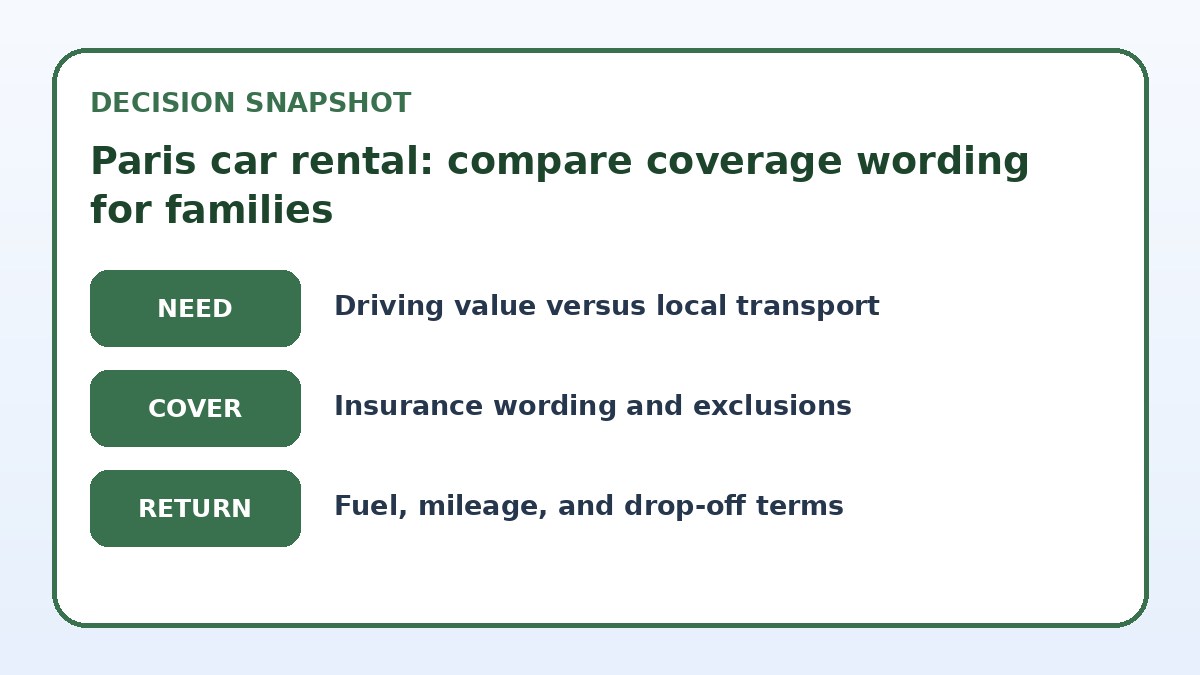
If you’re renting a car in Paris with kids, focus first on three things: liability limits (third-party), Collision Damage Waiver (CDW) and which drivers are covered. Choose a package that explicitly names every regular driver, lists the CDW excess (the amount you must pay after a claim), and confirms roadside assistance for metropolitan breakdowns. Many family trips are derailed by an unexpected excluded driver or an unclear excess for glass and tyre damage. Read the short practical checklist below before you click reserve: who’s insured to drive, what’s excluded for child seats and windows, how much you’d pay after a claim, and whether a credit card or third-party policy will actually reduce your deposit. The next sections explain common insurance wording, tradeoffs for family needs, and exactly what to verify on the rental provider’s final booking page.
Practical answer up front: what to buy and why
For most families visiting Paris, buy or accept a package that reduces your CDW excess to a level you can comfortably pay out of pocket (or opt for a refundable excess waiver). Ensure every potential driver is named and that the policy covers young drivers if your group includes them. A modest increase in daily cost can remove a large financial headache if a minor scrape happens in a tight Parisian street. Prioritise clear language on glass and tyre coverage: city driving raises the chance of chipped windshields or curb-scuffed tyres, and many basic CDWs exclude these items.
If your credit card offers rental insurance, read the card’s rental terms and compare them with the car rental wording—card policies often require you to decline the rental company’s CDW to be eligible. That interaction is critical: some credit cards will reimburse you after paying the excess, others will directly cover damage only if you refuse the rental company’s extra cover. Decide whether you want the convenience of lower deposit and zero-hassle local coverage, or the potential savings of relying on your credit card or an independent travel-insurance add-on.
Common policy terms families must understand
CDW/LDW (Collision/Loss Damage Waiver): this reduces your financial responsibility after a collision but usually doesn’t eliminate it entirely unless you buy a zero-excess option. Pay attention to whether the wording excludes windscreen, tyre, undercarriage, and mirror damage—these exclusions are common and matter for a family car manoeuvring narrow streets or parking in Paris. Also check whether the waiver is conditional on reporting incidents to the police or the rental company within a specific timeframe; many claims are denied because customers missed a required report.
Third-party liability: this covers damage to other people, vehicles, or property and is legally required. Look at the stated limit (often shown as a monetary cap) and any language about supplementary liability or umbrella cover. Personal accident insurance and personal effects coverage are separate; if you’re bringing child seats or valuable items, confirm whether loss or damage to those items is included or must be insured separately. Finally, clarify whether roadside assistance is basic (towing only) or includes on-site repairs and replacement vehicles—important with children aboard.
| Approach | Best for | Tradeoff to check |
|---|---|---|
| Accept rental company’s zero-excess waiver | Families who want minimal hassle and lower deposit at pick-up | Higher daily cost but immediate coverage and typically faster support in Paris |
| Take the rental company’s standard CDW with excess | Cost-conscious families confident they can cover a moderate excess | Lower daily rate but potentially large out-of-pocket payment after an incident |
| Use credit-card rental insurance | Families whose card provides strong primary coverage and clear terms | May require paying first and claiming later; often invalid if you buy the company CDW |
| Buy third-party excess waiver from an independent provider | Families seeking lower excess with cheaper daily fees than rental-company waivers | May need to pay and claim afterward and ensure the waiver’s wording matches the rental contract |
Tradeoffs and decision criteria for families
Choosing higher coverage reduces stress but increases upfront cost. If your family’s budget is tight, compare the excess you’d be responsible for with the likely real-world cost of the incident in Paris traffic—small scrapes can still carry large administrative fees. Factor in your tolerance for paperwork and out-of-pocket expense: paying more to the rental company typically lowers your deposit and avoids waiting for reimbursements from credit card insurers, while relying on third-party policies might require you to pay first and claim later.
Age and driver experience change the calculation. If a young driver will be behind the wheel, check surcharge and coverage limits—some policies refuse to cover drivers under a certain age or impose higher excesses. Also consider trip logistics: if you’ll need to replace a vehicle quickly to keep plans with children on schedule, a local waiver that promises prompt onsite support or a replacement car could be worth the extra daily cost compared with slower third-party claims processes.
Before you book
- Confirm every potential driver is named on the reservation and note any minimum or maximum age limits.
- Find and write down the exact CDW/LDW excess amount and whether glass, tyres, and undercarriage are excluded.
- Capture the rental company’s deposit/pre-authorisation amount and the payment method required at pick-up.
- If using a credit card for coverage, save the card insurer’s rental terms and any required claim procedure.
- Ask the provider to confirm in writing whether roadside assistance and replacement vehicles are guaranteed.
- Before collecting the car, photograph existing damage and get a signed vehicle condition report from staff.
Exactly what to verify on the provider’s booking page
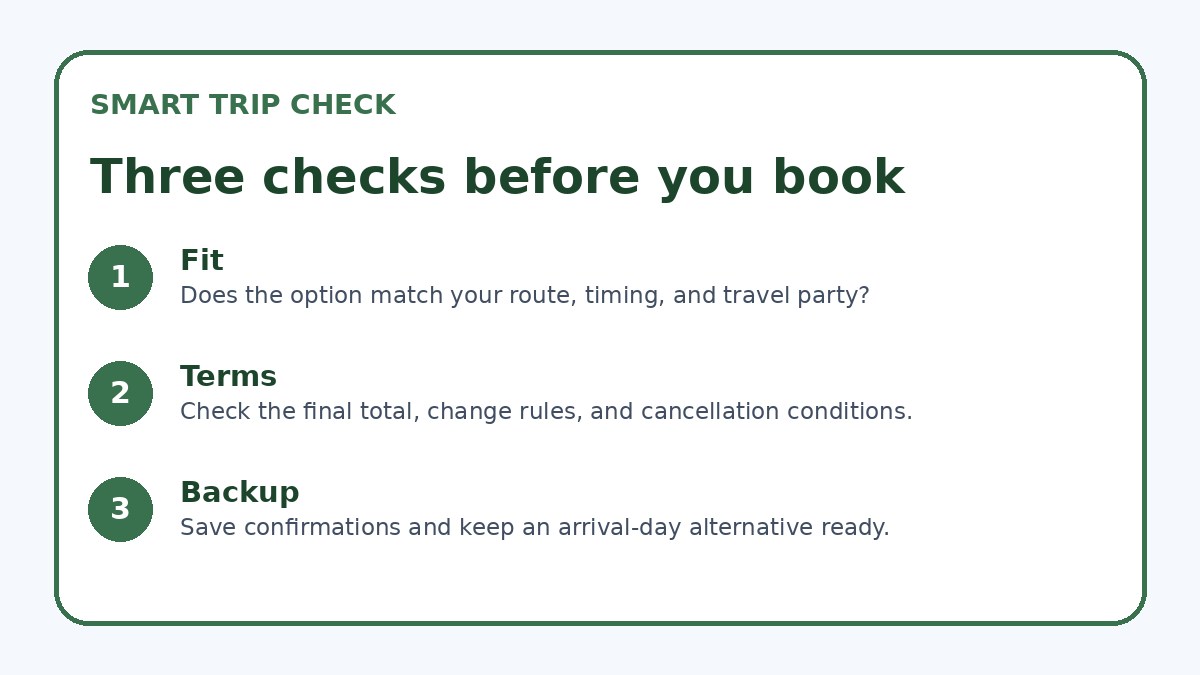
Before completing the booking, verify these exact items on the final rental page: named authorised drivers, CDW/LDW excess amount and what it excludes (glass, tyres, undercarriage), the deposit hold amount, and whether roadside assistance and replacement vehicles are guaranteed. If the booking page links to “terms and conditions,” open that document and search for the words “excess,” “glass,” “tyres,” “authorised driver,” and “police report” to find the critical lines. If anything is ambiguous, use the provider’s official contact method to get written confirmation you can save with your reservation.
Also check payment and credit-card hold wording: does the rental company place a pre-authorisation or charge a deposit, and will a third-party insurer or credit card reduce that hold? If relying on your credit card coverage, capture the card issuer’s coverage statement and confirm any required steps at pick-up, such as declining the rental company’s CDW. Finally, note the pick-up location’s special conditions—airport locations sometimes add surcharges or different hold policies—so verify those lines on the booking page before you proceed.
Frequently asked questions
Can I rely on my credit card to cover a rental car in Paris with kids?
Possibly, but don’t assume coverage—read your card’s rental insurance terms carefully. Many credit cards offer secondary coverage that reimburses your out-of-pocket excess after you pay the rental company, while a few offer primary coverage that removes the need to file with the rental firm first. Check exclusions for young drivers, vehicle categories (some luxury or commercial vehicles are excluded), and whether you must decline the rental company’s CDW to be eligible. Save the card insurer’s statement and confirm any required documentation you’ll need in case of a claim.
What counts as an authorised driver and why does the wording matter?
An authorised driver is anyone the rental agreement explicitly allows to drive the vehicle. Wording matters because some contracts list only the primary renter by default; any additional driver must be added and may cost extra. If an unauthorised person drives and causes damage, the insurer or rental company can deny the claim and charge the full repair cost. For families, include spouses and older children who might drive, check for age limits, and have the contract state each authorised driver’s name to avoid disputes.
How do glass, tyre, and undercarriage exclusions affect family trips in Paris?
These exclusions are common and matter on narrow Parisian streets and crowded parking areas where chipped windscreens or curb damage happens more often. A CDW that excludes glass and tyres can leave you responsible for relatively small but sometimes costly repairs and administrative fees. For family trips, where schedules are tight and children are involved, consider cover that explicitly includes these items or a separate glass/tyre add-on so you avoid unexpected charges and delays when returning the vehicle.
Final planning note
Families renting cars in Paris should prioritise clarity over price. Make sure every driver is named, understand the exact CDW excess and any glass/tyre exclusions, and confirm deposit and roadside assistance terms on the provider’s final booking page. Compare the convenience of a rental-company zero-excess waiver with the potential savings and added paperwork of credit-card or third-party coverage. Before pick-up, save written confirmations, photograph the car’s condition, and keep your insurer’s claim instructions accessible. Doing this short legwork reduces surprises and keeps your Paris family itinerary on track.
Continue planning
Check current options and final conditions
Use the provider page to confirm live availability, the final total, cancellation terms, and every condition that matters to your trip.
This evergreen planning guide was created with AI-assisted drafting and a structured quality review. It does not display live prices, schedules, availability, visa guidance, or provider rankings. Verify current details before booking. Some links are affiliate links; we may earn a commission at no additional cost to you.