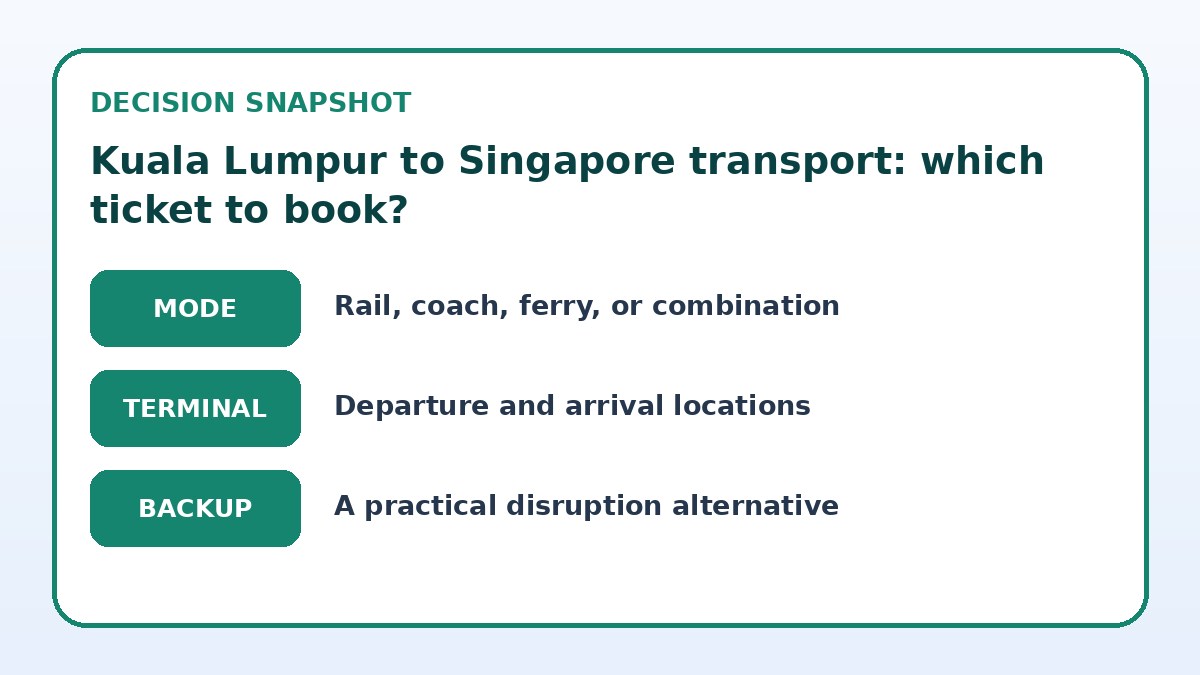
Practical answer: for most solo travelers on the Kuala Lumpur to Singapore route, prioritize a ticket with flexible change and clear refund terms over minimal upfront cost. Flexibility matters if your plans could shift by a day or two, if border processing is unpredictable, or if you prefer arriving with fewer timing constraints. When comparing options—train, bus, or flight—focus on change fees, refund eligibility, allowed name changes, and whether the fare class requires travel on a specific service. That gives you a reliable baseline to decide between a cheaper but restrictive ticket and a slightly more expensive option that reduces stress and potential rebooking complexity.
How ticket flexibility affects a solo traveler’s trip
Flexibility has practical impacts that matter more to solo travelers than to groups. If you travel alone, you have no backup passenger to swap or coordinate with, and changing your own plans can mean coordinating new connections, accommodation, or work commitments all on your own. A ticket that allows modest free date changes or credits reduces the logistical friction of shifting a plan because of weather, personal reasons, or schedule delays at the border. For journeys between Kuala Lumpur and Singapore, the trip often intersects with immigration checks and intercity transfers, so an easily adjusted ticket can be the difference between a smooth plan and a cascade of separate rebookings.
Beyond operational convenience, ticket flexibility also reduces stress and financial uncertainty. Solo travelers often carry fewer spare resources while on the move, so an unexpectedly strict no-refund policy or a large change fee can quickly turn a short disruption into a costly problem. Flexible tickets let you treat timing as a variable rather than a hazard. When you balance fare cost against potential change fees, you can choose a ticket strategy that matches how likely your plans are to change and how comfortable you are managing last-minute logistics alone.
Comparing flexibility across trains, buses, and flights
Each mode of transport typically comes with a different mix of flexibility features. Trains and premium bus operators sometimes sell fares with simple change-credit systems or last-minute exchange options because schedules are fairly regular and seat management is easier; however, low-cost bus tickets may be strictly non-refundable. Flights frequently offer a wide spectrum of fare classes—some fully flexible, some heavily restricted. For solo travelers, the key is to read the fare conditions: permitted changes, fee structure (flat fee or fare difference), and whether changes must be made before departure or can be handled at the station.
Also compare practical elements that interact with ticket rules: how the provider processes refunds and exchanges, whether refunds are given as cash or travel credit, and how long refunds take to appear. Some operators give immediate credit that you can reapply to another journey quickly, which can be useful if you plan to rebook quickly. Others require formal cancellation processes that can take weeks. For a solo traveler balancing time and cash, faster, clearer refund or rebooking procedures often outweigh minor fare savings.
| Approach | Best for | Tradeoff to check |
|---|---|---|
| Buy cheapest non-flex ticket | Travelers with fixed dates and low tolerance for extra fees | Low upfront cost but high risk of losing value if plans change; limited or no refund options. |
| Buy mid-tier flexible fare | Solo travelers who might shift plans and want simple change processes | Higher fare than lowest class, but lower change fees and clearer rebooking rules. |
| Buy fully flexible premium ticket | Travelers needing full assurance against schedule changes | Pays a premium for near-free changes and refunds; may be overkill for certain steady itineraries. |
| Buy restrictive ticket + travel credit card protections | Cost-conscious solo travelers who have good travel insurance or card benefits | Can save money if protections apply, but requires confirming insurer/card issuer rules for changes and cancellations. |
Decision criteria for choosing a ticket
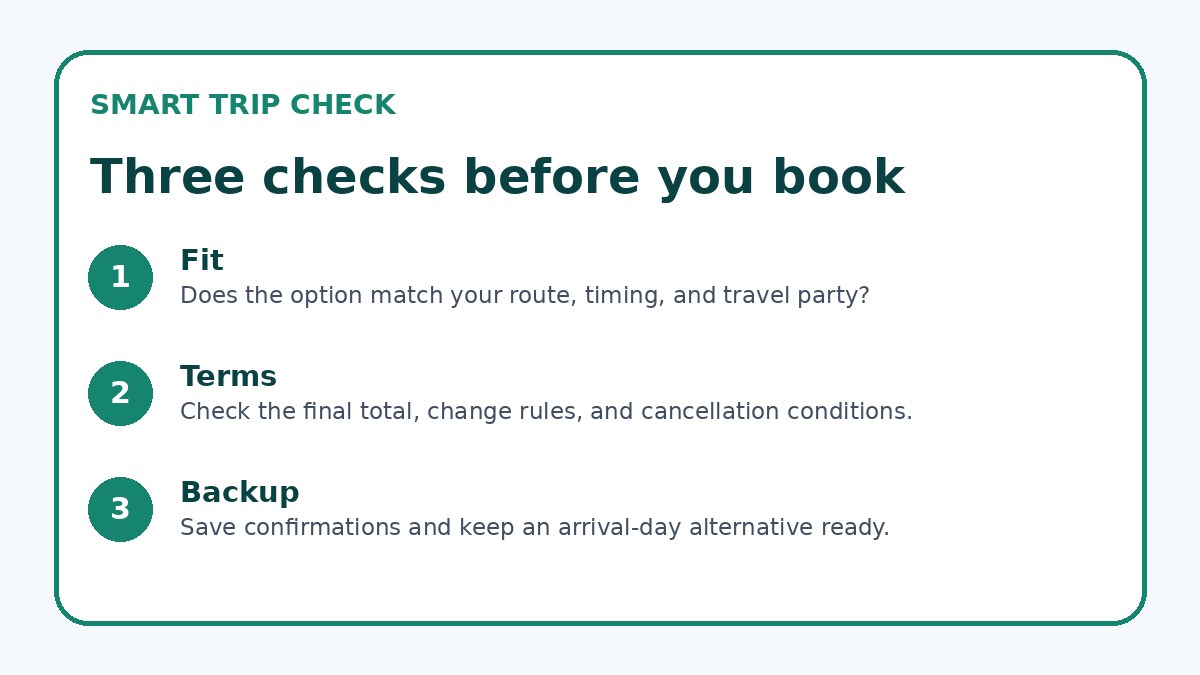
Adopt a checklist-style decision process: likelihood of change, acceptable fee threshold, preferred travel window tightness, and fallback options. Start by estimating how likely it is that your travel date or time will shift. If change is unlikely, a cheaper restrictive ticket may be acceptable. If there’s a medium to high chance of changes, choose a mid-range flexible fare or a ticket that allows fee-based changes without full cancellation. Next, identify acceptable maximum change fees and whether partial credit is offered. That helps you compare apples to apples when booking between different providers and modes.
Also consider practical fallback options: can you catch an earlier or later service on the same ticket, or will you need to buy a whole new one? Does the provider allow name transfers if your plans involve third-party adjustments? Check if the ticket permits split itineraries—useful when combining train segments and local transfers—or whether single-operator rules bind you. For many solo travelers, the optimal decision mixes moderate flexibility with the lowest possible hassle for making a change, rather than chasing the absolute lowest headline fare.
Before you book
- Read the fare conditions on the final booking page for exact change fees, refund eligibility, and whether refunds are cash or travel credit.
- Confirm whether the ticket ties you to a specific departure (train/flight number) or allows day-of-travel exchanges without reissue.
- Check the deadline for free or fee-based changes and whether changes can be made online, by phone, or only in person.
- Verify identity-check or border-crossing requirements that could affect boarding and rebooking options.
- Decide in advance the maximum change fee you are willing to pay and compare that to available fare classes.
- If using insurance or card protections, confirm coverage specifics for delays, cancellations, and refunds with the issuer before booking.
What to verify on the final booking page
When you reach the provider’s final booking page, verify several concrete items before entering payment details. Look for the exact change fee amount and whether the fee is waived within a certain window before departure. Confirm refund eligibility: is the ticket refundable, partially refundable, or non-refundable? If refunds are allowed, check whether you receive cash back, a travel voucher, or credit within a loyalty account. Note any deadlines for requesting a change or refund and whether administrative processing times apply.
Also confirm operational details that affect flexibility: whether the fare locks you to a specific departure or train number, if name changes are permitted, and whether exchanges can be completed online or require an in-person visit to a ticket office. If border-crossing documents are required for the journey, verify whether the operator enforces identity checks at boarding and how that affects rebooking. If you need help comparing current availability and conditions, you may optionally check a comparison site such as Trip.com, but always treat that as a starting point and confirm terms on the operator’s official pages.
Frequently asked questions
Should I book a flexible ticket if I’m confident my dates won’t change?
If you are highly confident in your travel dates, a restrictive ticket can be a reasonable choice because it usually costs less upfront. However, solo travelers should weigh the financial and time cost of handling a last-minute change if something unexpected occurs. Consider whether you have worst-case funds to cover a new booking and how much time you can spend sorting refunds. A modestly flexible mid-tier option can be a sensible compromise: a small extra outlay up front for greater peace of mind against administrative headaches later.
Can I mix modes—like train and bus—on one flexible itinerary between Kuala Lumpur and Singapore?
Sometimes you can combine different operators into a single itinerary through a multi-modal ticket, but more often you will book separate legs with separate conditions. When legs are booked separately, each has its own change and refund rules, so flexibility must be considered per segment. If you want unified protection, look for a single provider or a through-ticket that explicitly covers missed connections. Always verify on the booking page whether the ticket includes missed-connection protection or whether each operator treats delays independently.
What specific booking-page details should I screenshot or save before paying?
Save the exact fare conditions, the change and cancellation fee schedule, and any small-print notes about identity checks or required documentation. Screenshot the final price including taxes and any stated non-refundable components, plus the confirmation that shows ticket type or fare class. Also save contact details for customer service and the URL or transaction ID for the booking. These items make disputes or refund requests much smoother if changes become necessary after purchase.
Final planning note
For solo travelers on the Kuala Lumpur to Singapore route, balancing price against the true cost of changing plans is the central decision. Start by honestly assessing how likely you are to change dates, then compare fare classes specifically on change fees, refund method, and ease of making amendments. Prefer mid-tier flexible fares if you want a low-stress trip without paying top-tier premiums, and reserve the cheapest restrictive tickets for when your schedule is rock-solid. Always verify the exact conditions on the final booking page, keep records of the fare terms, and consider card or insurance protections as a secondary safety net.
Continue planning
Check current options and final conditions
Use the provider page to confirm live availability, the final total, cancellation terms, and every condition that matters to your trip.
This evergreen planning guide was created with AI-assisted drafting and a structured quality review. It does not display live prices, schedules, availability, visa guidance, or provider rankings. Verify current details before booking. Some links are affiliate links; we may earn a commission at no additional cost to you.