For most business travelers between Los Angeles and Las Vegas the key decision is simple: prioritize a fixed departure time and a short door-to-door journey, or accept some schedule flexibility to reduce cost or improve rebooking options. The practical answer is to decide which element you cannot compromise—meeting punctuality, same-day return window, or ease of baggage handling—and then evaluate flights that explicitly support that priority. This article walks you through the route-versus-fare tradeoff, how to compare direct and connecting itineraries where available, the real baggage and connection risks to consider, and which fare conditions to check before you finalize a booking. Prepare your exact travel dates, preferred arrival and departure windows, and the number of checked bags before searching live options so you can immediately filter for the combination of schedule fit and convenience you need.
See live routes for your exact travel day
Compare direct and connecting choices with the same baggage and traveler details.
Routing: direct versus flexible itineraries
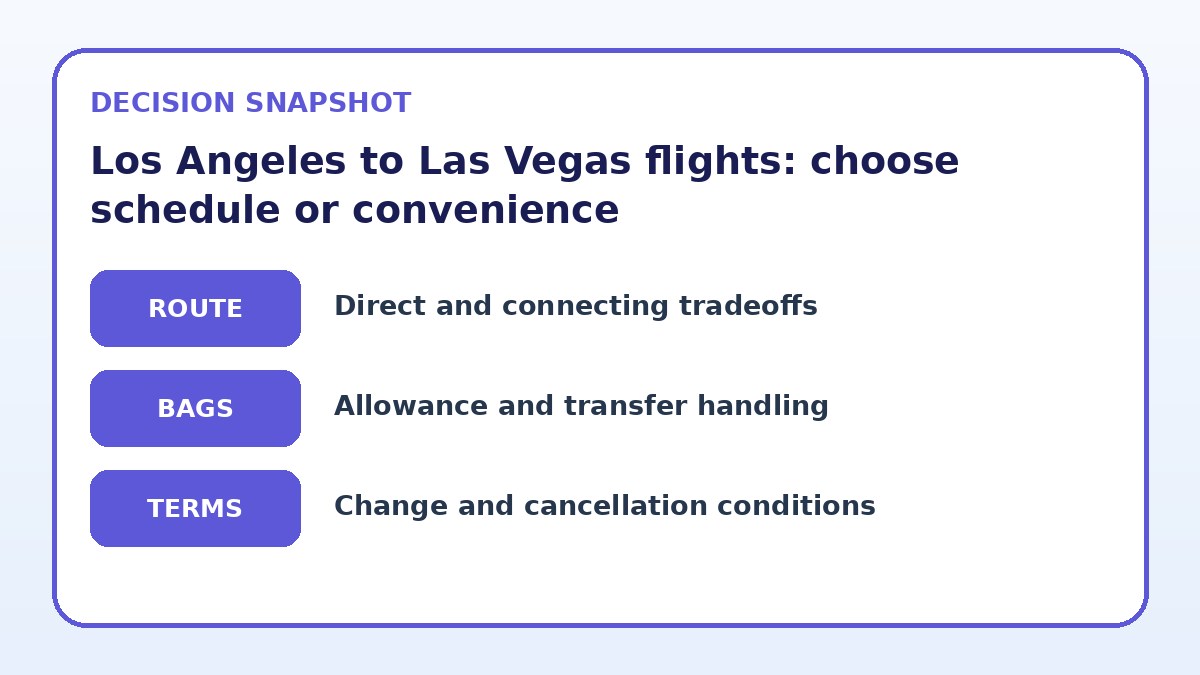
On the Los Angeles to Las Vegas corridor, direct flights are typically the fastest and simplest option for business travelers. A nonstop schedule removes the primary risk of missing connections, simplifies baggage handling, and reduces the number of steps between hotel and meeting. When nonstop options exist for your exact time window, they usually deliver the best reliability for tight schedules. However, nonstops may be less flexible in terms of fare conditions or change options, so weigh whether a slightly longer travel time is acceptable in exchange for a softer ticket.
Flexible itineraries—those with connections or multi-carrier routings—can sometimes provide more favorable change or refund rules or cheaper fare buckets. For business travelers who value the ability to rebook the same day, a connection on an itinerary with generous change permissions may be worth the added complexity. If you consider a connecting option, explicitly check minimum connection times at the connecting airport and the risk of separate tickets: separate tickets increase the chance of missed connections and lost baggage, so either allow more buffer time or buy through-checked itineraries when possible.
Baggage and connection risk: protecting work equipment
When you travel with laptops, presentation materials, or sensitive equipment, the easiest way to reduce potential loss is to travel carry-on only whenever feasible. Confirm the airline’s listed carry-on dimensions and weight limits for your fare class before booking; business travelers often assume standard carry-on rules apply, but some discount fares restrict cabin bags. If checked luggage is necessary, choose fares that permit through-checked bags on connections and verify the connection point won’t require you to re-check bags or clear security again.
Connection risk grows substantially with separate-ticket itineraries or tight transfer times at large airports. If your meeting window tolerates little delay, avoid itineraries with short layovers or those that force terminal transfers. Where an itinerary uses multiple carriers, check whether the airlines have interline agreements for baggage through-check and whether the booking shows a single itinerary record locator. For extra protection, photograph and label your equipment, keep serial numbers and receipts accessible, and consider luggage tracking devices for key checked items.
Compare flight-selection strategies
| Flight strategy | Best for | Risk to check |
|---|---|---|
| Nonstop premium fare | Travelers who cannot risk delays and want the quickest door-to-door time. | Higher price and potentially stricter change rules compared with flexible lower fares. |
| Nonstop basic or restricted fare | Solo travelers with light carry-on-only packing and fixed schedules. | Lower cost but limited baggage allowance and restrictive change/cancellation policies. |
| Connecting itinerary with flexible fare | Those who need changeable tickets and are willing to accept longer travel time. | Increased connection risk and possible baggage handling complexity. |
| Separate-ticket or mixed-carrier routing | Travelers focused on price or specific departure times not served on a single ticket. | Greater risk of missed connections and limited airline support if delays occur. |
Recheck the complete itinerary
Confirm airports, connection handling, baggage, and change conditions before deciding.
Schedule fit: matching flights to business priorities
Define your non-negotiables before you look at live availability. Are you required to arrive no later than a fixed time? Do you need same-day return flexibility? Do you prefer to travel early morning to maximize workday hours or evening to avoid midday disruptions? Once these constraints are clear you can filter search results for departure and arrival windows, preferred airports, and nonstop options. Remember to include ground transfer time in every calculation: airport-to-hotel or hotel-to-conference travel often determines whether an itinerary truly fits your schedule.
Consider writing down a decision rule—such as “never arrive later than X time” or “allow at least Y hours between arrival and first meeting”—and use that rule to eliminate options quickly. When comparing alternatives, compute total travel time from office or hotel to office or hotel, not just airborne time. For recurring travel, identify flights that consistently meet your rule and try to book the same schedule across trips to reduce planning friction and increase predictability for colleagues and assistants.
Flight details to verify
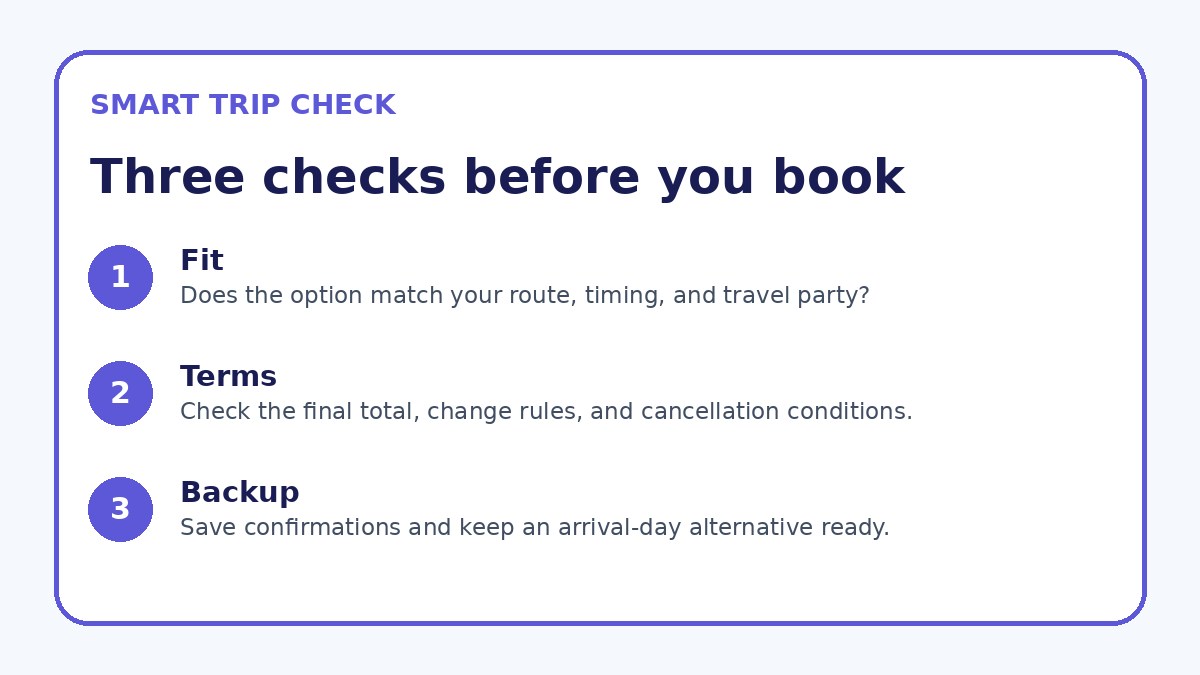
- Confirm exact travel dates, preferred departure/arrival windows, and the number of travelers before searching live fares.
- Filter search results for nonstop options first, then compare connecting itineraries only if nonstop times don’t meet your schedule.
- On the airline’s final booking page verify fare rules: change fees, refundability, and any rebooking windows.
- Check carry-on and checked-baggage allowances for the specific fare class you select; don’t assume standard limits apply.
- Calculate door-to-door travel time including airport transfers, security wait estimates, and terminal changes for each option.
- If booking separate tickets or multiple carriers, allow extra buffer time and consider travel insurance or protective rebooking services.
Fare conditions: what to verify on the booking page
Before completing any booking, verify these fare details on the airline or booking platform’s final page: whether the fare is refundable, the cost and conditions for changes, the cabin baggage allowance for your ticket class, and whether seats can be reserved in advance. Additionally, confirm whether the fare includes priority boarding or lounge access if those conveniences matter for rapid transitions between meetings. If the ticket is part of a codeshare or operated by a different carrier, note the operating carrier and which rules apply for changes or baggage.
Also check the exact cancellation and rebooking windows and any fees that apply for changes made close to departure. For business travelers, some corporate cards or travel programs add protections or allow free changes—verify how those policies interact with the fare rules shown at checkout. If you plan to book separate legs or a multi-carrier itinerary, read the provider’s guidance about missed connections and re-accommodation to understand what assistance you can expect during irregular operations.
Flight Guide questions travelers ask
Should I always choose a nonstop flight between Los Angeles and Las Vegas for business trips?
Not always, but nonstop flights are generally the safest choice for tight business schedules because they remove connection risk and simplify baggage handling. If nonstop departure times don’t align with your needs or their fares carry restrictive change penalties, a connecting itinerary with flexible change rules might be preferable. Before booking, compare total door-to-door time, the airline’s change and refund policy, and whether the connecting itinerary is a single ticket with through-checked baggage. If you routinely need the ability to change same-day, weigh that flexibility against the small added travel time of a connecting route.
How much buffer time should I allow when planning meetings around your flight arrival?
Plan buffer time based on the full arrival process: taxi or rideshare from the arrival gate, baggage claim if you checked bags, security checks if you need to re-enter, and traffic between the airport and your meeting location. For domestic business travel, a conservative rule is to allow at least 60 to 90 minutes after scheduled arrival before a critical meeting when baggage or terminal transfers are involved. If you travel carry-on only and use an airport close to your meeting destination, you can reduce the buffer, but never assume zero delay—always build in contingency time for unexpected hold-ups.
What specific fare conditions should I confirm before buying a ticket for this route?
Confirm whether the fare is refundable or changeable, the exact fees for cancellations or itinerary changes, and any deadlines for free changes. Check baggage allowances tied to your fare class and whether seat selection is included or extra. If the itinerary involves code-share or an operating carrier different from the seller, verify which carrier’s rules govern rebooking and baggage. Finally, review the provider’s policy on missed connections and whether you are eligible for re-accommodation or compensation in the event of irregular operations.
Final decision note
Balancing schedule flexibility and convenience on Los Angeles to Las Vegas flights comes down to a clear understanding of your business priorities and a methodical comparison of itineraries. Start by fixing non-negotiable timing constraints, then screen nonstop options for quickest door-to-door performance. If flexibility matters more than speed, look for fares with favorable change conditions and ensure any connections are covered on a single ticket. Always verify baggage allowances, change and cancellation rules, and total travel time on the carrier’s booking page before purchase. Preparing exact travel dates and traveler details ahead of time will make it faster to lock in the itinerary that best matches your needs.
Continue planning
Check current options and final conditions
Use the provider page to confirm live availability, the final total, cancellation terms, and every condition that matters to your trip.
This evergreen planning guide was created with AI-assisted drafting and a structured quality review. It does not display live prices, schedules, availability, visa guidance, or provider rankings. Verify current details before booking. Some links are affiliate links; we may earn a commission at no additional cost to you.